





War scenarios involving the Middle East and the Persian Gulf, and above all the prospect of prolonged instability across this entire geographical area, are raising pressing questions about the future of transport and trade relations. As in any geopolitical crisis, new scenarios are emerging that can promote and support alternative solutions, reviving options previously seen as secondary. This is the case with the Middle Corridor: Asia is becoming increasingly pivotal, particularly in light of its vast energy resources, with governments in the region keen to integrate into the global economy. This applies to both east–west and north–south traffic.
Kazakhstan offers a clear example, as it seeks a more significant role to avoid being squeezed between superpowers such as China and Russia. As early as 2015, Kazakhstan reached a partnership agreement with the European Union, making Brussels its main trading partner. In October 2025, Uzbekistan followed the same path. These agreements are estimated to have attracted international investment of around 20 billion dollars into Central Asia.
Although long-term forecasts remain uncertain, it is notable that before the war in Ukraine around 20,000 TEU were transiting through the region. This rose to 100,000 TEU in 2025, with projections suggesting volumes could reach, or even exceed, 800,000 TEU by 2040. Azerbaijan is also stepping forward. So far, freight flows have mainly been westbound transit, from China to Europe, but the outlook points to a more balanced distribution in all directions.
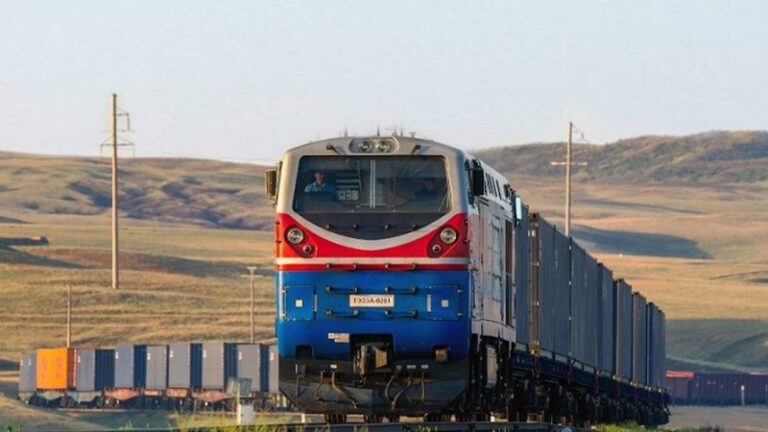
From an infrastructure perspective, one of the most significant initiatives involves Kazakhstan’s state railway operator, which is building a 130-kilometre Almaty bypass, a key hub for connections including those with neighbouring Kyrgyzstan. Financed with support from international funds, the project will enable faster and more efficient links and improve cargo flows along the Trans-Caspian International Transport Route, also known as the Middle Corridor.
According to international agency sources, Kazakhstan Temir Zholy (KTZ) could launch an initial public offering this year, supported by strong fundamentals, as freight volumes on the China–Kazakhstan–Turkmenistan route have quadrupled in a short time. In February 2026, a pilot multimodal shipment combining rail and maritime transport delivered rice to the port of Antwerp in Belgium, with shipping costs competitive with the Northern Corridor.
Developments are unfolding almost daily. The World Bank has approved a financing guarantee of 846 million dollars, expected to unlock total investments of more than 1.4 billion dollars, including private funding. The aim is to support construction of another railway line in Kazakhstan, over 300 kilometres long, between Moyynty and Kyzylzhar towards China. In addition, Kazakhstan and Uzbekistan have signed an agreement to build a modern multifunctional logistics centre in the Uzbek capital, Tashkent, a strategic location on the border between the two countries. The project includes railway infrastructure and a container terminal, with the first phase set to become operational as early as 2027.
Piermario Curti Sacchi