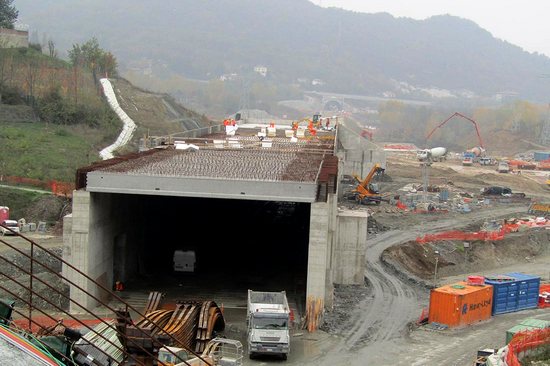






This could finally be the moment for a project the area has long awaited, but which for years remained little more than an idea. By the end of 2026, construction sites are due to open for what is known as Gorizia’s freight “lunetta”, the rail connection that will directly link the Udine-Gorizia-Monfalcone line with the Gorizia-Nova Gorica route and therefore with Slovenia. Sources from the Assessorato alle Infrastrutture della Regione Friuli-Venezia Giulia (Infrastructure Department of the Friuli-Venezia Giulia Region) say an executive agreement has been reached with Rfi to launch the works within the agreed timeframe.
After repeated calls from local administrations and from the management of the Gorizia interport, Sdag, the national railway infrastructure manager only awarded the design contract to Infrarail at the end of May 2025. Infrarail is part of the same FS group. In the meantime, the cost of building the project, initially estimated at €12m, has risen to €20m. In the best-case scenario, the new rail link will be completed by 2027.
The final design for the “lunetta” provides for the construction of a single-track connection almost 1.5 kilometres long, including electrification of the line and a short realignment of the historic railway on the Slovenian side over about 260 metres. The turnout leading into the interport connection on the Gorizia-Nova Gorica line will also be moved to allow 750-metre freight trains to access the link. Traffic management systems located at Gorizia Centrale will also be upgraded.
Although the project appears modest in scale, it will allow freight trains to run directly from Trieste or Venice to the line for Slovenia, and vice versa, without having to reverse at Gorizia or carry out a locomotive run-round. The benefits can be measured in shorter journey times, but above all in the removal of shunting costs. Because of these constraints, together with the lack of electrification on the Slovenian section, freight services are currently effectively suspended. The new infrastructure is therefore almost a bet on the future, a future still to be built, but one that would not even be conceivable without the foundations, namely the tracks.
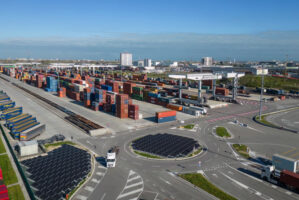
The positive impact will not only concern through trains, those running on the national network or coming from the ports of Trieste and Monfalcone, but will also enhance the role of Gorizia’s Sdag terminal, the intermodal logistics platform covering 60 hectares and specialising in agri-food products and temperature-controlled goods, while the rail terminal has two hectares of operating yards. The rail “lunetta” will benefit the terminal and allow the autoport and surrounding logistics hub to fully perform their back-port function, not least because all connections will be electrified. But the network of links will only be complete when the Transalpina railway in Slovenia is upgraded as far as Jesenice, the cross-border junction with Austria, not to mention a new route to be built between the existing Gorizia-Nova Gorica international section and the Nova Gorica-Ljubljana line.
Piermario Curti Sacchi