




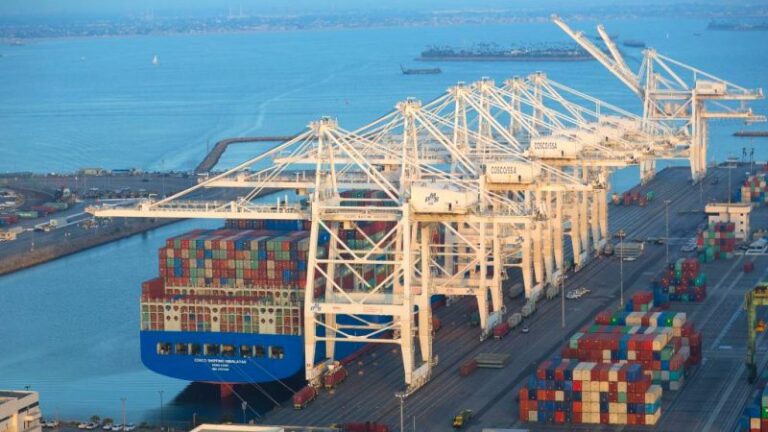
Chinese factories will close from 1 to 7 October for the national holiday known as Golden Week, so container shippers are concentrating deliveries to terminals in the second half of September. However, this early cargo is reaching a port system that has not yet cleared a two-month backlog caused by Asian typhoons, as shown by the fact that, on 8 September, the ports of Shanghai, Ningbo and Yantian showed no appreciable reduction either in waiting times or in vessel queues. An overview comes from Linerlytica, according to which, at the end of August, container capacity waiting for berthing reached 4.31 million TEU, exceeding the all-time high of 4 million recorded in 2022. The increase in global capacity has nevertheless reduced the weight of these figures, because the share immobilised in August 2026 was equal to 12.6% of a global fleet that has now reached 34.4 million TEU, compared with 15.7% of 25.3 million four years earlier.
At the beginning of September, the situation appeared to be improving: on the first day of the month the figure had fallen to 3.92 million TEU, around 11% of the fleet, but the decline in the aggregate figure does not correspond to an operational improvement. Again according to Linerlytica’s data, after the passage of Typhoon Saudel berthing delays in Shanghai and Ningbo-Zhoushan reached ten days, the worst level since the pandemic, while North Asia alone accounts for 54% of global congestion, with around 2.5 million TEU suspended.
Confirmation of this standstill comes from terminal data. On 4 September, Seaexplorer attributed to Shanghai an average waiting time of 5.46 days, with 42 vessels alongside and 99 at anchor, and arrival and departure delays of around six days, while in Ningbo yard occupancy fluctuated between 92% and 95%. Individual terminals in Shanghai, such as Waigaoqiao 2 and 5, exceeded nine days after reopening. Yantian recorded more moderate figures, between two and a half and five days, but the terminal’s schedule reliability fell to 48.3% in July.
In this context, what is considered the traditional buffer against a shortage of container capacity is missing: bringing idle container ships back into service. Linerlytica counts only 55 such vessels, out of an active fleet of more than 5,400 units, equal to 0.5% of the total and with combined capacity of 164,000 TEU. Today, no shipping line has idle capacity to deploy in order to recover missed rotations. The result is omitted calls, cargo being rolled onto subsequent sailings and berthing windows lost in sequence along the entire rotation, effects that will spread for weeks even after Chinese terminals reopen. As for cancellations, or blank sailings, Drewry counts 47 on the main east-west routes between weeks 37 and 41, out of 729 scheduled sailings.
The long tail of congestion is also reaching European ports, which are already suffering from entrenched delays. Sea-Intelligence indicates that transatlantic service reliability remained below 50% for much of 2026, with a low of 28% of on-time arrivals on North Europe-US East Coast services in July, while yard utilisation in Rotterdam and Antwerp remains consistently above 90%. In these conditions, the clustered arrival of delayed container ships from China, after omitted calls and reshuffled rotations, translates into further pressure on berths and on connections with barges, rail and road haulage.
Mara Gambetta