







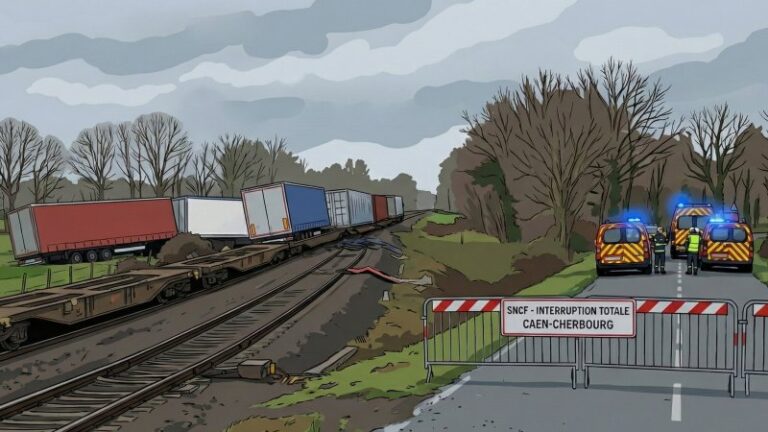
A freight train derailed on Sunday 11 January 2026 at around 3.00 pm near Carentan, in the Manche department, along the Caen–Cherbourg railway line, a strategic axis linking Paris with the port of Cherbourg. The incident led to a complete suspension of rail traffic in both directions between Caen and Cherbourg. While there were no consequences for people, the derailment has had a material impact on infrastructure and on the organisation of regional passenger and freight transport.
According to information released by the French authorities, the train consisted of seventeen wagons with a total length of around 750 metres and was not carrying dangerous goods. The derailment occurred shortly after the train passed through Carentan station, in an area characterised by low load-bearing ground. The wagons did not completely overturn, a factor that helped to limit further damage. Sncf Réseau, the national rail infrastructure manager, immediately mobilised its technical teams to secure the site and begin initial inspections. The company confirmed that the track and electrical installations were damaged, making complex repair works necessary.
In its first official communications, Sncf had suggested that traffic might resume as early as Sunday evening, but later clarified that the interruption would last for several days. On Monday 12 January, traffic remained completely suspended between Caen and Cherbourg, with no confirmed date for a return to normal operations. All long-distance passenger services were terminated at Caen, while replacement road services were introduced for regional trains.
The operational consequences do not affect passenger traffic alone. The Caen–Cherbourg line is also used for freight transport, including intermodal services linked to the port of Cherbourg. In this context, the incident has raised questions about the possible involvement of the rail motorway service launched by Brittany Ferries, which connects Cherbourg with Bayonne for the transport of unaccompanied semi-trailers. French sources refer generically to a freight train and, at present, there is no official confirmation that the derailed convoy was part of this service, whose traction is provided by Captrain.
Nevertheless, the line closure represents a critical issue for regional logistics and sea–rail intermodal flows. The Cherbourg–Bayonne connection was designed to shift a significant share of freight traffic from road to rail, with a target capacity of around 25,000 semi-trailers per year once fully operational. A prolonged blockage of the Normandy line risks affecting service reliability and forcing operators to seek alternative solutions, mainly by road.
As for the causes of the derailment, Sncf Réseau has launched an internal technical investigation, as required in such cases. No preliminary conclusions or official hypotheses regarding responsibility have been communicated so far. No immediate faults in the rolling stock or obvious operational errors have been reported, and checks are focusing both on the condition of the track and on the state of the rail formation.
The timing of the incident draws attention to the effects of storm Goretti, which hit Normandy hard between 8 and 9 January, with gusts of up to 152.6 kilometres per hour recorded in Cherbourg. In the days preceding the derailment, Sncf reported around 300 obstacles on the regional network, including fallen trees and widespread infrastructure damage, to the extent that rail traffic was completely suspended during the weather event. Although weather conditions had stabilised by the time of the derailment, technical teams are assessing whether there may be indirect links related to weakening of the track bed or installations.
Restoration operations require the removal of the train, a thorough inspection of the track and the repair of damaged electrical systems. According to Sncf Réseau, these are interventions that involve non-compressible technical timeframes, particularly to ensure that services can resume under fully safe conditions. The progress of the works and the outcome of the investigations will be decisive in clarifying the causes of the incident and in assessing any preventive measures for the line.