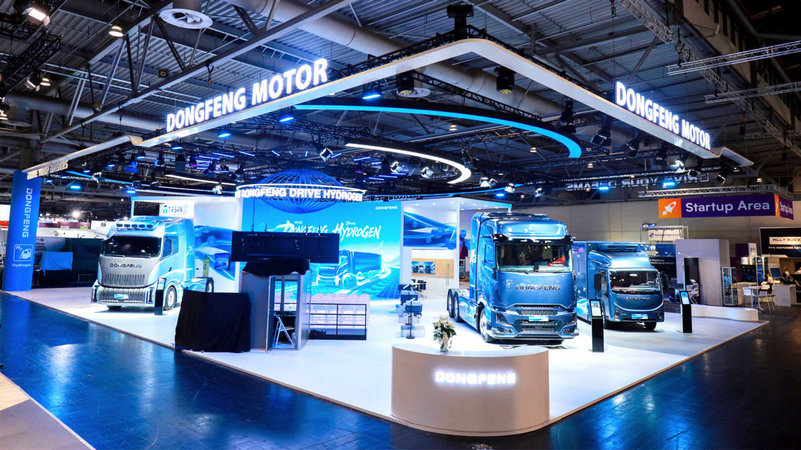





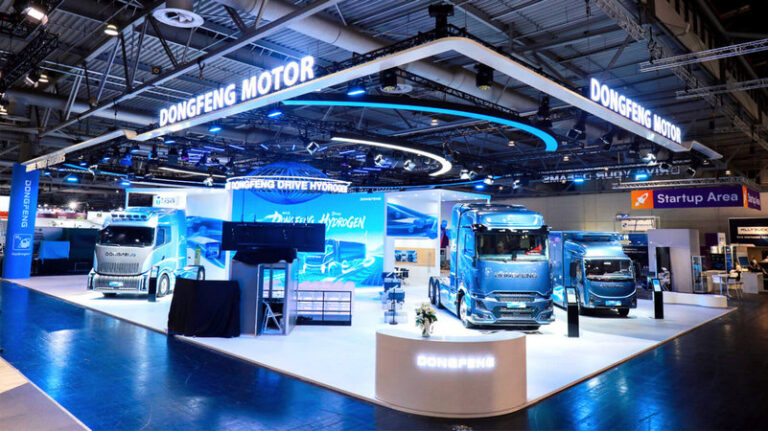
Dongfeng Motor Group has chosen the 72nd edition of IAA Transportation to bring its hydrogen technology for commercial vehicles to Europe. Its stand is entirely dedicated to this technology and hosts the world premiere of a 400 kW fuel cell system and three hydrogen fuel cell vehicles built on the T1 platform. Alongside them, the Chinese manufacturer is displaying two other fuel cell systems, rated at 120 and 150 kW, as well as a hybrid system featuring a hydrogen-powered internal combustion engine.
Dongfeng is no newcomer to this field, as it has been working on hydrogen for almost 30 years and now has a range of fuel cells from 20 to 400 kW for passenger cars, light and heavy trucks and special-purpose vehicles. The technology has been extensively tested on the road, with more than 10,000 Dongfeng-branded hydrogen vehicles operating in China. Tang Jing, deputy general manager of the commercial vehicle division, described the company's IAA stand as a showcase for hydrogen and hydrogen-electric solutions tailored to different freight transport applications. He also proposed that international manufacturers, suppliers and research institutes work together to develop technologies and standards and share production capacity.
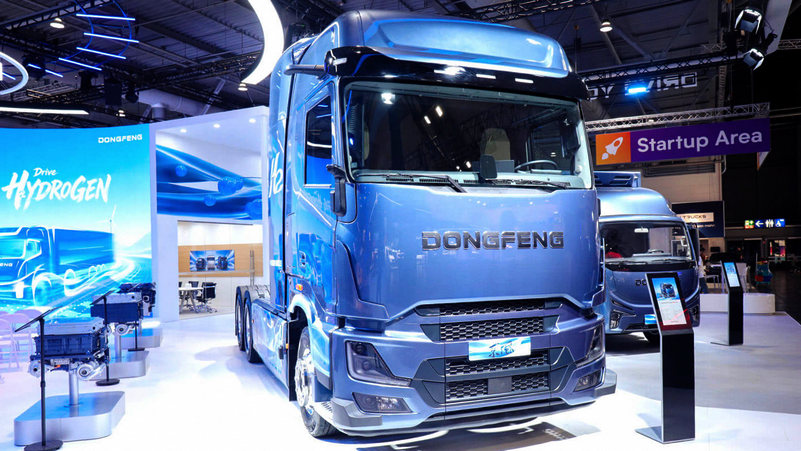
The state of the art is the T1 platform, which Dongfeng describes as the industry's first hydrogen-electric platform designed around hardware-software integration. Zhao Feng, head of the T1-H project, outlined its architecture, which comprises six modules: the fuel cell, hydrogen storage, traction battery, electric drive system, control unit and integrated thermal management. He said the 400 kW fuel cell stack achieves efficiency of more than 58% under typical operating conditions, a result the manufacturer attributes to improvements to the catalyst and membrane electrode assembly. The storage module provides a range of 1,700 kilometres on a single refuelling, while the thermal management system regulates temperature through around 30 operating modes.
Fuel cell control integrates predictive cruise control with V2X perception data fusion, using communications between the vehicle and its surrounding environment. This allows the powertrain to anticipate driving conditions rather than reacting afterwards, with the aim of reducing hydrogen consumption and slowing fuel cell degradation in long-haul tractors. The manufacturer claims equivalent hydrogen consumption of 7 kilograms per 100 kilometres, an unladen weight starting from 8.8 tonnes and an equivalent service life of 33,000 operating hours, or 1,375 consecutive days. Benny Oeyen, head of Europe and the Americas at the International Hydrogen & Fuel Cell Association, has followed the development of the project and said the 400 kW fuel cell had passed a 10,000-hour durability test.
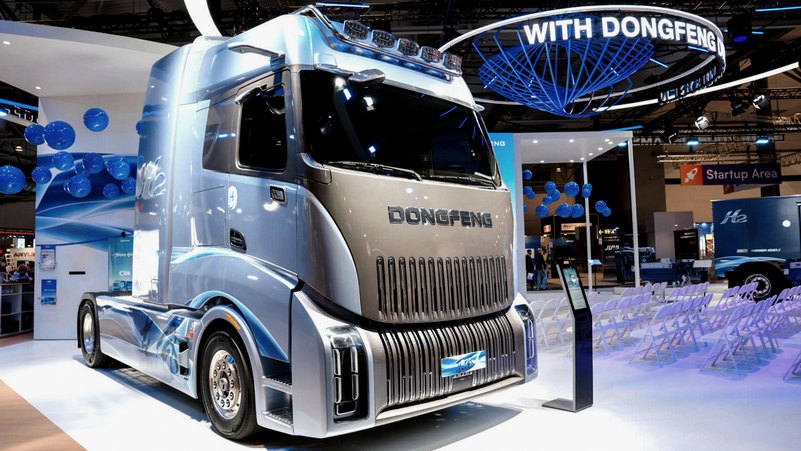
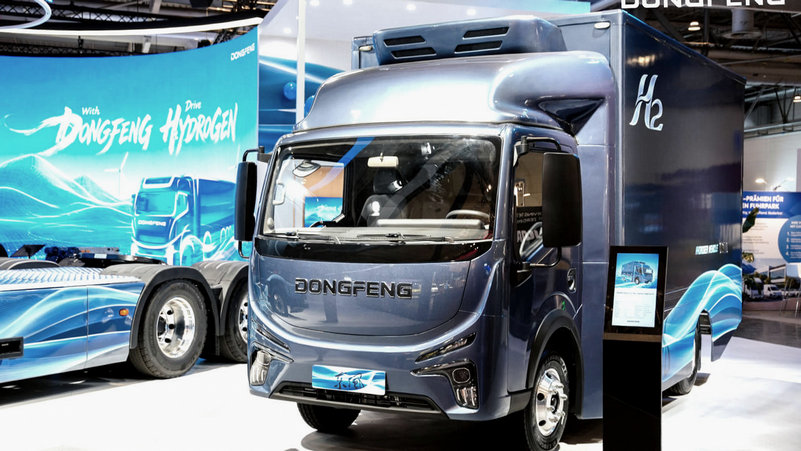
Three models are based on the T1 platform, all of which are on display at IAA. The Dongfeng-1 is designed for long-haul transport, with high-capacity hydrogen tanks and high-power systems, and is paired with the new Super cab. The manufacturer says the model has a lower total cost of ownership than diesel vehicles, although it has not provided figures. The Dongfeng-2, designed for transporting raw materials, can run on hydrogen or batteries depending on the refuelling and charging infrastructure available along the route. The Dongfeng-3 is intended for cold-chain operations, from fresh produce to pharmaceuticals, covering both urban distribution and interurban routes.
The 400 kW fuel cell system on display at the show is designed for long-haul and heavy-duty transport, as well as operation in harsh climates or at high altitude. It achieves maximum efficiency of 65%, a gravimetric power density of 1,350 W/kg and a dynamic response of 60 kW per second. Its equivalent service life is 33,000 hours, while cold starts are guaranteed down to -40 °C. The 150 kW system is intended for medium and large buses, medium and heavy trucks, tippers and tractors, while the 120 kW system is designed for light buses, light commercial vehicles and passenger cars. Typical applications cited by Dongfeng for the latter include 4.5-tonne refrigerated vans and 8-tonne trucks for interurban distribution.
At its stand, Dongfeng also showcased a hybrid featuring a hydrogen internal combustion engine, derived from the group's unified multi-energy platform for heavy-duty engines. The powertrain has a displacement of 16.2 litres and delivers a maximum output of 412 kW and 2,500 Nm of torque. The system offers 14 operating modes, including pure electric driving, hybrid drive, range extension, regenerative braking and charge sustaining.
P.R.