









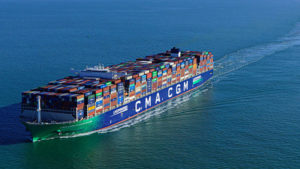
The return of container vessels to the Red Sea–Suez Canal route will have to wait longer. The clearest signal comes from the shipping line that, more than any other in recent weeks, had resumed use of the Egyptian canal: CMA CGM. On 19 January 2026, the French group announced that it would move three long-haul services back to the route around Africa, effectively postponing a structural return to the Red Sea and the Suez Canal. The decision affects the FAL 1, FAL 3 and MEX services, which are strategic links on the Asia–Europe and Asia–Mediterranean trades, and is officially justified by an “international context that is complex and uncertain”.
The announcement comes at a delicate moment, as the maritime sector attempts to assess whether security conditions in the region are sufficiently stable following the ceasefire in Gaza and the subsequent suspension of attacks by Yemen’s Houthi forces on commercial shipping, the most recent of which occurred in September 2025. During 2025, CMA CGM had been one of the most active Western carriers in efforts to restore transits via Suez, keeping some routes operational even under escort from the French Navy. The January reversal therefore carries particular significance, marking a shift in approach by an operator that had previously shown a higher risk appetite than many of its competitors.
The three affected services play a central role in east–west trades. FAL 1 operates weekly calls at thirteen ports between the Far East and Northern Europe, extending as far as the Baltic and including a transhipment call at Tanger Med. FAL 3 also serves the Asia–Northern Europe trade, calling at major hubs such as Hamburg, Rotterdam, Antwerp and Le Havre. MEX, meanwhile, links the Far East with the western Mediterranean, with calls including Malta, Fos, Barcelona and Valencia. A return to the Cape route is expected to extend transit times by an estimated 10 to 15 days for these services, with a corresponding increase in operating costs.
The French group is not diverting all services. Medex, linking India and Genoa, and the Phoenician Express, connecting the Far East with the Upper Adriatic via a call at Trieste, continue to transit via Suez. This highlights a selective approach that takes into account the commercial importance of certain trades and the need to maintain direct connections to Italian ports, while adopting a more cautious risk profile on the major Northern Europe routes.
CMA CGM’s repositioning fits into a broader picture of highly divergent strategies among leading shipping lines. Maersk announced on 15 January 2026 the structural return of its MECL service between the Middle East, India and the US East Coast via the Suez Canal, following two successful trial transits completed between December 2025 and January 2026. According to ICIS, the Danish carrier has reduced the number of vessels deployed on the service from 14 to 12 thanks to the shorter route. MSC, by contrast, has confirmed since last year that it will keep all services routed via the Cape of Good Hope, citing a security situation that remains insufficiently clear, while Hapag-Lloyd continues to require at least three consecutive months of stability before reconsidering a return to the Red Sea.
CMA CGM’s decision also has implications for the Ocean Alliance, of which it is a member alongside Cosco, OOCL and Evergreen. The three affected services are operated within the alliance framework, and the deviation is expected to be followed by partner vessels as well. At the time of the announcement, however, the Asian carriers were still offering transits via Suez, creating the potential for operational divergence within the cooperation.
On the geopolitical front, the situation remains fragile. New statements by Houthi leader Abdel Malek Al Houthi on 15 January 2026, including threats related to control of the Red Sea and the Bab el-Mandeb Strait, have added to uncertainty, alongside rising regional tensions linked to Iran’s internal crisis. The risk of a renewed escalation cannot be ruled out in the short term, making it difficult for shipowners to commit to a definitive return to the shorter routes.
Economic and insurance considerations also weigh heavily. War risk premiums for the Red Sea remain high, ranging between 0.7% and 1% of a vessel’s value, with costs per transit that can reach several hundred thousand dollars. The Cape route entails higher overall costs, estimated at between $2 million and $4 million per voyage on an annual basis for a large fleet, but it avoids both Suez Canal tolls and exposure to insurance and operational risks that are hard to predict.
Traffic data confirm that the recovery of the Suez Canal remains limited. In the week ending 11 January 2026, 26 container ships transited the canal, a figure higher than in previous weeks but still well below pre-crisis levels. In the fourth quarter of 2025, total transits were 19% lower than in 2023, with revenues sharply down, according to Egyptian sources.
For shippers and global supply chains, the situation translates into longer transit times, more complex planning and greater cost volatility. Analysts at Xeneta and ING warn that a premature return to the Red Sea followed by another diversion could further undermine service reliability, while a gradual resumption risks releasing capacity abruptly, putting downward pressure on freight rates.