







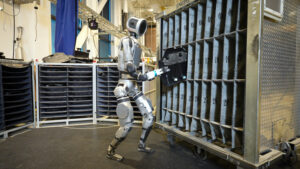
The transition of Atlas from a hydraulic to an electric system has been a turning point for Boston Dynamics, not only in terms of humanoid robot mobility but also as the start of a research path focused on object manipulation. The company’s engineers have long aimed to equip robots with grippers offering greater dexterity, precision and sensory capability. The technical challenge is significant: to concentrate a high number of actuators and sensors in a very compact space while maintaining reliability and impact resistance, especially under intensive use conditions.
The first stage of this evolution was the GR1 gripper, designed with a minimalist yet functional approach. Experience gained from this model made it possible to understand the mechanical and structural constraints of a component that must operate in synergy with a robot exposed to falls and collisions. GR1 laid the groundwork for a more sophisticated system, capable of combining robustness and flexibility without compromising ease of assembly and maintenance.
From this experience emerged GR2, the second model in the line, featuring seven degrees of freedom and seven independent actuators: two for each of the three fingers and one for the articulated thumb — the key innovation over the previous generation. The addition of an opposable thumb significantly expands the range of possible grips, enabling the gripper to handle objects of widely varying shapes and sizes.
The integrated tactile sensor system at the fingertips detects contact forces and adjusts the grip in real time. This human-like tactile response allows fragile objects to be held with the minimum necessary force to ensure stability while preventing slippage or breakage. The use of elastic, high-friction surfaces combined with distributed sensing has enabled finer control of mechanical interactions and a substantial improvement in operational precision.
According to Boston Dynamics, the GR2’s three fingers represent the optimal balance between complexity and functionality. Adding more fingers would increase costs, control difficulty and reduce reliability, without offering tangible advantages in manipulation performance. The three-finger configuration results from empirical analysis of movements required for grasping and rotating large or heavy objects, where stability depends on the correct balance of forces among contact points.
Another distinctive feature of the project is modularity: each gripper is a self-contained unit integrating actuation, sensors and cameras within the palm area. This architecture enables quick mounting and replacement on the robot, simplifying maintenance and reducing downtime. The presence of mirror versions for the right and left hand allows Atlas to choose the most suitable arm based on object position and surrounding obstacles, without fixed preference as seen in humans.
The evolution of Boston Dynamics’ grippers reflects a broader trend in industrial robotics towards increasingly anthropomorphic manipulation systems. The shift from simple gripping claws to dexterous robotic hands meets the needs of sectors where handling small, irregular or delicate items is common, such as assembly, component selection or operations in shared spaces with human workers.
In the context of automated logistics, these developments hold major promise. Grippers with tactile sensitivity and adaptive control can enhance picking processes, packaging of heterogeneous products, and handling of tools or containers of varying shapes. Looking ahead, the ability to combine mechanical dexterity with sensory perception will be one of the key steps towards collaborative robots capable of performing complex operations in goods movement and distribution lines.