







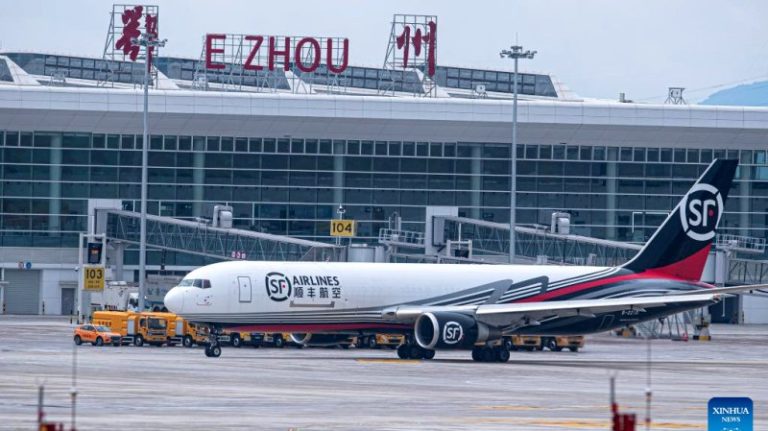
The air transport of lithium batteries carries a significant fire risk, including spontaneous combustion, as shown by at least a couple of serious incidents in recent years. To prevent such events, international organisations prescribe specific procedures for containers carrying these products, but China — the world’s largest producer of lithium batteries — is moving further ahead. This was demonstrated on 25 November 2025 at Ezhou Huahu airport with the presentation of a proactive prevention system during a conference dedicated specifically to the international transport of lithium batteries.
The new system draws on techniques developed to prevent thermal runaway and ignition as part of a project led by Chongqing Jiaotong University together with research institutes including the Beijing Institute of Technology, Southeast University and the Civil Aviation Research Institute, as well as companies such as battery manufacturer Catl and the airline Sf Express. According to the research group coordinated by Professor Wu Jinzhong, the core of the system is an active prediction architecture able to continuously monitor twelve key indicators, including temperature, gas concentration, pressure changes and abnormal electrical signals. The prediction model, supported by artificial intelligence algorithms, processes these data flows in real time and triggers an early warning with a verified accuracy of 96.7%, anticipating the critical stage of any potential thermal runaway.
When the parameters evolve towards potentially unstable conditions, the system activates an internal protection mechanism designed to halt the outbreak of fire. Engineers at the Beijing Institute of Technology stressed that the unit uses a combination of high heat-resistance materials and rapid-release suppressive agents which, once activated, come into effect in about three seconds. This timeframe has been defined as essential to interrupt the exothermic reaction before it reaches the point where the battery’s internal temperature increases uncontrollably. Professor Liu Xingliang specified that even in experimental conditions with internal temperatures above one thousand degrees, the surface of the equipment remains at around one hundred degrees, a threshold that allows emergency management without heat spreading externally.
Another technical element concerns the mitigation of gas emissions in the event of cell failure. The system incorporates a filtering compartment that reduces by around 70% the release of toxic gases generated by the decomposition of electrolytes, helping to prevent the cargo hold from becoming saturated. This approach is based on research from the National Laboratory for Explosion Science at the Beijing Institute of Technology, which identified the uncontrolled dispersion of vapours as the main cause of the rapid spread of fires in damaged batteries.
Structural protection was developed by addressing the second bottleneck identified in the project: material resistance under extreme stress. The container is built with a lightweight, high-strength composite designed to withstand sudden thermal shocks and pressure variations while remaining 40% lighter than previous prototype devices. This helps improve the payload capacity of cargo operators and enables the system to be deployed across a wide range of air routes. Researchers described the reduced weight and high robustness as key factors for aligning the technology with the needs of international air logistics.
The third technical area involves the creation of a testing protocol capable of simulating real transport conditions. According to the institutes involved, there had previously been no consistent testing methods to assess lithium battery behaviour during air transport. The project therefore developed high-intensity thermal, mechanical and environmental verification procedures, used to calibrate the prediction models and define risk thresholds that the system employs to anticipate thermal runaway. Professor Zhu Yanli explained that this protocol made it possible to move from the laboratory testing phase to operational use in the logistics sector.
The industrial relevance of these techniques was highlighted by China’s centre for managing air transport of dangerous goods, which recalled at the conference that the national lithium battery industry surpassed 1.2 trillion yuan (around 155 billion euros) in 2024, and that the associated air transport volume reached 64.5 million tonnes, up 21.26% on the previous year. In this context, Ezhou Huahu airport — certified in September 2025 with Iata’s CEIV qualification for lithium battery handling — represents the reference site for the first real-scale application of the new system.
The new system was presented in concrete terms by loading half a tonne of lithium batteries onto an Sf Express cargo aircraft for a flight from Ezhou Huahu to Shenzhen. The flight time is two hours, compared with ten hours by road. Chinese authorities have included this project within the broader policies to improve battery transport safety for new-energy vehicles, as outlined in the interministerial measures published in 2024 with the aim of removing the main infrastructural and technological obstacles by 2027. According to Sf Express manager Zhao Ning, the technology offers air logistics a solution that combines early risk control, physical protection and reduced operating costs, providing a model likely to be integrated into future safety standards for international lithium battery transport.