





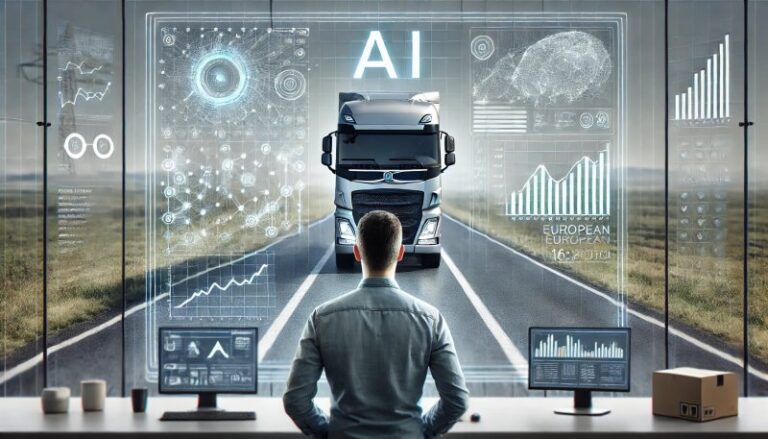
The transport and logistics sector is undergoing a phase of structural transformation driven by the adoption of artificial intelligence. This is confirmed by the Transportation Pulse Report 2026 published by Transporeon, a Trimble Group company, based on a survey conducted between August and September 2025 among more than 230 supply chain executives, freight forwarders and carriers in Europe and North America. The aim of the study is to assess how artificial intelligence is influencing transport management and which areas are set to see the greatest impact in the coming years.
According to the report, the sector has reached a turning point. Artificial intelligence is no longer confined to pilot projects, but is increasingly being integrated into transport management systems, with direct effects on operational organisation, decision-making speed and corporate competitiveness. The ability to respond to rapid technological change is therefore becoming a decisive factor in operators’ future positioning.
The data show accelerating, albeit uneven, adoption. Among freight forwarders, 44% say they are already using artificial intelligence solutions for transport planning and optimisation, alongside tools for carrier sourcing and real-time shipment visibility. On the carrier side, 42% have introduced AI into pricing processes and route improvement, while 39% use it for real-time tracking.
Despite this growth, data quality remains the main limiting factor. Information fragmentation and the lack of shared standards continue to represent the most significant obstacle to the effective adoption of artificial intelligence. Freight forwarders and carriers point to data inconsistency as the primary element slowing the ability to achieve tangible benefits, confirming that mature data foundations are an essential prerequisite for any technological evolution.
Analysis of future expectations also clarifies the role companies attribute to artificial intelligence within TMS platforms. Automation of repetitive back-office activities emerges as the most important function, cited by 67% of freight forwarders and 61% of carriers. This is followed by the identification of opportunities to improve service levels and operational performance, mentioned by 43% of freight forwarders and 30% of carriers, and the provision of real-time recommendations on loads and routes, indicated by 36% and 44% respectively. Delivery scenario simulations and outcome forecasting are particularly relevant for freight forwarders, at 38%, while only 15% of carriers consider them a priority. Expectations of fully autonomous AI decision-making remain marginal, cited by 14% of freight forwarders and 13% of carriers.
Looking at the impact over the next three to five years, freight forwarders and carriers agree on three key areas where artificial intelligence can generate the greatest value: planning, pricing and transport execution. Operational priorities, however, differ. Eighty-six per cent of freight forwarders expect AI to have a significant influence on planning and flow optimisation, while 59% of carriers see pricing and route improvement as the main value-creation area. In both cases, the findings point to a shift from an exploratory phase towards more informed use, focused on measurable gains in operational efficiency.
Another aspect examined concerns the level of autonomy companies are willing to grant AI agents in transport operations. The prevailing model is one of human supervision. Among freight forwarders, 52% say they are comfortable with semi-autonomous systems under human oversight, while 39% prefer solutions in which AI proposes actions but final decisions remain with people. Among carriers, 50% favour this latter approach and 31% opt for semi-autonomous models. Full decision-making autonomy remains a minority choice, cited by just 6% of freight forwarders and 9% of carriers, while a limited share still report discomfort with AI-driven decisions.
The report also devotes considerable attention to so-called Agentic AI, namely software systems capable of analysing data, making decisions and executing actions within defined limits. For freight forwarders, the main opportunities lie in real-time monitoring of estimated times of arrival, cited by 52%, with knock-on effects for route improvement, network optimisation and carrier selection processes. Carriers identify ETA calculation and alert systems as priority areas, mentioned by 59%, followed by route optimisation, fuel consumption reduction and spot rate negotiation.
The value of artificial intelligence is amplified in contexts characterised by connected logistics ecosystems. According to the Transportation Pulse Report 2026, 43% of freight forwarders point to strengthened predictive capabilities, such as more accurate ETAs and more effective management of disruption risks, as the main benefit of integrating AI with network-based TMS platforms. On the carrier side, 55% identify smarter vehicle matching as the key advantage, enabled by better load allocation and more efficient use of available resources.
Jonah McIntire, Chief Product and Technology Officer at Trimble Transportation, highlights that the value of artificial intelligence does not lie in the technology itself, but in the ability to make it operational and integrate it into processes, supply chain relationships and people’s skills. This approach reflects the orientation emerging from the survey, in which AI is increasingly seen as an advanced support for human decision-making and as an enabler of more efficient and connected operating models.