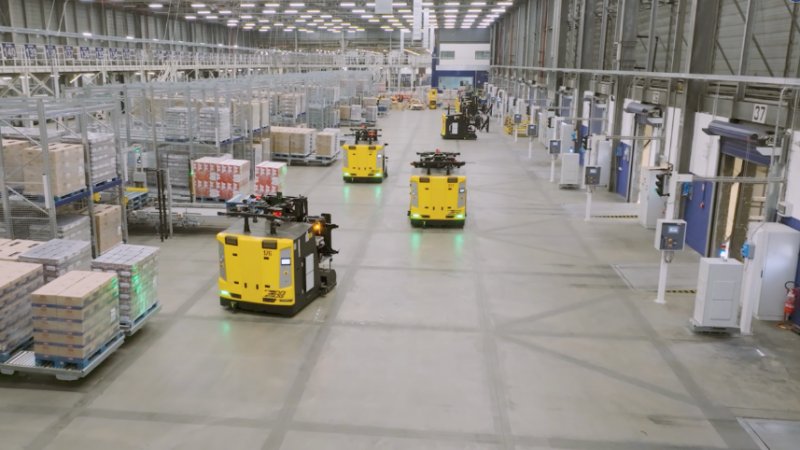









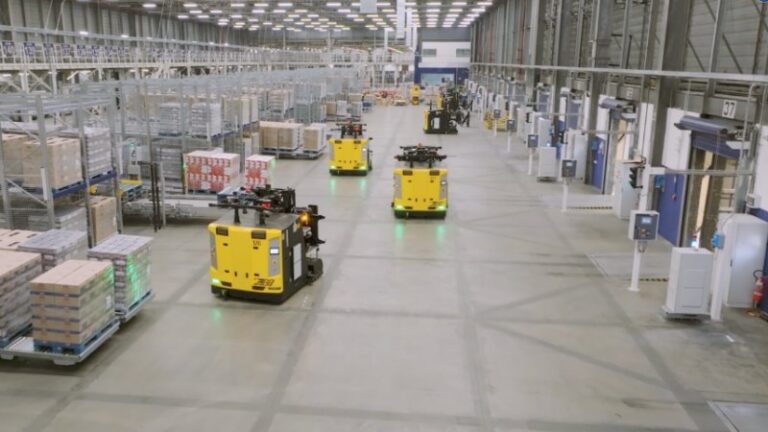
Three years ago, describing the transformation of the Pedrignano plant, its then director Alessandro Spadini identified raw material handling and truck loading as two operations that had yet to be automated. For the latter, the project was completed on 25 September, when Barilla and E80 Group announced the introduction of an automated truck loading system based on laser-guided vehicles (LGVs) at the site near Parma. Automation now extends to the final stage of the intralogistics flow, when finished products leave the warehouse and are loaded onto semi-trailers.
The new system covers the route from the finished goods warehouse to the dispatch area and then into the trailer, combining LGVs with gravity-based handling solutions and truck restraint and stabilisation devices developed in collaboration with Rite-Hite, a US manufacturer of loading dock equipment based in Milwaukee. The project also involved redesigning the loading bays to improve safety in the loading area. Spadini, now Plan to Fulfill End-to-End Process Redesign Leader at the food group, explains that the first reason for this development is to complete the integration of a process that was already largely automated, from finished goods to dispatch. The second is safety, as the new system makes loading operations more controlled and reliable. There is also a third reason, arising from a supply chain analysis that confirmed the value of solutions capable of increasing process resilience.
For E80 Group, a multinational headquartered in Viano, near Reggio Emilia, Pedrignano represents the introduction in Europe of technology already established in the United States, where the group has been designing and installing automated truck loading and unloading systems using LGVs for consumer goods manufacturers for more than ten years. The company adopts a modular approach, allowing it to work with existing infrastructure without interrupting plant operations. The company's president and founder, Enrico Grassi, describes automated loading as "the last mile towards total integration" of the site, designed to make the most of existing equipment while maintaining scalability and operational continuity.
The new system builds on a digitalisation programme that Barilla has been pursuing for thirteen years, with E80 Group as its technology supplier in a relationship that, according to Spadini, spans more than three decades. In October 2013, the group inaugurated what Elettric 80, as the Emilia-based supplier was then known, described as the largest LGV-served automated warehouse in the food industry: 40,000 square metres, 80,000 pallet positions and 54 vehicles, with 120 trucks loaded each day and approximately a quarter of Barilla's worldwide volumes passing through the facility. Ten years later, the plant's covered area had reached 165,000 square metres, while the number of laser-guided vehicles had risen to 107. These were supported by 35 robotic systems, including palletisers, labellers and wrapping machines, high-density warehouses equipped with six stacker cranes operating at heights of up to 35 metres, and an LGV-managed drive-in warehouse with a further 50,000 pallet positions. Today, the fleet comprises more than 100 vehicles, and the entire system is coordinated by the proprietary SM.I.LE80 software platform, which manages flows from raw material intake to dispatch. The increase in on-site storage capacity has already enabled Barilla to eliminate more than 3,000 truck journeys a year to external warehouses previously used by the company.