








- Ilya Espino de Marotta took over the leadership of the Autoridad del Canal de Panamá (Panama Canal Authority) on 7 September 2026 for the 2026-2033 term, becoming the first woman to hold the post. A naval engineer who joined the authority in 1985, she has served as vice-president for engineering and operations, deputy administrator since 2020 and head of sustainability since 2024.
- In summer 2026, the Autoridad reduced daily slots to 34, falling to 32 on 15 September, while postponing a planned reduction in the maximum draught for the Neopanamax locks, which remained at 14.63 metres. Rainfall in September, October and November will determine whether further cuts will be needed between January and March 2027.
- The structural response is the Río Indio reservoir, estimated at $1.5-1.6 billion and expected to be completed in five or six years, with a dam, artificial lake and transfer tunnel to Gatún. The project involves the resettlement of 500-550 families and a complex environmental impact assessment.
Forty-one years after joining the Industrial Division shipyard as its only female engineer, on 7 September 2026 Ilya Espino de Marotta took over the leadership of the Autoridad del Canal de Panamá at an inauguration ceremony held in the Canal administration building, beginning a term that will run until 2033. It is the first time a woman has held the infrastructure’s top executive role. The Board of Directors of the Autoridad approved her appointment on 21 May, initially indicating October as the month of the handover, before the date was brought forward. Espino de Marotta succeeds Ricaurte Vásquez Morales and moves up from the post of deputy administrator, which she had held since 1 January 2020, with responsibility for the authority’s sustainability added in January 2024.
Her professional career has been entirely within the authority and has been mainly technical and operational in nature: naval engineering, dredging, investment planning and project control. As executive vice-president for engineering and programme management, she oversaw the expansion project and the Neopanamax locks, which entered service in 2016, before moving to the operations vice-presidency. The new administrator therefore has first-hand experience both of capacity expansion and of the water-related consequences that followed, and this expertise is probably one of the main reasons for her appointment to the top job.

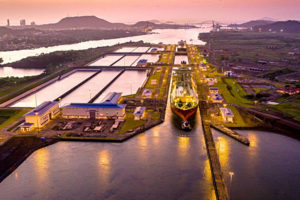
Indeed, water is the subject of the most important file awaiting her on her desk. The Panama Canal is not at sea level like Suez: ships must overcome the height difference between the Atlantic and the Pacific through three lock systems supplied with fresh water, and every transit entails a significant release of water. Water availability depends on the artificial lakes Gatún and Alajuela, which not only operate the locks but also supply the water system for a large share of Panama’s population. When rainfall across the watershed declines, the Autoridad must choose between protecting reserves, maintaining transit continuity, authorised draughts and the country’s drinking water needs.
That difficult choice returned to the fore in summer 2026. The authority therefore scheduled a reduction in daily transits to 34 from the first days of September and to 32 from 15 September, with nine passages reserved for Neopanamax vessels and 23 for Panamax vessels in the second phase. It also announced tighter maximum draught limits for the Neopanamax locks, before postponing one of the planned reductions and provisionally maintaining the limit at 14.63 metres (48 feet), instead of lowering it to 14.48 metres (47.5 feet). The value shipping companies place on the route’s reliability can be seen in the auctions for slot allocation, where some vessels have paid more than $1 million, around €860,000, to secure a passage without long waits.
Espino de Marotta has already said that rainfall trends between September and November will determine whether daily transit quotas will have to be cut further in the first quarter of 2027. In the background is the strengthening of El Niño, which is again raising the risk of water scarcity in the basin. The benchmark is the 2023-2024 drought, when daily capacity fell from normal levels of 36-38 transits to a low of about 22. In fiscal year 2024, passages stood at 9,944, compared with 14,080 the previous year, a decline of 29.3%. The measures adopted in 2026 remain far from those levels and are preventive in nature, but the new administrator has not ruled out further limits.
For shipping companies, the difference between the two interventions - reducing slots or draught - is highly significant. The first affects the number of voyages and the length of waits, while the second affects the yield of each voyage, because it forces operators to leave containers or other tonnage ashore and therefore to spread crew, fuel and toll costs over a smaller volume of cargo. In the previous cycle, the effects were asymmetric: scheduled container traffic, which is more structured and has greater booking capacity, protected its transit options more effectively, while liquefied natural gas and dry bulk saw the sharpest reductions.
As a result, many US shipments of liquefied gas bound for Asia continued to use longer routes, while part of the grain trade from the Gulf of Mexico shifted towards the Cape of Good Hope or towards ports on the US Pacific coast. Among the most exposed segments, Rabobank identifies US agricultural exports, grains and oilseeds, and fresh fruit arriving from the South American Pacific. However, route diversions lengthen voyages and absorb vessel capacity. According to Unctad estimates, for flows between the Americas and Asia, sailing distance increased by as much as 31%, raising costs and delays, while in mid-2024 the combination of diversions from the Red Sea and Panama increased global demand for tonnage by 3% and demand for container ship capacity by 12%.
In the Autoridad’s accounts, the 2024 crisis did not translate into lower revenue. On the contrary, in fiscal year 2024 the Autoridad closed its accounts with 4.99 billion balboas, around €4.3 billion, up 1% on the previous year and above budget, thanks to tariff increases, slot auctions and an economic selection of demand that favoured cargoes willing to pay more. The recovery in water reserves then lifted fiscal year 2025 to 13,404 transits, up 19.3%, and 489.1 million Cp/Suab tonnes, up 15.6%, with revenue rising to 5.705 billion balboas, around €4.9 billion, an increase of 14.4%.
The current level of transits nevertheless remains below pre-crisis figures, and this is where the first challenge for the new administration lies: customers pay for predictability, not for a passage that is theoretically available. An announced and scheduled reduction allows a shipping company to change port calls, organise rail forwarding, and reposition ships and containers, whereas a sequence of close revisions during the dry season has the opposite effect. In addition, higher tolls are sustainable for high-value containers, but much less so for grains, minerals, fertilisers and coal, traffic that may not return to the canal once it has become used to alternative routes.
The infrastructure response to this situation, which appears increasingly structural, partly because of climate change, is the Río Indio reservoir, a project involving a dam, an artificial lake and a transfer tunnel to Gatún, with investment estimated at $1.5-1.6 billion, around €1.4 billion. Espino de Marotta believes that, once completed, the project would make it possible to avoid both draught cuts and transit reductions even during drought, while improving the water supply for more than one million Panamanians. Completing the project, however, will take five or six years, so it offers no relief for the 2026-2027 dry cycle.
The construction of the artificial reservoir also has a social and regulatory cost that will affect its timetable. Local and environmental sources estimate that 500-550 families, around 2,500 people, will have to be resettled. The Autoridad says it has held more than 200 meetings with the population and has prepared a plan for compensation, housing and the restoration of livelihoods, but some farming communities oppose the project because they fear the loss of land and the transformation of the rural economy. In addition, before construction can begin, a Category III environmental impact assessment is required, the strictest level under Panamanian law, followed by detailed design, tendering and the management of relocations.
Río Indio is only one item in the Visión Estratégica 2025-2035, the ambitious plan under which the Autoridad aims to invest more than 8 billion balboas, around €6.9 billion, over the decade to develop port terminals on both coasts, the port of Corozal, an interoceanic energy corridor with a 76-kilometre oil pipeline and maritime terminals to move energy products between the Atlantic and the Pacific without using the locks. Its logic is to increase the value retained in Panama without consuming additional water, within an authority that also remains a pillar of national public finances through transfers to the state. The first test for the new administrator, however, is much closer: the transit quotas and draughts that the Autoridad sets for the January-March 2027 quarter will depend on the levels of lakes Gatún and Alajuela at the end of the rainy season. All under the shadow of an El Niño that is shaping up to be the most severe ever.
M.L.