







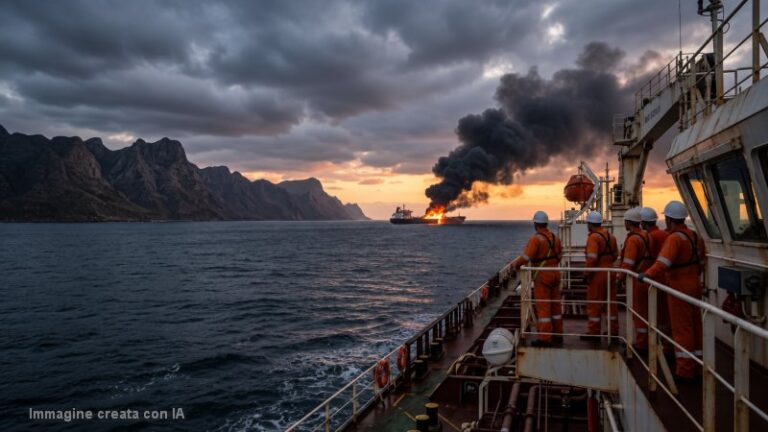
The conflict between the United States and Iran is failing to break out of the spiral of reciprocal attacks, and everyone is paying the price, with the cost of a barrel returning above the $100 threshold on 8 September 2026. On the war front, the United States Central Command, Centcom, said it had destroyed as many as five Iranian tankers on 8 September loaded with crude oil. Four vessels, the Kivik, the Charminar, the Horizon 1 and the Riesco, were hit in the Gulf of Oman, and the fifth, the Derya, near the island of Kharg, Iran’s main oil export terminal. The crews had been ordered to abandon the ships before the attacks, according to the US command statement, which presented the operation as a response to two attempts by the Revolutionary Guards to strike a US Navy warship with ballistic missiles in the previous two days. The unidentified vessel reportedly avoided both attacks without suffering damage or casualties.
Iran’s retaliation came a few hours later. Through the semi-official Tasnim news agency, the Pasdaran Navy said it had hit two US ships and eight tankers, causing "considerable damage", and had targeted another ten vessels that allegedly tried to cross an area of the Strait described as "prohibited and unsafe". None of these claims has so far been independently verified, unlike the US attack on the five tankers. Tehran has also been credited with the capture of an unmanned underwater vessel at the entrance to the Strait, of which it released several photographs, an event to which the US military responded by saying that one of its own older-model drones had malfunctioned in the area, without clarifying whether it was the same unit.
The threats do not spare the ports across the whole area and the ships moored there. A note by Iran’s official Irna news agency said the Revolutionary Guards had warned that all tankers in ports in Kuwait and Bahrain, whether at anchor or alongside, would be considered targets, urging crews to abandon them immediately. This extension of risk from the Strait of Hormuz to Gulf ports broadens the scope both of insurers’ assessments and of instructions to captains. On the opposing front, US Secretary of State Marco Rubio reiterated that any Iranian attempt to hit US naval units would lead to the destruction of further Iranian tankers.
The market reacted immediately to this series of events and statements. On the morning of 9 September, Brent first returned above $100 a barrel, at $100.08, up 2.18%, before reaching $100.54 on the November contract. It is the first time since 23 July 2026 that the European benchmark has reached this threshold. WTI, by contrast, remained below $100, at $94.69, up 1.8%, but its price has risen by almost 20% in a week. These increases have also been fuelled by falling supply, with Opec production in August estimated to have declined by 900,000 barrels a day to 19.91 million because of Saudi cuts, and by Houthi attacks on Saudi Arabia’s energy infrastructure.
In this context, navigation through the Strait of Hormuz remains cautious. Some data indicate that crude flows may have recovered to around ten million barrels a day, about half of pre-conflict levels, with selective transits. The situation for liquefied natural gas is different, as there appears to be an almost total blockade: according to Kpler tracking data, no LNG carrier has crossed Hormuz since 11 July. Qatar and the Emirates are testing ship-to-ship transfers off the coasts of the two countries, but only three cargoes were moved in August because the operation is complex: each transfer requires 30 to 35 hours, specialist equipment, tugs and qualified personnel, increasing costs by more than $1m (€860,600) per cargo, according to Vortexa estimates.
But the real cost of risk is measured in insurance cover, which is increasing. According to Marcus Baker, global head of marine, cargo and logistics at broker Marsh, additional war risk premiums for the Gulf area have risen from 1-3% of hull value to 7.5-10%, with insurers increasingly reluctant to offer spot terms. For a ship worth $100m, this means moving from $1m-$3m to as much as $7.5m for a single transit, a burden that is passed on to freight rates and, downstream, to the landed cost of crude. Container shipping has absorbed the same mechanism through the geopolitical surcharge that operators have called the Hormuz Premium, now firmly incorporated into spot rates.
M.L.