






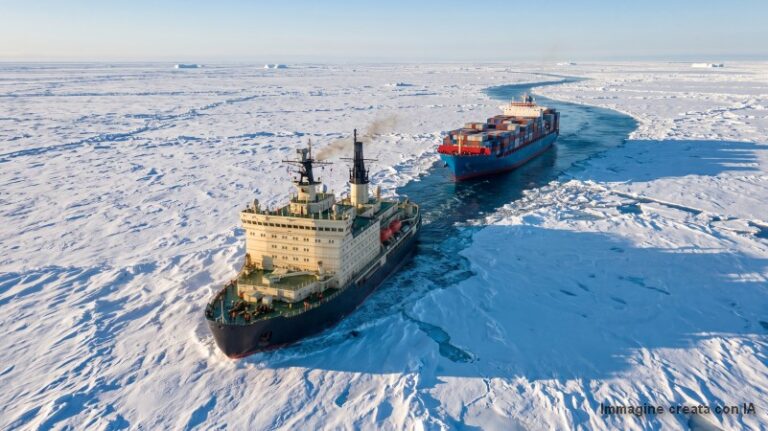
In 2026, the Arctic route, or Northern Sea Route, accelerated, with more container ships using it thanks to co-operation between Russia and China. This partnership is extending beyond navigation alone and now also includes the design of dedicated container ships under an agreement between Russian nuclear group Rosatom and Chinese shipowner NewNew Shipping. Rosatom has approved the outline design for an Arc7-class cellular vessel dedicated to navigation along Russia’s Arctic coast. According to initial information that emerged in September 2026, the ship, designed by United Shipbuilding Corporation, would have a capacity of around 4,800 TEU, with a length of 255 metres and a beam of 35 metres, and would be fitted with a 46 MW diesel-electric propulsion system, with two 15 MW electric motors. The beam is not accidental, as it corresponds to the channels opened by Rosatom Project 22220-class nuclear icebreakers, allowing the container ship to travel in the wake opened by the Russian giants when ice thickness requires it.
Rosatom, Russia’s state nuclear group, has for years managed the infrastructure of the Northern Sea Route, including icebreakers and navigational assistance services, while NewNew Shipping Line, a Chinese shipowner, began Arctic sailings between China and Russia in 2023. At the end of 2024, the two companies set up a joint venture in China, Northern Sea Route Shipping Line, with the aim of organising traffic and commissioning the design and construction of high ice-class ships. NewNew wants to carry out two monthly voyages on the Arctic route and move at least 1.2 million tonnes during the 2027 summer season. For Moscow, containers are becoming a complement to traffic currently driven by oil, liquefied natural gas and supplies for Arctic projects, with the aim of turning the Northern Sea Route from a seasonal corridor into a more stable state infrastructure. Rosatom reports that in 2025 the Northern Sea Route recorded 24 container ship voyages, carrying more than 410,000 tonnes of cargo, more than double the previous year.
In August 2026, the Xin Xin Hai 1, a NewNew Shipping vessel of around 29,000 tonnes gross tonnage, reached Murmansk from China carrying about 500 containers of components for the automotive industry. The Chinese company is also preparing its own fleet of six container ships of around 4,800 TEU, four of which will enter service in October 2026 on the China-St Petersburg route and another two in June 2027. According to some Chinese sources, they are classified as Arc3, meaning they have ice capabilities well below those planned for the future Arc7 units.
The Arctic route is also attracting other Asian countries, notably South Korea. On 22 August, the PanStar Acro sailed from Busan with 737 TEU bound, via this route, for the northern European ports of Felixstowe, Rotterdam and Gdańsk, on a round voyage expected to take about 45 days. The distance between Busan and Rotterdam falls from around 20,000 kilometres via Suez to around 13,000, with a potential saving of 35% and around ten days’ sailing. But the price to pay is the use of specialised crews, icebreaker services, higher insurance premiums and the risk of underused return voyages, given that Asia-Europe flows remain structurally stronger than those in the opposite direction. In the Korean case, questions also emerged over payments and insurance cover linked to the involvement of Rosatomflot, which is subject to European sanctions.
The Arc7 class defines what a ship can do in ice, and above all what it cannot do without assistance. The Russian Maritime Register of Shipping authorises it for autonomous navigation in first-year Arctic ice of up to 1.4 metres in winter and spring, and 1.7 metres in summer and autumn. Behind an icebreaker, this thickness rises to 1.8 metres in the cold season and to three metres of second-year ice in the warm season. In this case, however, crossing pressure ridges does not take place through continuous progress but through ramming, meaning repeated reversals and controlled impacts. Even when navigation is permitted, the ice is not a uniform block, and ridges, hummocks and fields compressed by wind and currents can bring the ship’s speed down far below what the nominal thickness values would suggest. For this reason, the Polar Code requires every unit to have a Polar Water Operational Manual specific to the area, season and expected conditions.
To this must be added the fact that icebreaker availability is limited. Beam compatibility with the channels opened by Project 22220 icebreakers reduces the need for their assistance under certain conditions, but it does not remove waiting windows for escort, convoy co-ordination or competition for icebreaker capacity, which is required not only by container ships but also by LNG projects and Arctic ports. Arc7 vessels must also have very powerful engines, up to 46 MW, almost twice the output of a conventional container ship of comparable size. This means higher fuel consumption during icebreaking, heavier structures at the bow, hull and propellers, and lower cargo capacity than an equivalent ship without polar requirements. There are also the constraints of low temperatures, which can block valves, cranes and container-handling equipment. Finally, there are visibility problems, as maritime fog, frequent in some seasons, can by itself add one to four days to a voyage. In short, despite global warming, the Arctic route is no easy passage and cannot in any way compete, in terms of volume, with the traditional routes from Asia to Europe.
M.L.