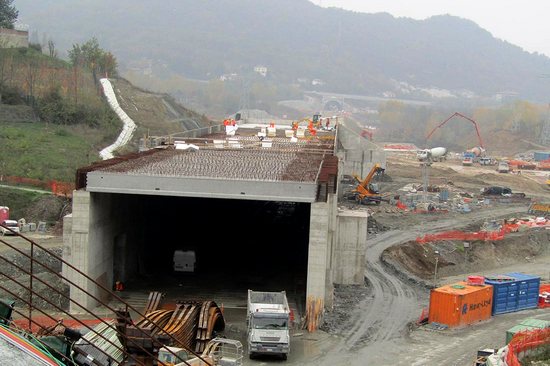







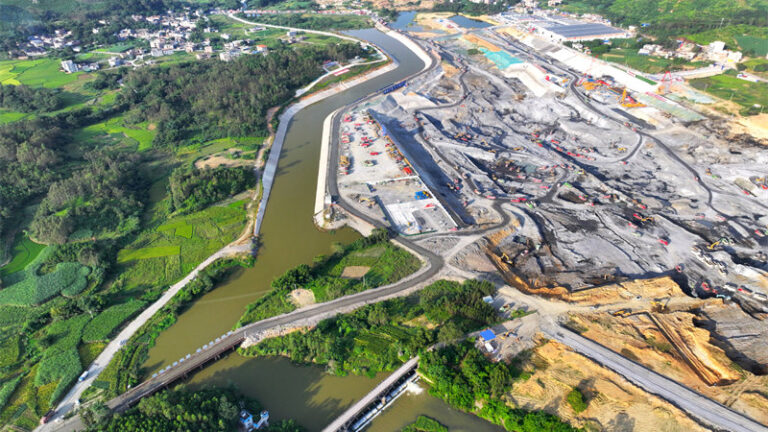
A new waterway will open in China in September 2026 to carry goods from the interior to seaports. It is the Pinglu Canal, which will connect the Xijiang river system with the Gulf of Tonkin, giving south-western China more direct access to the sea. The project, located in the Guangxi autonomous region, is 134.2 kilometres long. Construction began in August 2022 and required investment of around 72.7 billion yuan, almost €9 billion. Built to China’s Class I inland waterway standard, the canal will allow vessels of up to 5,000 tonnes to pass through and will shorten the river route for south-western export cargoes by more than 560 kilometres compared with the eastern route via Guangzhou.
The project overcomes a height difference of around 65 metres between the Xijin basin and the sea through a series of three major lock complexes - Madao, Qishi and Qingnian - rather than a single barrier. The lock chambers use side basins for water recovery which, at Madao, are said to save 63% of water and allow filling in around 16 minutes. This is a decisive measure for maintaining the draught of 5,000-tonne vessels without draining the Xijiang during the dry season.
The route starts from the mouth of the Pingtang, in the Xijin basin near Hengzhou, within the administrative area of Nanning, crosses Lingshan and reaches the Gulf of Tonkin along the Qinjiang river, connecting with the Beibu Gulf port system, where Qinzhou plays the central role. But the corridor is not intended for Guangxi alone. Through the Xijiang river network, the new waterway also brings parts of the freight flows of Guizhou, Yunnan and Chongqing closer to the sea, within the western land-sea corridor that Beijing has identified as the project’s strategic framework.
Historically, a significant share of cargo from Guangxi’s hinterland bound for maritime transport followed the eastern course of the Xijiang towards the Pearl River Delta and the ports of Guangdong. The new canal now diverts the flow south, towards Qinzhou and the other ports of the Gulf of Tonkin. Estimates released by the Guangxi authorities indicate an overall reduction in logistics costs of between 18% and 30%.
The port of Qinzhou enters this phase from a position of strength. In 2025 it handled 7.462 million teu, followed by 3.355 million teu in the first half of 2026, and it has an automated terminal connected to the rail container terminal. In 2024, the western corridor’s rail-sea system exceeded 500,000 teu, distributed across 18 provinces, 73 cities and 157 stations, while the wider Beibu Gulf port system surpassed 9 million teu.
Container traffic will grow on the new canal mainly indirectly, as a result of the reorganisation of supply chains, inland terminals and feeder maritime services to South-east Asia. The main beneficiaries will be low-value-per-tonne, less time-sensitive containers, imports bound for industrial centres along the corridor and consolidated flows at river terminals, for which the canal makes a barge system between Nanning, the Xijiang basin and Qinzhou more credible. High-value cargoes or those integrated into just-in-time supply chains will continue to favour rail and, for the busiest ocean destinations, the ports of Guangdong.
The canal increases competitive pressure on Guangdong’s ports for traffic from western and south-western China, but it will not replace them. The ports of Shenzhen and Guangzhou will retain a greater density of ocean services, higher frequencies, established logistics networks and volumes that support competitive freight rates and transhipment. The most likely outcome is selective erosion: Qinzhou and the Gulf of Tonkin will gain share in regional China-Asean traffic and in some hinterland flows bound for global markets, while the Pearl River Delta ports will give up margins without facing structural displacement. The port offering is meanwhile being reinforced. Guangxi has scheduled 37 projects covering berths and waiting areas for river-sea intermodality, worth 35.5 billion yuan - around €4.4 billion - with completion expected by 2029, while the Beibu Gulf port plan sets container capacity at more than 16 million teu by 2030.
M.L.