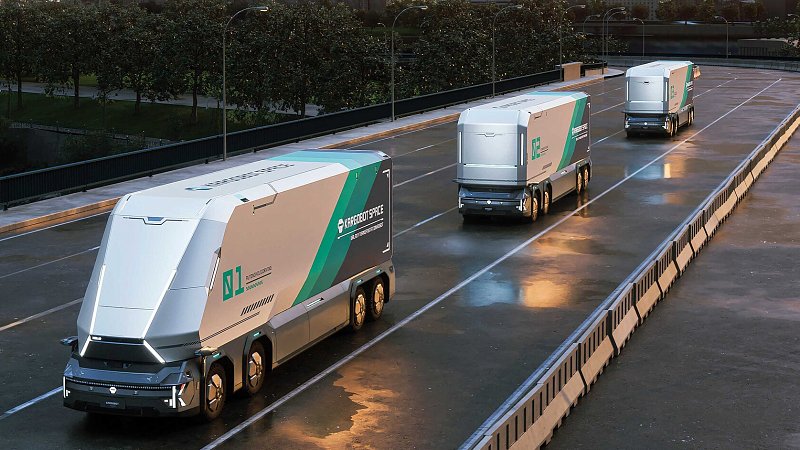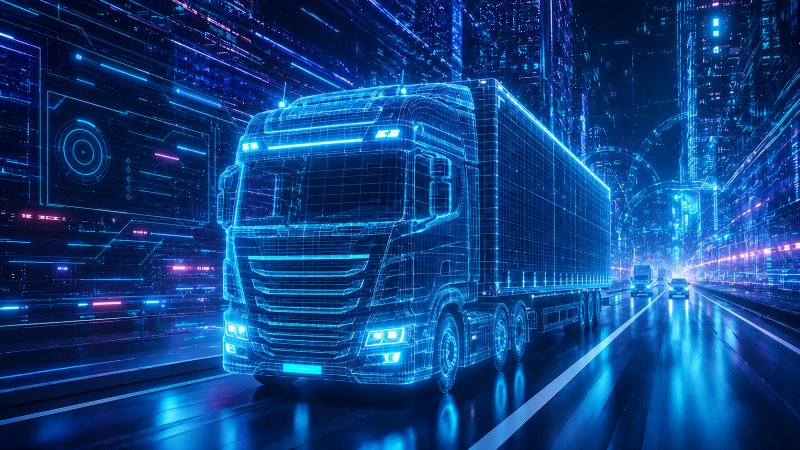



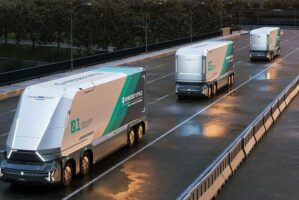
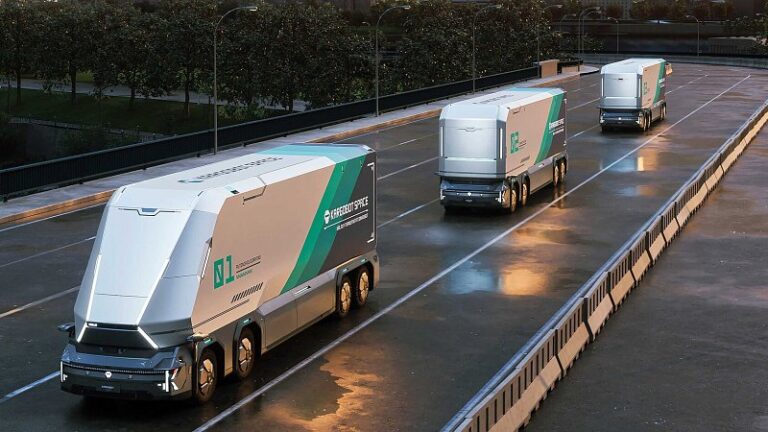
KargoBot Space is an L4 autonomous freight vehicle developed by KargoBot, formerly known as Ka’er Dongli, a Beijing-based company founded in 2021 as a spin-off from the autonomous driving division of DiDi Chuxing and made independent in October 2023. The manufacturer describes it as a "transport robot" rather than simply an autonomous truck: the term reflects the complete absence of a driver’s cab, a design choice that sets the model apart from autonomous vehicles that retain a cabin for possible human supervision. Space was officially unveiled on 23 April 2025 at the Shanghai International Auto Show, while the production version 2.0, equipped with a new 4,320-line colour Hesai lidar, was shown at the Beijing Auto Show in April 2026.
The removal of the cab results, according to figures released by KargoBot, in 25% more cargo space and a 10% higher payload, equivalent to around three additional tonnes compared with a conventional road tractor with semi-trailer. The vehicle’s overall weight falls by around 20%. The manufacturer says the removal of the cab cuts production costs by almost 100,000 yuan, about €12,800, with KargoBot estimating a gross margin per vehicle up to five times higher than that of a conventional tractor. In financial terms, this equates to an additional annual profit of between 250,000 and 400,000 yuan, around €32,000 to €51,000, per customer in the coal and mineral transport segments.
Perception of the surrounding environment is handled by 32 sensors in total, including lidar, 4D millimetre-wave radar and infrared cameras, fused to provide 360-degree coverage with no blind spots, even in strong wind, sand, rain, snow or fog. Data processing is handled by the Horizon Robotics Journey 6P chip: the launch configuration uses two chips for total computing power of more than 1,120 TOPS, with full hardware redundancy required to support L4 autonomous driving.
Electric traction is based on a chassis with an interchangeable battery developed together with CATL, and this is the first vehicle in the sector to connect to China’s national "Qiji" battery-swap station network. The battery pack has a maximum capacity of 1,026 kWh, with a declared range of more than 800 kilometres per swap. This means that, by changing batteries more than once a day, the vehicle can achieve high daily mileage with only very short stops.
The declared launch price is 250,000 yuan, about €32,000, which KargoBot says is roughly half the cost of a conventional tractor with semi-trailer. This is supplemented by an annual fee of 50,000 yuan, about €6,400, for the autonomous driving software service. Mass production of the variants intended for bulk transport and express logistics is scheduled for 2027, in collaboration with industrial suppliers including Aote, CIMC Vehicles, ZTO Express, Deda Logistics and Fuyou Trucks. The wider KargoBot group, which also includes models other than Space that are still in the prototype phase ahead of commercial launch, currently reports more than 400 trucks in service and 35 million kilometres travelled overall, with a target of 1,000 vehicles on the road by the end of 2026 and 10,000 in the coming years. By December 2025, the company had already exceeded 20 million kilometres of accumulated road testing, while in March 2026 KargoBot closed a funding round of more than $100 million led by Horizon Robotics.
P.R.