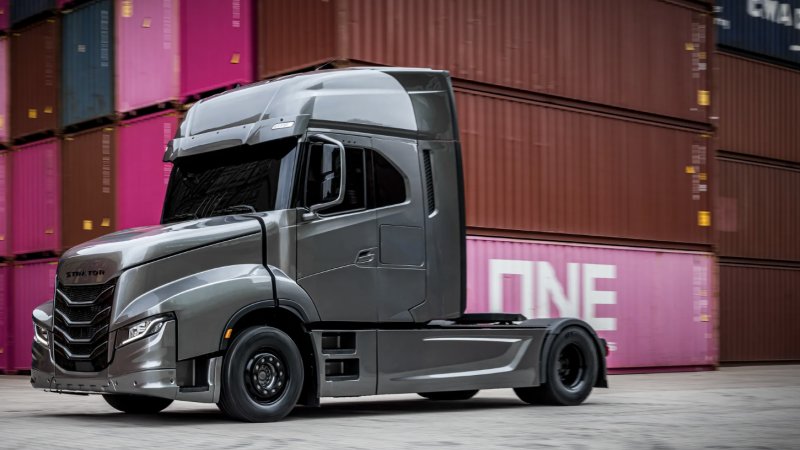



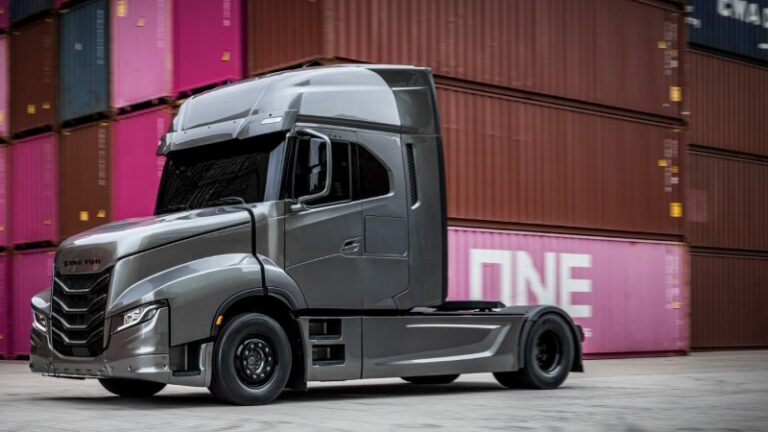
Twenty years after the first vehicle left the workshop in Born, the bonneted road tractor built in the Netherlands on an Iveco platform is returning to production with an entirely new generation. Iveco Schouten presented the 2026 Strator in a world premiere at the Truckstar Festival, held on 25 and 26 July 2026 at the TT Circuit in Assen, now in its 44th edition. The vehicle replaces the first series, launched in 2006, and adopts the cab, driveline and electronics of the latest-generation Iveco S-Way.
The Strator belongs to the category of bonneted heavy-duty vehicles, known in the northern European market as “torpedo” trucks: a configuration with the engine positioned ahead of the cab, rare in Europe, where rules on weights and dimensions have for decades favoured the cab-over-engine layout. Iveco Schouten stresses that this is not a show vehicle or a prototype, but a production vehicle that can be ordered and delivered in several configurations. The model’s distinctive bonnet has been completely redesigned for the 2026 model year, in collaboration with Jacco Hoogendoorn, an engineer at Spyker Cars, and the Belgian studio Arens Vehicle Design in Amel. The aim was to preserve the line of the original model while aligning it with the shapes, aerodynamics and technical content of the current S-Way, whose cab forms the basis of the conversion.
Under the bonnet is the xCursor 13 diesel engine, developed by Fpt Industrial, in three power ratings of 338, 368 and 427 kW, equivalent to 460, 500 and 580 hp. The six-cylinder engine has no exhaust gas recirculation, or EGR, and features 2,500-bar common rail injection and a variable-geometry turbocharger. Maximum torque ranges from 2,500 Nm in the 460 hp version to 2,800 Nm in the 580 hp variant. The transmission is the latest-generation 12-speed ZF TraXon automated gearbox. The drivetrain range includes 4x2, 6x2 with an additional front steering and lifting axle or with a twin-wheel trailing axle, and 6x4. The electric driveline available on the standard S-Way is not currently planned for the Strator. Each vehicle is assembled in Born to customer specification, with a supply programme that the manufacturer describes as suitable for both national and international transport.
The history of bonneted vehicles within the Turin-based group dates back to the 1950s. Magirus, which came under Iveco’s control in 1975, produced the Rundhauber between 1950 and 1970, followed by the Eckhauber until the early 1980s. With the acquisition of International Trucks Australia in 1992, the 7800 Roadtrain and later the PowerStar returned to the line-up. The Strator is directly derived from the latter: in 2006, Charles Feijts Bedrijfswagens combined the driveline of the then newly launched Stralis with the cab of the Australian model.
The corporate structure has changed in the meantime. In October 2025, Iveco Schouten, a family-owned dealership based in Giessen, acquired the shares of Charles Feijts Groep from managing director and majority shareholder Georges Simons, bringing the number of its locations in the Netherlands to 19. Simons remained operationally responsible for the Born and Venlo branches and has taken a stake in the acquiring group. The manufacturer points out that the team that built the first Strator has remained involved in the development and production of the new model. “Twenty years ago we built the first Strator out of pure passion,” Simons recalled, “and today we can present a completely new generation that uses the latest Iveco technology”. The available configurations and equipment options can be viewed through the online configurator launched by the manufacturer at strator.nl.
P.R.