







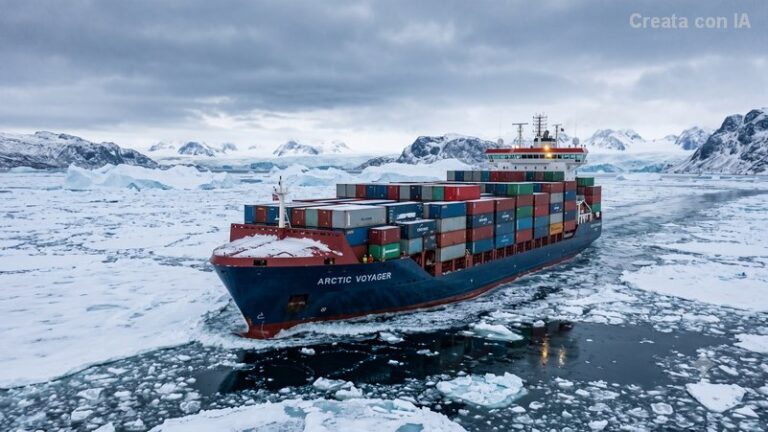
The Arctic shipping season is getting under way again, and Chinese operators are among the first to take advantage of it, having already sent cargo vessels from Asia to Europe along this route in recent years. The first report of a liner service came in July 2026 from Sealegend Shipping, a Singapore-based shipping company linked to Safetrans Line and Haijie Shipping, which announced the launch of the China-Europe Arctic Express along the Arctic route skirting Siberia through the Northeast Passage. The 2026 programme includes eight scheduled departures between 12 August and 27 October, using a fleet of seven small and medium-sized container ships. This marks the shift of Chinese Arctic shipping from one-off and experimental voyages to a structured commercial operation.
The vessels deployed have capacities ranging from 1,528 to 4,890 TEU. The rotations will be opened by the 1,740 TEU Dubai Tower, followed by the Riyadh Mukaab, at 2,872 TEU, the Athens Odeon, at 1,829 TEU, and the 4,890 TEU Istanbul Bridge. The latter is the same vessel that in October 2025 completed the pioneering Ningbo-Felixstowe voyage in around 20 days of sailing, rising to 26 days including port calls, setting the precedent that persuaded the company to scale the operation into a regular service. The fleet is completed by three sister ships in the Tiger series, Tiger Maanshan, Tiger Bintulu and Tiger Lianyungang, each with a capacity of 1,528 TEU.
Cargo will be consolidated at the port of Ningbo-Zhoushan through feeder services from Dalian, Qingdao, Shanghai, Taicang, Fuzhou and Nansha, before following the Northeast Passage along Russia’s Arctic coast and crossing the Bering Strait. On the European side, the scheduled ports of call are Felixstowe, Rotterdam, Wilhelmshaven and Gdynia, while some Chinese sources also mention Gdansk and Hamburg as destinations for onward links by truck or rail from the ports of discharge. The first departure is expected to take place from Ningbo-Zhoushan on 15 August, with arrival at Felixstowe on 5 September. The port of Tianjin, through its Customs authority, has confirmed that the 2026 Arctic navigation window opened on 22 June, several weeks ahead of the usual July opening, because of early ice melt. The navigable season typically runs from June-July to October-November.
The service is being marketed as a faster seasonal alternative both to the traditional route via the Suez Canal, which remains exposed to the risk of Houthi attacks, and to the China-Europe railway, particularly during the peak shipping period in the third quarter. Sealegend gives a transit time of 20-22 days to Hamburg, comparable with rail but with significantly greater cargo capacity. A comparison with other routes shows 18-20 days for the Arctic, compared with 25 days or more by rail, 35-40 days via Suez and 50 days or more for the voyage around the Cape of Good Hope, a route adopted by many carriers because of the Red Sea crisis. The company says the service will accept standard containers, refrigerated cargo, out-of-gauge loads and dangerous goods such as batteries, with a cargo mix designed for cross-border e-commerce and high-value goods such as electronics and photovoltaic components. Sealegend also estimates a reduction in CO2 emissions of around 50% compared with conventional routes, owing to the shorter distance travelled.
This remains a niche segment, as most current traffic along the Arctic route still consists of Russian energy and raw materials bound for Asia, while container volumes remain marginal. Transit along this route stood at around 3 million tonnes in both 2024 and 2025, compared with about 1.57 billion tonnes handled by the Suez Canal in 2024 alone.
In a broader context, Li Xiaobin, chief operating officer of the Chinese company Haijie Shipping, confirmed to 21st Century Business Herald the company’s plans for 2026 to strengthen its fleet with ice-class vessels and to stabilise a weekly or fortnightly service during the summer window. On the Russian side, Rosatom, the state nuclear agency that manages the icebreaker fleet, is preparing the Arctic route for year-round navigation, while the authorities in the Arkhangelsk region have signed agreements with Chinese partners for sea-rail intermodal services called Arctic Express 1. Other Chinese operators are moving in parallel. NewNew Shipping has signed an agreement with the government of the Murmansk region to develop container shipping through that ice-free port, following a 2024 memorandum on a joint-venture ice-class fleet.
All of this forms part of the so-called Polar Silk Road, the Sino-Russian initiative to jointly develop the Arctic route as an alternative corridor within the wider framework of China’s Belt and Road Initiative. An official from China’s Ministry of Transport described the route as "the world’s first designed specifically for cross-border e-commerce and high value-added goods". The development of this route suits both countries: for Russia it brings investment and new markets, while for China it provides shorter routes less exposed to bottlenecks such as Suez and Hormuz. The security crisis in the Red Sea, which has pushed many major carriers to sail around Africa, has made any alternative capable of reducing exposure to these mandatory transit points more attractive.
The Arctic route nevertheless remains a "plan B", useful for diversifying logistics options rather than replacing established routes. There is also a geopolitical dimension, as regular Arctic sailings allow China to gather navigational and environmental data and to consolidate ties with Russian Arctic port authorities, with possible dual-use civil-military implications in the event of a future expansion of China’s strategic interests in the region.
Not everyone, however, shares China’s optimism about the route. MSC has said it does not intend to use the NSR because it does not consider it safe, while some independent analysts describe Sealegend’s operation as a test bed rather than a turning point, given that the fleet remains small compared with the standards of major global carriers. Experts consulted by Anadolu Agency go further, estimating that the route is at least a decade away from commercially significant development, because of ice variability, reliance on icebreaker convoys and limited search and rescue capacity. These factors make the route poorly suited to the relatively fast deliveries, up to and including just-in-time shipments, required by container transport.
M.L.