







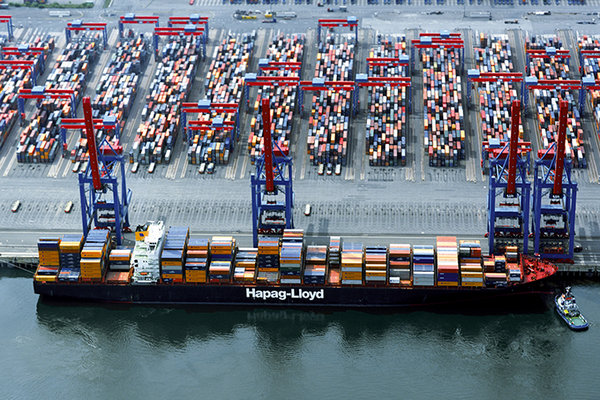
Mediterranean Shipping Company, through its founder and chairman Gianluigi Aponte, is reportedly in contact with Hapag-Lloyd’s main shareholders to assess the purchase of a stake in the German company. The news, reported by Manager Magazin and picked up by Reuters on 17 June 2026, indicates that Aponte’s attempts have so far been rejected by the group of shareholders that controls an absolute majority of the company’s capital and voting rights. Neither MSC nor Hapag-Lloyd has officially commented on the reports.
Neither the size of the stake MSC may be considering acquiring nor the potential value of the transaction has been disclosed. According to the sources cited, the idea remains at a preliminary sounding-out stage, with no binding offer having been formally submitted. It also remains unclear whether Aponte’s objective is a minority stake without governance rights, the acquisition of a block with veto power, or a first step towards broader involvement in the company.
Hapag-Lloyd’s reference shareholders are bound by an agreement that concentrates in their hands an absolute majority of the capital and voting rights, reducing the free float historically to below 10 per cent and, in 2019, to less than 9 per cent after the main shareholders increased their stakes. More recent analyses indicate that the free float is now in the order of just a few percentage points, at about 3-4 per cent. In 2024, CSAV and Kühne Maritime extended their long-term agreement ahead of schedule until 31 December 2030, effectively strengthening stable control over the company. HGV, the city of Hamburg, Qatar Investment Authority and Saudi Arabia’s Public Investment Fund nevertheless remain reference shareholders with significant stakes. These arrangements make it more difficult for an external player such as MSC to quickly secure a position of influence.
MSC’s interest should be read in the context of the reorganisation of the major shipping alliances. The group led by Aponte is already the world’s largest container carrier by capacity and, since 2025, has chosen to operate outside the main alliances after the end of the 2M partnership with Maersk, stating its intention to proceed independently on intercontinental routes. Hapag-Lloyd, by contrast, has moved towards close cooperation with Maersk in the new Gemini consortium, under a structure that assigns 60 per cent of capacity to Maersk and 40 per cent to Hapag-Lloyd, effectively scaling back The Alliance and reorganising key routes, particularly on the Far East-Europe trade. In this context, a possible stake in Hapag-Lloyd would give MSC strategic leverage over a direct competitor now tied to Maersk, as well as indirect access to networks and markets where the German carrier is strong, including Germany, northern Europe and Latin American trades.
The two companies have already competed for the same targets. According to Israeli sources, MSC submitted an offer for ZIM, placing it in direct competition with Hapag-Lloyd, which was also identified as a potential buyer of the Israeli carrier. Hapag-Lloyd, for its part, has strengthened its position over the years through deals such as the merger with UASC, which increased the weight of Arab shareholders in its ownership structure and reinforced the group’s presence on routes between the Middle East and Europe. The picture that emerges is one of two companies often pursuing the same objectives, and an MSC entry into Hapag-Lloyd’s capital could turn what has so far been a competitive relationship into a more ambiguous one, with possible tensions in relation to existing operational alliances.
The resistance shown so far by Hapag-Lloyd’s reference shareholders is consistent with the logic of the long-term agreement, which aims to preserve Chilean and German control of the company and the stability recently reaffirmed through the extension to 2030. An entry by MSC, led by a direct competitor that is already dominant in capacity terms, could be seen as a threat to Hapag-Lloyd’s strategic independence and to the partnership launched with Maersk through Gemini. The presence of public investors, including the city of Hamburg and Gulf sovereign wealth funds, also makes it likely that any concrete transaction would face detailed regulatory and geopolitical scrutiny, in a context already strained by routes through the Red Sea and the Strait of Hormuz.
M.L.