





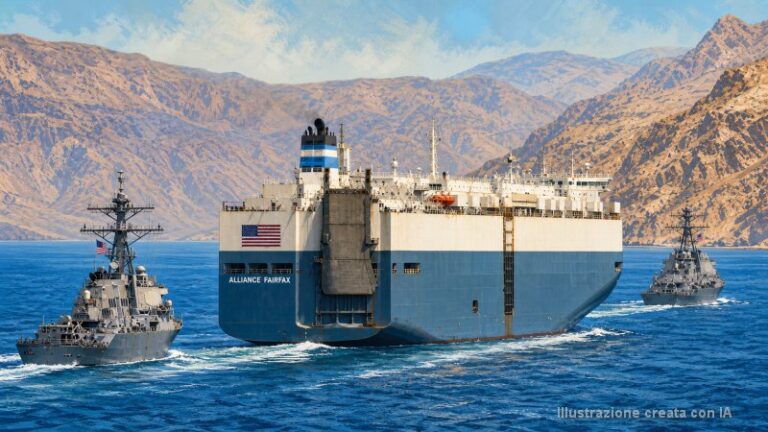
The ro-ro vessel Alliance Fairfax, owned by Farrell Lines, a Maersk subsidiary, and flying the US flag, crossed the Strait of Hormuz on 4 May 2026 under US military escort as part of Operation Project Freedom. Maersk announced the transit, saying it was completed without incident and that all crew members were safe. The news was released on 5 May, while the area remained at the centre of the military confrontation between the United States and Iran and of an information standoff between Western and Iranian sources. According to Blueconomy, the vessel had been held in the Persian Gulf for 66 days, since 28 February 2026, the day the war between the United States and Iran began. The passage of the Alliance Fairfax should not be seen as a normal resumption of transits, but rather as an authorised and protected departure made possible by a specific military framework.
Operation Project Freedom was announced by President Donald Trump on the evening of 3 May with the stated aim of "restoring freedom of navigation in the Strait of Hormuz" and escorting out of the Gulf vessels from countries described as "neutral and innocent". The deployment outlined by Centcom (US Central Command) includes guided-missile destroyers, 100 aircraft based on land and on aircraft carriers, multidomain uncrewed platforms and 15,000 military personnel. These figures point to a high-intensity maritime control operation, not a simple naval escort. Admiral Brad Cooper, commander of Centcom, said two US-flagged cargo ships had successfully crossed the Strait of Hormuz. The US command also said its forces had intercepted and destroyed Iranian cruise missiles and drones aimed at military and merchant vessels, while Apache attack helicopters were said to have sunk six Iranian military speedboats considered a threat to the units in transit. The operating theatre therefore remains marked by simultaneous actions at sea and in the air.
Iran offers a completely opposite account of events. Tasnim news agency denied the transit had taken place, saying that "no reliable maritime tracking site" had published information consistent with the crossing and claiming that Maersk had not issued official statements confirming the passage. The agency also said that, in the previous 24 hours, no vessel had transited the Strait as part of the US operation, citing alleged international maritime tracking data. In this war zone, however, AIS signals can be switched off, delayed, filtered or made invisible for security reasons. The absence of a public track therefore does not automatically mean the transit did not take place, but it limits the possibility of immediate independent verification. For operators, this uncertainty weighs almost as heavily as the physical risk, because it makes it more difficult to assess timings, insurance policies, freight rates and contractual clauses linked to force majeure.
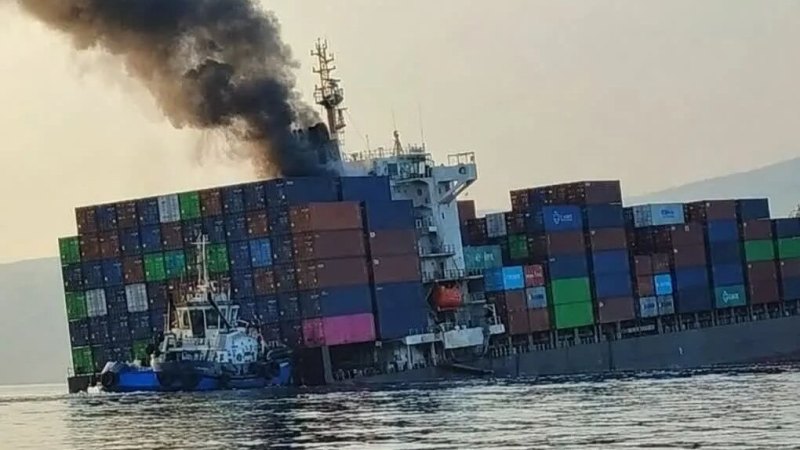
The fact that the area remains high-risk, despite the large US presence, is shown by the clashes that took place in the Strait of Hormuz on 4 May, the day of the transit reported by Maersk. Here too, reports from the two sides are uncertain and sometimes conflicting. Iran is said to have launched at least 15 missiles against the United Arab Emirates, hitting a port and a fuel depot in Fujairah, with three people injured according to Emirati sources. In the same hours, a South Korean cargo ship was reportedly hit by an explosion in the waters of the Strait. Tasnim also reported Iranian accusations that US forces had attacked two small boats carrying goods from Oman to Iran, killing five civilian passengers. Centcom rejected that version of events and said it had struck only military speedboats belonging to the Islamic Revolutionary Guard Corps.
The Iranian government accompanied the denial with political statements. Foreign minister Abbas Araghchi wrote on X that "Project Freedom is a dead project" and that "there is no military solution to a political crisis". The speaker of the Iranian parliament, Mohammad Bagher Ghalibaf, added that the country "has not even begun" its confrontation with the United States. These statements are also directed at shipping operators, because they reinforce Iran’s message that no route can be considered safe without a political agreement or coordination with Tehran. On 4 May, the IRGC (Islamic Revolutionary Guard Corps) also announced the creation of a new maritime control zone in the Strait of Hormuz. The area would be bounded to the south by the line between Mount Mobarak, in Iran, and the area south of Fujairah, in the United Arab Emirates, and to the west by the line between the tip of Qeshm Island and Umm Al Quwain. Tehran warned merchant ships and tankers to avoid transits without coordinating with its armed forces. For shipowners and freight forwarders, this means the crossing could depend on opposing and incompatible authorisations.
Uncertainty therefore continues to dominate the Gulf scenario and is hardly an incentive to force a passage through the Strait. Military escort can enable individual crossings, but it cannot by itself rebuild stable scheduling. An open route allows predictable frequencies, rates and timings, while an escorted route requires operating windows, military coordination and acceptance of a high residual risk. There is a precedent: Operation Earnest Will, conducted by the United States between 1987 and 1988 during the Iran-Iraq war to escort tankers in the Hormuz area. The parallel is useful because it shows how military protection of merchant traffic can reduce some risks while increasing others, especially when confrontation shifts to mines, small craft and attacks on coastal infrastructure. In 1988, the frigate USS Samuel B. Roberts struck an Iranian mine, an episode that led to Operation Praying Mantis and a naval escalation against Iranian assets.
If Operation Project Freedom continues, though how long it can continue, given the high costs and the concentration of forces in a single theatre, remains to be seen, shipping companies will have to decide whether to wait, accept a military escort, change their schedules or keep vessels and cargoes in safe positions. Shippers will have to assess the impact on contracts, inventories and continuity of supply, while insurers must distinguish between war risk, political risk and blockade risk, with consequences for premiums and coverage exclusions. But decisions require independent information, which is currently scarce in that context. Otherwise, every passage becomes a gamble.
M.L.