









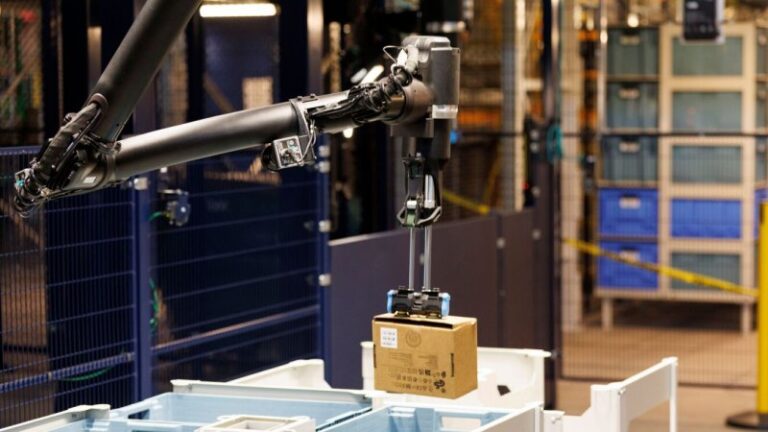
Amazon has announced the discontinuation of the Blue Jay project, a multi-arm robotic system designed for same-day delivery warehouses in the United States. The programme was halted in January 2026, less than six months after its public launch in October. The decision concerns the robot’s hardware, while the technology developed will be integrated into other robotics initiatives within the Amazon Robotics division. Blue Jay had been conceived to operate in same-day centres, facilities smaller than traditional fulfilment centres and focused on orders requiring delivery within the day. The system featured multiple gripping arms and was designed to sort, move and consolidate parcels along a single compact line, combining tasks that would normally require separate picking, storage and sorting stations. The pilot trial was conducted at a site in South Carolina.
According to an Amazon spokesperson, Terrence Clark, Blue Jay was a prototype rather than a product industrialised on a large scale. The company stated that, despite discontinuing the hardware programme, it will reuse the underlying technology, particularly the manipulation software, recognition systems and control algorithms, in other projects already under way. The engineers and technicians involved have been reassigned to new internal initiatives, with no indication of job cuts directly linked to this project.
The development of Blue Jay took around a year, a relatively short timeframe compared with traditional warehouse robotics cycles, supported by the use of advanced simulation and artificial intelligence tools. However, according to US media reports, the system encountered issues related to overall costs and the complexity of production and deployment. In particular, the multi-arm architecture and associated sensor systems are understood to have made large-scale industrialisation and integration into existing warehouse layouts more expensive.
The decision comes against the backdrop of a broader evolution of Amazon’s logistics network. The group is gradually moving away from its previous same-day warehouse architecture, known as Local Vending Machine, in favour of a new modular model called Orbital. The latter aims to deliver greater flexibility and easier scalability, including in smaller spaces such as facilities integrated into Whole Foods stores. In parallel, Amazon is developing solutions such as Flex Cell, which could incorporate elements of the technology developed through Blue Jay.
Blue Jay had been presented as a support tool for warehouse workers, described as “an extra pair of hands” for repetitive and physically demanding tasks. The stated aim was to improve safety and ergonomics, rather than fully replace staff. Amazon already operates hundreds of thousands of robots across its global network, following its acquisition of Kiva Systems, and in recent years has introduced systems such as Vulcan, a dual-arm robot for shelf handling. In this context, the discontinuation of Blue Jay is seen as a tactical adjustment within a long-term trajectory focused on human-machine integration.
P.R.