




- On 6 February 2026, dockworkers at at least 21 ports across the Mediterranean and Northern Europe will down tools under the slogan “Dockworkers do not work for war”. The map of participation reaches at least 21 ports across the Mediterranean and Northern Europe.
- The mobilisation is coordinated by a network bringing together Usb for Italy, Enedep/Pame for Greece, Lab for the Basque Country and Spain, Liman-Is for Turkey and Odt for Morocco.
- The demands combine a halt to arms traffic, the creation of humanitarian corridors and the demilitarisation of infrastructure, alongside claims on pay, working hours, safety and recognition of dock work as arduous. According to union sources, EU rearmament amounts to €850 billion and is fuelling inflation and pressure on labour.
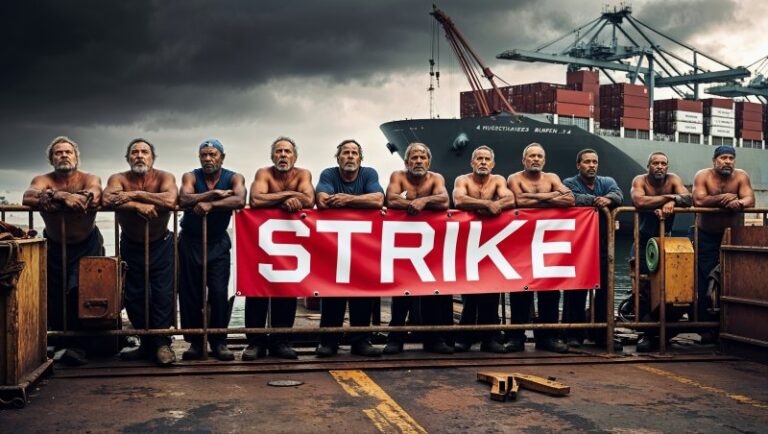
Thursday 6 February 2026 is the confirmed date for the international strike by dockworkers, a coordinated mobilisation aiming to stop for 24 hours a significant share of loading and unloading operations in the Mediterranean basin, with extensions towards the North Sea. The promoters are operating on an international scale. The coordination consists of five organisations: Usb for Italy, with a central role played by the Calp of Genoa; Enedep/Pame for Greece; Lab for the Basque Country and Spain; Liman-Is for Turkey; and Odt for Morocco. The shared platform is expressed in the slogan “Dockworkers do not work for war” and links the refusal to handle military cargoes and opposition to the militarisation of ports with more strictly trade union demands, covering pay, working hours, safety and protections.
Abroad, the map of participation reaches at least 21 ports across the Mediterranean and Northern Europe. In Italy, participation could involve the ports of Genoa, Trieste, Livorno, Ancona, Civitavecchia, Ravenna, Salerno, Bari, Crotone and Palermo; in Greece, Piraeus and Elefsina are involved; in Spain, Bilbao; in Morocco, Tangier; in Turkey, Antalya and Mersin; and in Germany, Hamburg and Bremen, with confirmation of participation reiterated after the international webinar on 27 January. The union coordination also refers to solidarity initiatives in various port contexts in the United States, not necessarily in the form of a formal strike.
The motivations operate on several levels. The first is geopolitical: the promoting organisations are calling for an end to hostilities, the creation of stable humanitarian corridors and a halt to arms shipments to war zones, with particular attention to the Gaza crisis and to commercial and logistical relations with Israel. The second level concerns infrastructure: the demand is for the demilitarisation of ports and logistics hubs, presented as civilian infrastructure that should not be integrated into military supply chains. The third is trade union and industrial: the promoters link the “war economy” to inflation, the erosion of real wages, intensification of workloads and increased risks, alongside calls to recognise dock work as arduous and to strengthen health and safety measures. This framework also includes criticism of privatisation and “accelerated” automation, which, in the unions’ view, would reduce employment and narrow the scope for union activity.
The path leading to 6 February 2026 began in February 2025 in Athens, when Usb and Enedep/Pame launched a coordination among dockworker organisations from several countries during a day of mobilisation linked to the commemoration of the Tempe rail disaster. The next step was the international conference in Genoa on 26–27 September 2025, which produced the joint declaration “Dockworkers do not work for war” and launched the idea of a common day of strike action. Autumn 2025 was then marked by blockades and initiatives against specific routes and vessels, with episodes in Genoa, Livorno, Taranto and Ravenna.
The run-up to the strike has been punctuated by public events. On 23 January 2026, a national Usb Ports assembly was held in Genoa, with delegations from several ports, formalising the stoppage and participation arrangements. On 27 January 2026, an international webinar brought together the five promoting organisations and hosted contributions from figures in trade unionism and activism.