






After a 2025 characterised by strong instability, with tariffs once again at the centre of trade policies and corporate strategies, 2026 opens under the sign of structural uncertainty. According to Customs Support Group – one of Europe’s leading independent providers of customs management and trade compliance solutions – geopolitical tensions, trade disputes, new regulations and macroeconomic fragilities will continue to have a direct impact on international goods flows and on the very role of the customs function.
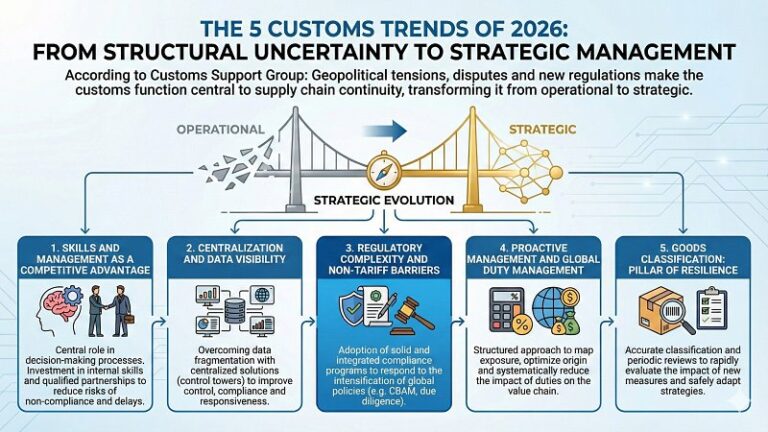
The group’s analysis, based on projects developed with clients, market developments and the evolution of the regulatory framework, identifies five trends for 2026 that are expected to have a significant impact on corporate organisation over the coming year. In this context, customs management is set to move definitively beyond an operational perimeter to take on a strategic role in supporting supply chain continuity.
According to John Wegman, chief executive officer of Customs Support Group, the rise in trade barriers and persistent geopolitical volatility will make 2026 a pivotal year. The ability to rely on centralised data, structured duty management and deep customs expertise will become essential to address new regulatory requirements, operational disruptions and compliance risks, while ensuring reliable cross-border flows.
The first trend concerns the transformation of customs management and people’s skills into a competitive advantage. Companies cannot prevent geopolitical shocks or sudden regulatory changes, but they can strengthen their organisational foundations. In this scenario, the customs function evolves from an administrative back-office activity into a central role in decision-making processes. Choices related to sourcing, supplier changes, logistics flow diversions, import cost models and risk management strategies increasingly depend on specialist assessments of origin, customs value, classification, licences, trade agreements and regulatory requirements.
This evolution is driving growing demand for qualified customs professionals, expected to strengthen further in 2026. According to Customs Support Group, companies will need to invest structurally in developing internal capabilities, complementing them, where necessary, with stable partnerships with reliable customs brokers or with full outsourcing of operations. The aim is to reduce exposure to compliance risks, operational delays and penalties in an increasingly complex regulatory environment.
The second trend relates to customs centralisation and data visibility. Supply chain resilience is increasingly linked to the availability of advanced digital tools, such as end-to-end visibility, predictive analytics and real-time tracking of flows. However, customs data still represents a weak point for many organisations, as it is fragmented across different brokers, IT systems and formats.
The response identified by Customs Support Group is the centralisation of customs management, both operationally and through consolidated brokerage models. Working with a single provider able to ensure multinational coverage and advanced digital tools, or adopting customs control tower solutions, allows data to be collected in a consistent way, enriched and integrated into corporate systems for master data management, analysis and planning. This visibility becomes a key factor in improving cost control, compliance and responsiveness to unexpected events.
The third trend concerns rising regulatory complexity and the growth of non-tariff barriers. While 2025 was dominated by the issue of tariffs, 2026 will see a further intensification of compliance policies, already increasing for several years. No geographical area is exempt from this phenomenon. China is strengthening export controls on critical minerals and high-technology products, the European Union is introducing new regulations linked to sustainable trade, such as the Carbon Border Adjustment Mechanism and due diligence obligations, while the United States is tightening domestic content rules and expanding controls on advanced technologies.
For companies, this scenario implies the need to adopt robust, risk-based trade compliance programmes capable of responding to increasingly complex regulatory requirements. According to Customs Support Group, these programmes will need to be integrated into existing business processes, avoiding becoming an additional operational burden and instead contributing to the continuity and reliability of cross-border activities.
The fourth trend focuses on proactive duty management and the creation of a dedicated operational playbook. During 2025, many companies operated in reactive mode, rapidly adapting to new tariffs and short-term shocks. 2026 will require a shift towards a more structured approach, based on mapping global duty exposure, using trade facilitation programmes, optimising rules of origin and accessing refund mechanisms where available.
According to the group’s analysis, this is no longer just about managing duties, but about systematically reducing their impact across the entire organisation. For many companies, the coming year will represent the moment to develop a Global Duty Management Program, an environment capable of ensuring full visibility of duties paid and identifying cost-reduction opportunities along the entire value chain.
The fifth trend focuses on goods classification, identified as one of the pillars of supply chain resilience. Correct classification determines the application of duties, restrictions and regulatory requirements, directly affecting the total cost of importing products. In a context marked by geopolitical volatility, sanctions, trade wars and frequent tariff changes, having accurate classification data enables companies to quickly assess the impact of new measures and to adapt their sourcing, pricing and logistics strategies with greater confidence.
Customs Support Group highlights how periodic classification reviews, combined with strong integration with master data management systems and analytical tools, are essential to anticipate risks and maintain operational continuity in an ever-evolving regulatory landscape.