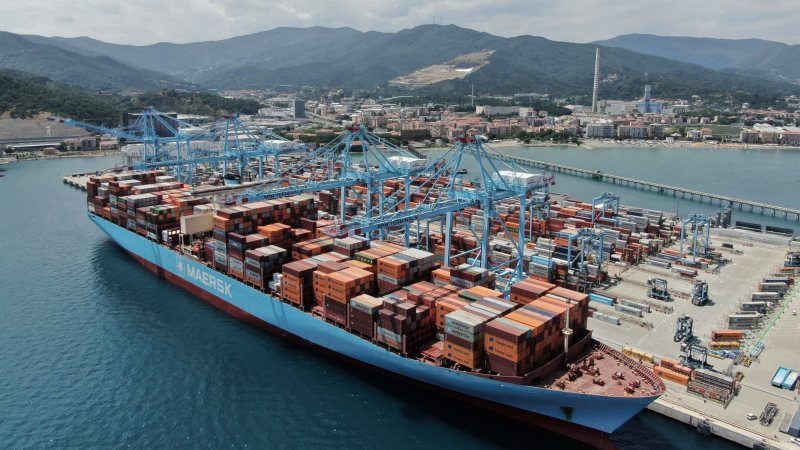










On the evening of 21 November 2025 the 8,212-TEU container ship One Henry Hudson was hit by a fire caused by an electrical fault in the lower decks while moored at the Yusen terminal in the Port of Los Angeles. According to the reconstruction provided by the Los Angeles Fire Department, the incident escalated rapidly, with an explosion involving between 100 and 117 containers. This required the evacuation of the ship’s twenty-three crew members and the removal of the vessel from the port area within a few hours. Between 180 and 200 firefighters, seven fireboats and HazMat teams from several agencies were deployed in what became one of the port’s most complex emergency operations in recent years.
The fire broke out at 18:38 on 21 November following the report of an electrical failure below deck. Within an hour the flames had already spread across multiple levels of the holds in inaccessible areas, limiting the ability to attack the fire directly. At 20:00 an explosion cut off the power supply and complicated the emergency response because of the presence of dangerous goods, including lithium-ion batteries. Confirmation of the full evacuation of the crew came shortly before 21:00, after which the unified command ordered personnel to withdraw from the vessel and deploy high-capacity water streams from shore and from the water. At midnight a precautionary shelter-in-place order was issued for residents of San Pedro and Wilmington, although joint air-quality assessments by Lafd HazMat, the EPA and Los Angeles County indicated readings within permissible limits.
At 03:00 on 22 November it became possible to begin unberthing the ship, which was towed beyond the Vincent Thomas Bridge and anchored at 04:43 about one mile off the coast near Angel’s Gate lighthouse. The shelter-in-place order was lifted at 06:30 and port activity resumed later in the morning. By early afternoon the fire had been contained within a single hold while cooling operations continued. On 23 November Lafd firefighting units were replaced by private assets as the damaged cargo began to be progressively removed.
According to the Port of Los Angeles, the flames damaged around 117 of the ship’s 8,000 containers, carrying a mixed range of goods including automotive parts, machinery, food products, footwear, protective equipment, consumer goods and dangerous cargo, among them lithium-ion batteries. The structural integrity of the 336-metre vessel, built in 2008, was assessed by the US Coast Guard with no immediate signs of listing. The ship operates on Ocean Network Express’s Fs1 rotation between Europe, Asia and the US West Coast and had arrived in Los Angeles on 19 November after calls in Japan.
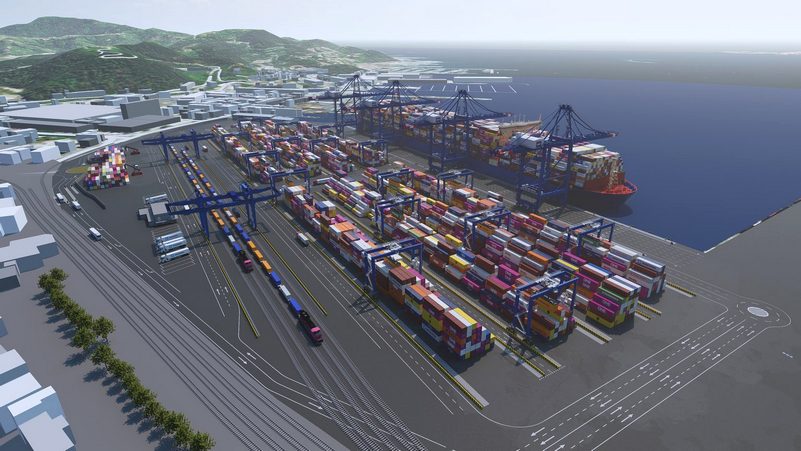
The fire caused limited disruption for the Port of Los Angeles: four terminals suspended operations for several hours and various infrastructures – including the Vincent Thomas Bridge and State Route 47 – were temporarily closed because of smoke and reduced visibility. The safety zone established by the US Coast Guard restricted maritime traffic in the harbour basin. However, coordinated management made it possible to resume activities quickly at a time when the port is on track to exceed 10 million TEU in 2025, a level reached only twice in its history.
The investigations, led by the unified command together with the US Coast Guard, are examining the exact origin of the electrical fault, the sequence of the fire’s spread and the possible presence of incorrectly declared dangerous goods. Recovery operations will continue with the full removal of damaged cargo and structural inspections of the ship, which will determine whether it is repaired or decommissioned. The vessel therefore remains out of service indefinitely.
The incident is considered significant not only because of the number of containers involved but also for its implications for maritime safety and the handling of shipments containing lithium-ion batteries. The Cargo Incident Notification System reports that about 25% of major incidents are linked to dangerous goods that are incompletely or incorrectly declared. Cins data also show a steady rise in container ship fires, from 31 cases per year in 2020 and 2021 to 65 in 2022. Studies such as the Emsa CargoSafe report have identified lithium-ion batteries as one of the most critical risk sources: hotter fires, difficult to extinguish and prone to reignition. Recent episodes such as the Felicity Ace in 2022 and the Fremantle Highway in 2023 demonstrated that a single container with damaged batteries can compromise the entire ship.
The One Henry Hudson case renews attention on prevention, with guidance that shipowners and logistics operators are already prioritising. The combination of an electrical fault and dangerous goods below deck highlights the need for advanced thermal detection systems on all decks, greater cooling capacity, targeted placement of battery-laden containers on open decks and dedicated crew training. Classification societies are introducing voluntary notations for ships equipped with firefighting systems suitable for battery-related fires, while the International Maritime Organization is evaluating specific regulatory updates.