






Is it more appropriate to invest in railway infrastructure or in rolling stock? This question, which may seem somewhat nonsensical at first—since one does not necessarily exclude the other—actually arises quite naturally and holds its own logic when the debate centres on the different rail gauge systems adopted across Europe's main networks. The exceptions to the European standard gauge of 1435 mm are found in the Iberian Peninsula and the Russian-speaking world, both of which use broader gauges, albeit with different measurements.
What’s curious is that recent developments on this front appear to be moving along parallel tracks, if not in outright contradiction. Here’s why. In March 2025, Adif, the Spanish railway infrastructure manager, launched a pilot project to test a gauge-changing system for freight trains at the Irun station, located at the French border and one of the main crossing points between the two countries affected by the gauge difference. With a relatively modest investment of 2.3 million euros, two modular gauge-changing platforms were installed, suitable for freight wagons fitted with wheels of 920 and 760 mm diameter.
Without undermining the merit of this initiative, the pilot project seems to echo the long-running and still inconclusive trials surrounding the Dac, the digital automatic coupler. Numerous prototypes have been tested across Europe and often seem on the verge of being adopted, only for everything to be postponed yet again. Already in June 2019, the Aesf—Spain’s state railway safety agency—had authorised variable gauge freight wagons for regular commercial service. The variable-width axle system had been jointly developed and tested by three companies: Adif, Azvi and Tria.
The secret behind that project lay in the ability to adjust the axles, telescopically, so to speak, allowing them to automatically adapt as the train passed over specially designed gauge-changing platforms, with the only requirement being that they travel at low speed during the transition. Approval had been granted for container wagons and vehicle transporters—the types most frequently used in these international routes—with maximum speeds of up to 120 km/h and axle loads of up to 22.5 tonnes, depending on the wagon type. Apparently, though, this solution did not progress any further.
But do these trials make sense if they remain little more than prototypes? The question is reasonable, especially given that, almost in contrast to these limited experiments, Spain is now decisively accelerating the conversion of track gauge on its key rail corridors—those forming part of the Ten-T European freight network. In March 2025, the Ministry of Transport awarded three contracts marking another step towards completing the conversion to standard gauge along the entire Mediterranean corridor, from the French border down to the southern Spanish port of Algeciras.
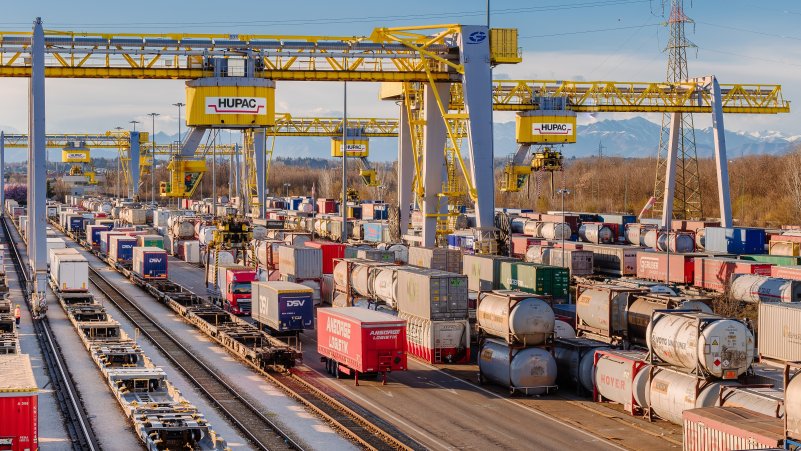
Sleepers are being replaced with ones designed to accommodate a third rail, allowing for dual gauge operations: both the European standard and the broader Spanish gauge of 1668 mm. The electrification system is also being upgraded, shifting from 3 kV direct current to 25 kV alternating current. Almost simultaneously with the awarding of these contracts, rail traffic between Barcelona and Tarragona returned to full capacity following the reopening of the Roda de Berà tunnel, now equipped with dual gauge. This is a development with far-reaching implications, well beyond the local level, to the extent that Hupac immediately announced an intermodal service to Antwerp, Belgium, seizing the new opportunities created for freight traffic on standard European gauge.
Piermario Curti Sacchi