






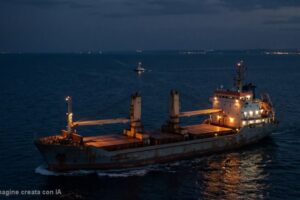


On 26 March 2024, the Singapore-flagged container ship Dali, nearly 300 metres in length, suddenly lost power and propulsion while crossing the Patapsco River in Baltimore on its way out of the port. At 1:29 am, the crew lost control of the vessel, which crashed into pier 17 of the Francis Scott Key Bridge. The impact caused a portion of the bridge to collapse, resulting in heavy consequences: six road workers lost their lives and a seventh was seriously injured, while a crew member on the ship sustained minor injuries. Sections of the structure fell onto the Dali’s deck and into the water below, causing extensive damage to both the bridge and the vessel.
A year after the event, the National Transportation Safety Board released a detailed report into the incident, carried out according to Method II as suggested by the American Association of State Highway and Transportation Officials (AASHTO). The report revealed that the bridge had an annual collapse risk nearly thirty times higher than the maximum acceptable threshold for critical or essential infrastructure. Had the bridge operator conducted such an assessment beforehand, the high likelihood of a catastrophic collision with large vessels would have become evident, and preventive measures could have been adopted, such as reinforcing the piers or redirecting maritime traffic in emergency scenarios.
The Francis Scott Key Bridge, opened in 1977, had not been designed according to AASHTO’s post-1991 guidelines, which include vulnerability analyses to prevent collision risks from large ships. At the time of its construction, maritime traffic was lighter and vessels were significantly smaller. In 1980, the bridge was involved in a relatively minor collision with a Japanese ship, much smaller than the Dali.
With the expansion of the Panama Canal in 2016 and the subsequent increase in the passage of maritime giants, the layout of the navigable channel and the positioning of the bridge’s central piers have become heightened vulnerabilities. Existing structural protections, such as concrete fenders, proved insufficient to deflect or absorb the impact of a container ship.
NTSB investigations also revealed that the risk to similar structures extends beyond the Francis Scott Key Bridge. An analysis conducted in collaboration with the Federal Highway Administration (FHWA) and the US Army Corps of Engineers identified dozens of bridges across the United States spanning waterways regularly navigated by ocean-going vessels and built before 1996, when compliance with AASHTO guidelines was not yet mandatory.
In particular, 68 of these bridges were found to lack a comprehensive vulnerability assessment. Their operators may now be required to recalculate collapse probabilities and implement corrective plans where necessary. Many of these structures could carry unknown and potentially very high risk levels, especially due to the combination of increased maritime traffic, the growing size of ships, and the absence of robust pier protection systems.
Faced with such an alarming scenario, the NTSB has issued urgent recommendations to the FHWA, the Coast Guard, and the US Army Corps of Engineers, urging them to form an interdisciplinary task force to guide bridge owners and operators in assessing vulnerabilities and drafting risk mitigation plans. Local authorities have been asked to promptly calculate hazard levels and, if these exceed recommended standards, to take steps to reduce the likelihood of collisions severe enough to cause further collapses or loss of life.
In light of the events in Baltimore, authorities have stressed the need for a dynamic approach to safety, one that includes ongoing assessments of maritime traffic trends, structural resilience of bridges, and the effectiveness of protective systems. It is a call to rethink how critical infrastructure is monitored and maintained, which is still too often evaluated solely in terms of traditional wear and tear, without considering the risks posed by new-generation vessels. The shared goal, the NTSB explained, is to prevent future catastrophic events like the collapse of the Francis Scott Key Bridge and to avoid further loss of life in incidents that, with proper foresight, could be averted.