





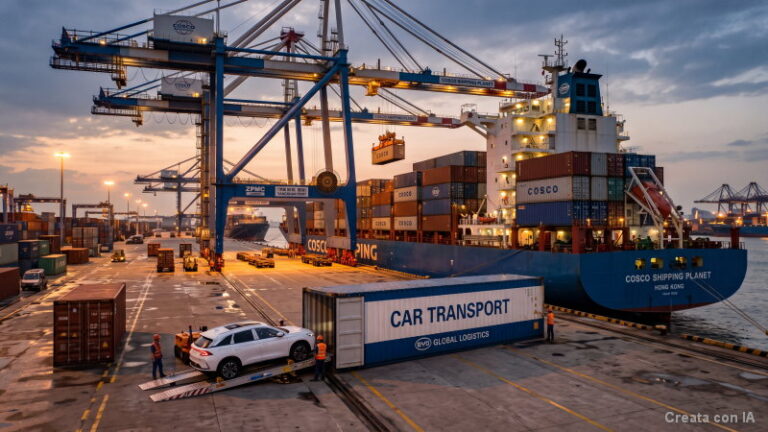
The boom in Chinese vehicle exports has caused congestion at ports, because there is not enough cargo space on car carriers to meet demand for ocean transport. As a result, alternative ways of moving vehicles are being used, even though they are less efficient than Pure Car and Truck Carrier vessels. According to research by Veson Nautical, around one million cars are already being exported from China on container ships, while projections towards the two million units cited in an article by Splash247 appear plausible in light of the growth in Chinese exports in 2026. But that is not all: alongside standard containers, improvised solutions have emerged, including "flat racks", metal frames loaded on conventional cargo ships, and even the conversion of pulp bulk carriers into multipurpose vessels capable of carrying more than 1,000 cars per voyage, stacked up to eight levels high. Meanwhile, car carrier charter rates have reached record levels: a 7,000 ceu vessel was fixed at $90,000 a day, about €79,000, for Saic Anji Logistics.
The trend has intensified sharply over the year. In June 2026, China exported more than one million vehicles in a single month for the first time, with 1.037 million units, up 75.1% year on year, bringing the first-half total to more than five million units, 65.3% higher than in the same period of 2025, according to data from the China Association of Automobile Manufacturers, or Caam. The previous month, passenger car exports had already risen by 73% year on year to around 809,000 units, with new energy vehicles, or NEVs, exceeding half of total exports for the first time. Chinese exports are diversifying beyond Europe, taking in South-east Asia, the Middle East, Latin America, Africa and Australia. In Europe, meanwhile, calls by large Chinese car carriers operated directly by vehicle manufacturers have become normal, including the Byd Shenzhen, with capacity for 9,200 vehicles, and the Saic Anji Ansheng, a 9,500 ceu vessel that carried 7,000 Chinese cars to Europe in a single voyage.
Chinese shipyards are the main driver in meeting demand for cargo space. According to AxsMarine, around 219 of the 276 PCTCs scheduled globally between 2023 and 2028, almost 80% of the total, will be built in China, with Guangzhou Shipyard International among the key players. Global PCTC deliveries rose from just 12 ships in 2023 to 46 in 2024, then to a record 75 in 2025, while another 67 units are expected in 2026, equal to around 518,000 ceu. At the end of June 2026, Guangzhou Shipyard International delivered the third 10,800 ceu vessel in its series: 230 metres long, 40 metres wide, with 14 vehicle decks, making it the world’s largest class of car carrier. The record had been set just two months earlier with the Glovis Leader, delivered in April to South Korea’s Hmm.
As seen, Chinese carmakers themselves are building proprietary fleets. Byd has ordered six 7,700 ceu ships for $710 million, about €622 million, while Saic already has its own vessels, including the Anji Ansheng mentioned above. The main manufacturers involved in the expansion are Byd, Saic, Geely, Changan, Chery and Great Wall Motor. On the shipowning side, China’s Cosco and China Merchants are active, as is Lebanon’s Sallaum Lines, which in June 2026 received two new 7,400 ceu PCTCs, the Ocean Express and the Ocean Navigator, from the China Merchants Jinling yard. For alternative transport, China Daily reports that standard 40-foot container products designed for rail transport of cars on the China-Europe route are already in use, having departed from Chongqing in June 2026.
The causes of the imbalance are structural and go back to decisions made during the pandemic. Darron Wadey, an analyst at Dynamar, explains that, unlike container operators, car carrier operators had rationalised their fleets before Covid, reducing capacity in a targeted way. When the post-pandemic boom in Chinese electric vehicle exports took off, the available capacity proved insufficient. Shipyard slots for specialised vessels are also scarcer than those for container ships, widening the gap between demand growth and capacity growth compared with what happened in the container sector. To understand the scale of the phenomenon, China’s annual vehicle exports rose from 1.06 million units in 2021 to 7.098 million in 2025, almost quadrupling in four years.
M.L.