







- On 24 July 2026, the United States imposed new tariffs ranging from 10% to 12.5% on imports from more than 60 economies, with the stated aim of tackling forced labour in supply chains. The rates vary according to the commitments already made by individual trading partners with Washington.
- The measure replaces the 10% global tariffs ruled unlawful by the US Supreme Court, avoiding a gap between the two tariff regimes. It is based on Section 301 of the Trade Act of 1974 and follows an investigation launched by the US Administration in recent months into forced labour in global supply chains.
- The repercussions will be felt immediately, particularly on Asia-US and Asia-Europe routes, which are already exposed to more than €3.5 billion linked to US tariff measures.
On Friday 24 July 2026, the United States will apply new tariffs of between 10% and 12.5% on imports from more than 60 countries, including those of the European Union, treated as a single entity. The Trump Administration justifies the measure on the basis of an investigation into alleged failures by these countries to counter forced labour in their supply chains, to the detriment of American workers. The new rates came into force at midnight New York time and do not apply to goods already loaded on ships before that time.
Around ten countries, including Mexico, the United Kingdom, Canada and India, receive the lowest rate, 10%, as they are deemed compliant with restrictions on forced labour. The European Union and Taiwan also remain below that threshold, while Japan, Switzerland and South Korea are subject to a 12.5% ceiling, in line with the trade agreements already signed with Washington. For dozens of other countries, the full 12.5% rate applies, in some cases on top of additional tariffs already in force. Exemptions are provided for goods that cannot be produced in the United States or where the tariff would cause widespread economic disruption. The new tariff framework replaces the 10% global tariffs that the US Supreme Court had ruled unlawful, and the timing of its entry into force avoids a gap between the two regimes. An Administration official said the forced-labour tariffs had been planned regardless of the ruling and had been introduced now to limit the impact on US businesses. Compared with the initial proposal, announced last month, India secured a 10% rate instead of the 12.5% originally envisaged.
Fuels, food products and fertilisers remain excluded from the new tariffs, as do cars, metals and pharmaceuticals, which are already subject to separate sectoral tariffs, along with goods covered by the North American trade agreement with Mexico and Canada. The measure stems from an investigation under Section 301 of the Trade Act of 1974, which proposed a 12.5% rate for countries without rules against the import of goods produced with forced labour, and 10% for those that have such rules but do not enforce them sufficiently, or that have pledged to do so. Canada, for example, presented a bill in June to strengthen border controls in this area.
Several Asian countries described the measure as unjustified, without announcing retaliatory action. New Zealand’s Trade Minister, Todd McClay, called it a disappointing but expected decision, consistent with Trump’s election promises. Australia, through Trade Minister Don Farrell, judged the initiative incompatible with the bilateral free trade agreement and called for it to be withdrawn. Singapore, through Foreign Minister Vivian Balakrishnan, also rejected the economic justification for the measure, while Japan sought reassurances over its compatibility with the agreement reached with Washington last year. In a note, the European Union stressed that its rate, capped at 10%, complies with the bilateral agreement concluded with the United States over the past year.
Thursday’s announcement forms part of a wider set of trade initiatives by the US Administration. On 15 July, a 25% tariff was applied to imports from Brazil, also under Section 301, over alleged unfair trade practices. An investigation into production overcapacity in some countries also remains open, with no date yet set for its outcome. This week, Trump also proposed tariffs on Canadian goods, using Section 338 for the first time. These would affect around 5% of US imports from Canada and are due to begin on 19 August, depending on the progress of negotiations. US Trade Representative Jamieson Greer also criticised the European Union over the fine imposed on Alphabet and over a state-backed loan to Airbus in Toulouse, describing them as risk factors for transatlantic trade stability. At the same time, US Customs is already refunding reciprocal tariffs ruled unlawful by the US Supreme Court last February.
Analysts consider the announcement largely expected and estimate that the new tariff structure leaves the overall level of duties broadly unchanged. Olu Sonola, head of US economics at Fitch Ratings, sees this week’s tariffs as more significant in communication terms than in substance, while the real risk would remain linked to future tariffs on production overcapacity, which would be added to those just introduced. Blake Harden, a trade expert at consultancy Ernst & Young, says uncertainty remains high and that further tariff measures are expected during the year, in a context made more tense by the war in Iran and rising energy costs, a few months before the US mid-term elections.
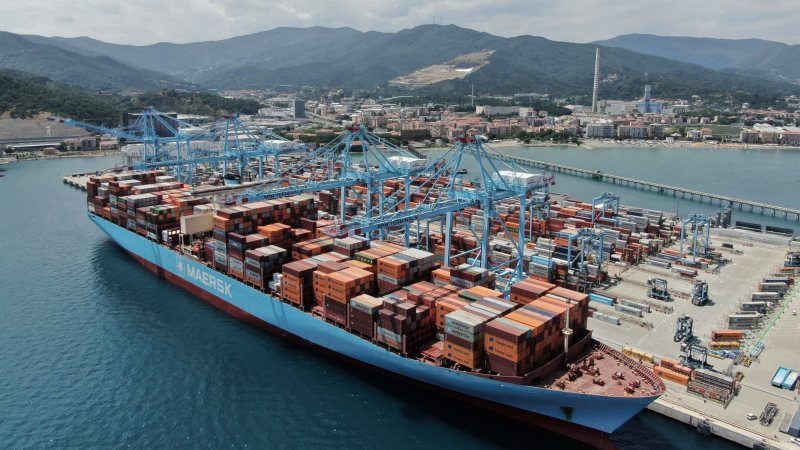
Although of limited relevance from a purely trade perspective, the entry into force of the new tariffs adds instability to a maritime and logistics sector already marked by two years of tariff shocks and geopolitical crises along the Suez and Hormuz routes. Beijing responded with a statement of condemnation, describing trade wars as harmful to all parties. The effects are concentrated mainly on transpacific routes between Asia and the United States and on Asia-Europe routes, where ocean freight rates have shown sharp fluctuations since the first announcement of US tariffs in April 2025. In previous acute phases of the trade war, the ports of Los Angeles and Long Beach, the main gateways for goods entering the United States, had already experienced congestion and bottlenecks in cargo unloading. In Europe, the Italian port system is exposed, having so far incurred total costs of more than €3.5 billion linked to US tariff measures, given that almost all Italian imports and 98.2% of Italian exports to the United States travel by sea.
In addition to port congestion caused by shippers bringing forward consignments ahead of new tariffs, handling costs are rising, pushing companies to consolidate cargo into less frequent but larger shipments to absorb the impact of the duties, with direct consequences for transport planning. Customs operations are becoming slower and more complex, lengthening clearance times and increasing the risk of errors, a critical factor for short-cycle sectors such as fashion, food and hi-tech. Inventory levels are also rising in destination countries as companies seek to manage tariff uncertainty, with negative effects on liquidity and operational agility. In container transport, the slowdown in flows has led to the return of a large number of units and congestion at depots, creating an imbalance between supply and demand that is weighing on prices.
M.L.