





The future of Rail Baltica, the new 870-kilometre standard-gauge railway corridor that will connect Tallinn, Estonia's capital, to the Lithuanian border and onwards to Warsaw through the three Baltic states, now rests not with engineers and construction companies but with politicians and their compromises. Latvia, one of the three countries sharing the project's costs, has decided to impose a moratorium on the scheme. It is not yet clear whether this represents a temporary suspension or a decision to withdraw from the project altogether. The Latvian authorities adopted this position after commissioning an independent study of the expected costs of the new line from Alvarez & Marsal, an international business consultancy and professional services firm. The study suggests that Latvia's share of the costs is unsustainable. This entirely unexpected finding has left the other Baltic participants waiting to see how the political situation develops and what decisions the government in Riga will ultimately take.
The change of heart probably stems from a fundamental misunderstanding about the project's costs. The first phase of Rail Baltica is currently estimated to require total investment of around €15 billion, a substantial financial commitment that is nevertheless largely supported by the European Union, which has so far allocated €4.5 billion. Initially, however, when the new Baltic railway corridor had only been outlined, the estimated cost was just under €6 billion. The problem is that this figure was based on a limited preliminary scheme, without the ambition of developing a high-capacity European transport corridor.
According to RB Rail, the company responsible for delivering Rail Baltica, the subsequent increase in estimated costs to the current €15 billion reflects changing market conditions but, above all, the evolution of the project over six years into a cross-border corridor designed for high-speed passenger trains and high-capacity freight services, features that were not included in the original plans. Six years ago, in 2020, Rail Baltica was little more than a visionary concept, without a fully developed design and, of course, without any construction work under way. The fact remains that, since the project was revised and acquired its current scope, the cost estimates have not changed. In the meantime, however, the overall situation has altered considerably. So much so that, in early October 2026, Estonia, Latvia and Lithuania issued a joint statement requesting €10 billion from the European Union to complete construction of the railway.
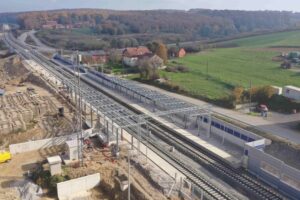
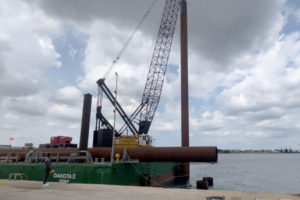
Construction work on the main railway line began in late 2024, initially in Estonia and Lithuania, while Latvia only joined the operational phase of the project at the beginning of 2026. More than 100 kilometres of railway are under construction in Estonia and Lithuania, while work has started on just under 40 kilometres in southern Latvia. By early 2026, Rail Baltica had reached a major milestone: more than 40% of the main line already had funding secured, detailed engineering designs completed, construction permits issued, land made available following purchases and compulsory acquisitions, and construction contracts awarded. This means that the project's engineering phase is now largely up and running. The possibility of reconsidering a scheme that has effectively passed the point of no return is therefore all the more surprising.
Even the potential scope for containing construction costs appears limited. One proposal involves revising the route specifications and technological choices to reduce the maximum passenger train speed from 250 to 160 kilometres per hour. The savings would be virtually insignificant compared with the overall cost, while substantially reducing the capacity and performance of a corridor strongly supported by the European Union. The aim is to establish a cross-border railway linking the Baltic states to the EU rail network, providing an alternative to the old transport connections that were all oriented towards Russia.
The Rail Baltica project is divided into two construction phases. The first covers 680 kilometres of new railway, initially equipped with a single track: 265 kilometres in Lithuania, 202 in Latvia and 213 in Estonia. In the best-case scenario, which will need to be confirmed given the current situation, construction will be completed in 2030, allowing the new line to enter service. A second running track will subsequently be installed, together with additional branches totalling 190 kilometres. The new international corridor also involves Poland, which will become the gateway to Central Europe. Polish railways will have to build a new 90-kilometre section from the Lithuanian border to connect Rail Baltica directly to the national network, as well as modernising and upgrading approximately 280 kilometres of existing railway lines that form part of the new European corridor.
Piermario Curti Sacchi