






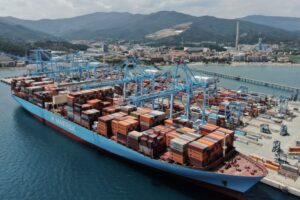
The container ship Panstar Acro returned to Busan on 11 October 2026 after a 50-day voyage between South Korea and Europe via the Arctic route. It was the first round trip by a container ship operated by a South Korean shipping company, calling at Felixstowe, Rotterdam and Gdańsk, although it returned carrying only empty containers. The trial voyage was part of a pilot project launched by the South Korean Government through the Ministry of Oceans and Fisheries, together with Korea Ocean Business Corporation and the Korea Shipping Association. Panstar Line was selected through a public tender in May. The 2,758 TEU vessel departed Busan on 22 August with 737 loaded TEU carrying chemicals, used cars and spare parts shipped by 85 customers. Including approximately 100 empty containers, the ministry reported a total of 837 TEU, equivalent to around 30% of the vessel's capacity.
After leaving the Northern Sea Route waters at Cape Zhelaniya on 6 September, Panstar Acro arrived at Felixstowe on 11 September, completing a 7,577-nautical-mile voyage in approximately 20 days and seven hours. It then called at Rotterdam, where it remained from 13 to 15 September, and Gdańsk on 17 September, while a previously scheduled call at Hamburg was cancelled. The European leg lasted seven days and five hours, covering 1,148 nautical miles between ports. The vessel departed Gdańsk on 19 September carrying 1,743 TEU of empty containers and no import cargo. South Korean President Lee Jae Myung acknowledged that securing return cargo after unloading in Europe remained a challenge, adding that concentrating higher volumes on the route and gaining operational experience could reduce costs and improve service reliability. Both Arctic passages were completed without icebreaker assistance and at almost identical average speeds: 2,320 nautical miles in approximately six days and nine hours at 15.1 knots westbound, and 2,115 nautical miles in approximately five days and 21 hours at 15 knots eastbound.
Navigation along the Northern Sea Route requires Russian authorisation, while access to icebreaker escorts is provided through the state-owned nuclear fleet operator Rosatomflot, which is subject to Western sanctions. Before departure, Seoul consulted Moscow about the voyage, including possible assistance if the vessel became trapped in ice. Some experts warned of the risk of breaching sanctions if the ship used paid Russian navigation and weather services, even for relatively small amounts. President Lee stated that South Korea would strictly comply with international rules and sanctions principles. However, at a government meeting, he described the route as a national priority, adding that diplomatic engagement must continue even with adversaries.
Seoul plans further trial voyages in 2027, involving container ships and car carriers, with the aim of establishing a regular service by 2030. According to South Korea's Minister of Oceans and Fisheries, the route may not become economically viable until around 2040. On 28 October, during a visit by the Busan Chamber of Commerce, Panstar presented five requests. Group chairman Kim Hyeon-gyeom observed that opening a route was within a shipping company's capabilities, but maintaining it depended on port infrastructure and cargo volumes. The company is calling for a dedicated Arctic route terminal in Busan, with transhipment incentives, a shippers' organisation offering incentives to companies using the route, greater support for container manufacturing costs, assistance in securing logistics hubs in Europe, and coverage of costs arising from emissions allowances and fuel standards under European regulations.
Antonio Illariuzzi