





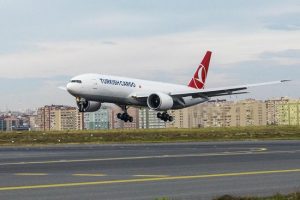
Turkish Airlines announced in early January 2026 an investment of 100 billion Turkish lira, equivalent to around €2 billion, for the construction of one of the world’s largest air cargo terminals and a new in-flight catering facility. The project will be developed at Istanbul Airport and is intended to strengthen Turkey’s role as a logistics hub between Europe, Asia and Africa.
The foundation stone ceremony is scheduled for 8 January 2026, in the presence of the Minister of Transport Abdulkadir Uraloğlu and the Chairman of the Board of Turkish Airlines, Ahmet Bolat. According to information released by the airline, the investment will generate around 26,000 new direct and indirect jobs and forms part of the Vision 2033 strategy, which is guiding Turkish Airlines towards its centenary in 2033.
The project is being led by Turkish Airlines and its freight division Turkish Cargo, which has recorded strong growth in recent years. In 2024 Turkish Cargo handled around two million tonnes of freight, a 20% year-on-year increase, reaching third place globally in terms of tonne-kilometres transported, behind FedEx Express and Emirates SkyCargo. This position was achieved ahead of the company’s original industrial plans.
At the heart of the investment is the new cargo terminal, designed to reach an annual capacity of 4.5 million tonnes. This level would place Istanbul ahead of major global cargo hubs such as Hong Kong and Memphis, which handled lower volumes in 2024. The new complex represents an expansion of the existing Smartist terminal, inaugurated in 2022 with a capacity of 2.2 million tonnes per year and already considered among the most technologically advanced in the sector.
The expansion, referred to as Smartist 2.0, will bring the terminal’s total surface area to more than 300,000 square metres. The infrastructure will feature a high level of automation, with automated storage and retrieval systems, digital management of unit load devices and the use of autonomous vehicles for internal handling. Particular emphasis is placed on cold chain management, with dedicated areas covering multiple temperature ranges for pharmaceuticals, food and perishables, in line with the international certifications already obtained by Turkish Cargo.
Alongside the cargo terminal, the plan includes the construction of an in-flight catering facility with a production capacity of up to 500,000 meals per day. The facility will serve the entire Turkish Airlines network, which carries more than 85 million passengers a year, and will enable greater integration of meal preparation, logistics and distribution, delivering benefits in terms of operational efficiency and quality standards.
The investment package also includes new data centres to strengthen the airline’s digital infrastructure, a large maintenance centre for widebody aircraft engines and new training facilities for technical and operational staff. According to the Ministry of Transport, these initiatives are consistent with the national plan to reinforce logistics and transport infrastructure.
In terms of timing, Turkish Airlines has not indicated a precise completion date. Projects of comparable scale generally require between two and four years of construction. Given the size of the Istanbul cargo terminal, commissioning is expected to take place progressively between the end of the decade and the beginning of the next, in line with the targets set for 2033.
The choice of Istanbul as the location for the investment reflects both geographical and strategic considerations. The city sits at the centre of major traffic corridors between Europe, Asia and the Middle East and plays a key role in the Middle Corridor, the logistics axis linking China to Europe via Central Asia and the Caucasus. According to industry analyses, this corridor offers shorter rail transit times than traditional routes and represents a significant alternative in a context of geopolitical tensions.
In recent years Istanbul Airport has rapidly improved its position in global cargo traffic, climbing several places in international rankings. According to the airport operator, in 2023 the airport’s direct and indirect contribution to the Turkish economy exceeded $24 billion, equivalent to around 2.2% of national GDP.
For Turkish Cargo, the expansion of infrastructure supports a growth strategy that includes enlarging its dedicated fleet and extending its destination network. The company has announced orders for new-generation freighter aircraft and aims to further strengthen its global market share.
Anna Maria Boidi