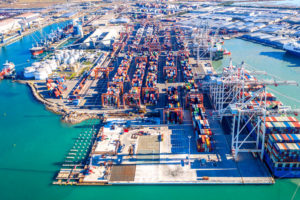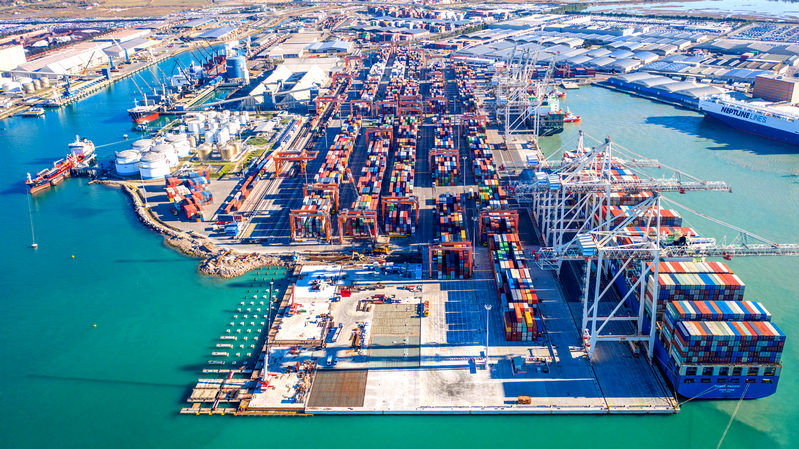





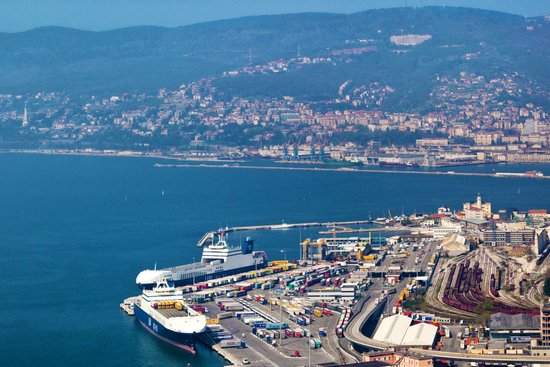
2025 was a year of contrasts for the port of Trieste. While semi-trailer traffic increased, one of the distinctive activities of the Julian port, container traffic fell by as much as one fifth. Overall tonnage, covering all cargo segments, remained broadly stable at around 60 million tonnes (+0.72%). On the container front, 2025 closed at 681,733 TEU, down 19.05% compared with 2024. The decline affected transhipment only, which handled 144,803 TEU, a sharp 52% drop year on year, while gateway traffic remained stable (+0.30%) at 536,930 TEU. Within this segment, full containers increased by 4.9% to 405,015 TEU. The Port Authority attributes this trend to the withdrawal of the 2M consortium, which took place at the beginning of 2025.
By contrast, the ro-ro segment confirms a more linear expansionary cycle. In 2025, 317,296 rolling units transited through Trieste (+7.42%). This growth was supported by the launch and strengthening of connections with Turkey. The relationship between maritime supply and logistics demand is reinforced by the port’s role as a gateway to Central Europe, where the transport chain is integrated with inland services, particularly rail.
Competition among operators has played a direct role in strengthening ro-ro volumes. In October 2025, Grimaldi introduced a fourth vessel, Eurocargo Roma, on the Trieste–Gemlik route, alongside Eco Malta, Eco Mediterranea and Eco Salerno, in close competition with DFDS. For inland logistics, this translates into an incentive for modal shift and greater route attractiveness, especially for semi-trailer traffic and accompanied units, with knock-on effects on yards, gates and peak management.
Another sign of the vitality of this segment is the increase in the container component carried on ro-ro vessels. According to data from the Autorità di Sistema Portuale del Mare Adriatico Orientale (Eastern Adriatic Sea Port Authority), 31,717 TEU were transported on ro-ro ships in the first quarter of 2025. This is a useful indicator, as it links ro-ro not only to rolling cargo flows but also to hybrid solutions and supply chains that use the maritime leg to reduce transit times and variability compared with alternative routes.
Overall, the 2025 figures depict a port that, in the container segment, has absorbed a network reconfiguration by shipping lines, with a contraction concentrated in transhipment and a broadly resilient hinterland, accompanied by growth in full containers. At the same time, ro-ro traffic has continued to expand, driven by connections with Turkey and by competition that has broadened service offerings and influenced economic conditions. Within this framework, the intermodal base remains an enabling factor: the system’s year-end figures show 11,600 trains in total (+3.85%), a result achieved despite construction works and route diversions, and one that helps sustain the gateway flows to which Trieste continues to anchor its logistics role.
A.M.B.