





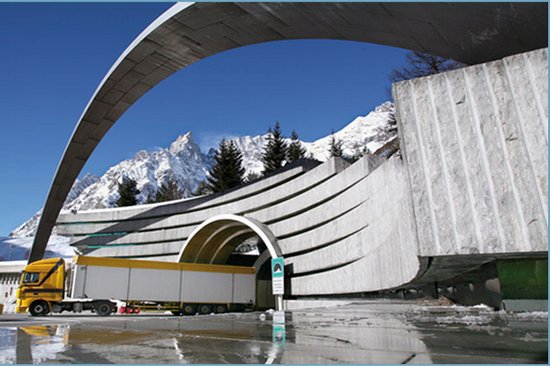
From 1 January 2026, tolls at the Mont Blanc and Fréjus tunnels have increased by 1.19% for all vehicle categories. The tariff adjustment affects two of the main road crossings between Italy and France and was decided by the Italo-French intergovernmental commission at its meeting on 9 December 2024, applying the automatic indexation mechanism set out in the bilateral agreements governing the management of the infrastructure. The increase came into force simultaneously at both tunnels and applies without distinction between light and heavy vehicles.
The 2026 increase is calculated on the basis of the average inflation rates recorded in Italy and France between September 2023 and August 2024. Over this period, inflation slowed compared with previous years, settling at levels close to 1%, which explains the relatively modest size of the rise. For road haulage operators, however, even a limited increase is significant when placed within a framework of overall costs that continue to rise. Alpine tunnel tolls remain among the highest in Europe for industrial vehicles and have a direct impact on the competitiveness of companies operating along corridors linking Italy, France, the Iberian Peninsula and the Benelux area.
The new tariffs confirm the alignment between the Mont Blanc and Fréjus tunnels. For light vehicles, a single journey for a car under two metres in height now exceeds €56, while for commercial and industrial vehicles the figures are substantially higher. A two-axle heavy goods vehicle over three metres in height pays more than €200 for a single crossing, rising to over €400 for vehicles with three or more axles. For exceptional transports, tolls exceed €1,100 per passage. Subscription and post-payment schemes for haulage companies remain in place, allowing reductions linked to traffic volumes.
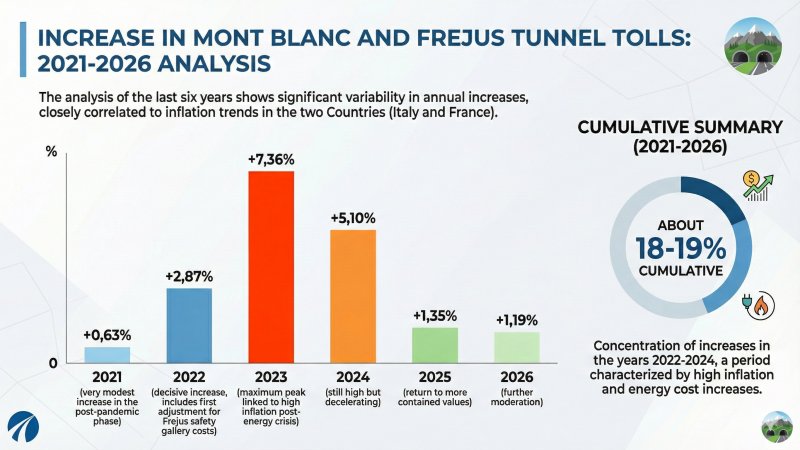
To understand the significance of the 2026 increase, it must be viewed in historical perspective. Toll trends over the past six years show marked volatility, closely linked to inflation dynamics and infrastructure investment. In 2021 the increase was 0.63%, in a phase still affected by the pandemic. In 2022 it rose to 2.87%, including an extraordinary component connected to the initial costs of the Fréjus safety gallery. The peak came in 2023, with a 7.36% rise linked to the energy crisis and the inflation surge in both countries. In 2024 the increase eased to 5.10%, while in 2025 it returned to more moderate levels at 1.35%. The 1.19% increase in 2026 confirms this phase of moderation. Overall, between 2021 and 2026 tolls at the two tunnels have risen by around 18–19% cumulatively, with increases concentrated in the 2022–2024 period. For freight transport companies that regularly cross the Alps, this represents a cost increase that is difficult to pass on to customers in a market characterised by intense international competition.
Tariff developments are closely linked to ongoing investment in both infrastructures. At the Fréjus tunnel, the second tube entered service in July 2025, a project worth around €700 million that has significantly improved safety levels and service continuity. At the Mont Blanc tunnel, a complex programme to refurbish the vault has been under way since 2023 and is set to continue for many years. Works carried out between September and December 2025 required a full closure of the tunnel and an investment of €21 million, including structural interventions and more than 800 tests on safety systems prior to reopening.
According to technical assessments, the Mont Blanc maintenance programme could extend until the 2040–2045 period, with total investments estimated at several hundred million euros. Scenarios under consideration include either a continuous closure for several years starting from 2030 or a series of repeated seasonal closures over time. Both options are fuelling debate over the construction of a second tube for this tunnel as well, following the Fréjus model, an issue of direct interest to the logistics sector given the implications for traffic flow reliability.
From an operational standpoint, the 2026 increase comes in an already challenging context for road haulage. At the start of the year, it coincided with adjustments to Italian motorway tolls, averaging around 1.5%, and an increase in diesel excise duties. For a small or medium-sized company making dozens of transalpine trips each month, the combination of these factors can translate into several thousand euros of additional annual costs, further eroding operating margins.
Comparison with other Alpine crossings highlights how the Mont Blanc and Fréjus tunnels remain among the most expensive for heavy vehicles. Compared with the Great St Bernard or the Swiss Gotthard system, which is based on a vignette for light vehicles and kilometre-based charging for lorries, the Italian-French tunnels have higher toll levels. While these are justified by the costs of managing complex infrastructure, they are often challenged by trade associations.
Pietro Rossoni