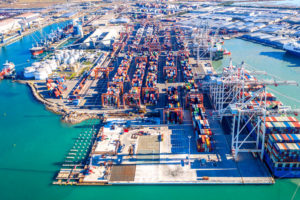






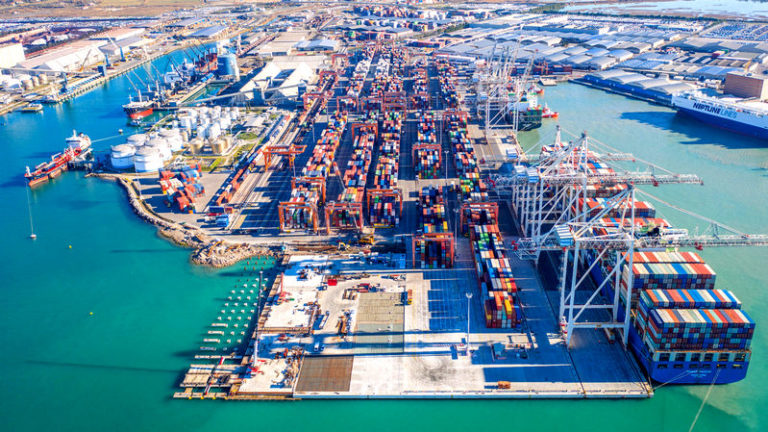
The Slovenian port of Koper closed 2025 with strong growth in container traffic, reaching 1,272,161 TEU, up 12.2% on 2024, while the nearby port of Trieste recorded a decline of 19.05%. This suggests a shift in cargo flows, potentially driven by the dissolution of the 2M shipping alliance (Maersk–MSC) and the launch of the Gemini alliance between Maersk and Hapag-Lloyd. From February 2025, Gemini strengthened the regularity of services on the Asia–Northern Mediterranean corridor, with Koper designated as the first Adriatic port of call on some services and initial calls taking place between late March and April.
The acceleration in container volumes was evident from the first quarter, when March set a new all-time monthly record of 110,810 TEU. In the first half of the year, the Slovenian port handled 623,731 TEU, up 14% year on year and performing above plan. This trend reflects a market environment in 2025 that pushed flows from the Far East towards the North Adriatic, also due to saturation at competing ports and the search for alternatives closer to Central European markets. In this area, new contracts were activated in connection with the expansion of manufacturing facilities, particularly in Austria, Germany, the Czech Republic and Hungary, with direct effects on outbound intermodal flows.
The year, however, also highlighted the typical friction points associated with rapid growth in container volumes. The combination of import peaks and limited truck and rail evacuation capacity led to periods of high yard occupancy, requiring operational management measures to restore fluidity. During the summer of 2025, container terminal occupancy was high and faster cargo evacuation was requested. From 4 August, a rule was introduced allowing acceptance of export containers no earlier than seven days before the vessel’s expected arrival; this was lifted on 26 September following an improvement in conditions. Regularity was further affected by rail disruptions on the Slovenian network: infrastructure works between June and December reduced capacity by up to 50% on some sections, with planned closures and consequent impacts on service frequencies and intermodal chain punctuality.
Koper nonetheless confirms its role as the main container gateway of the Adriatic, particularly for flows to and from Central and Eastern Europe, with a market profile historically oriented towards Austria, Slovenia, Hungary and Slovakia, and to a lesser extent the Czech Republic and southern Germany. Rail transport remains a distinguishing feature, accounting for more than 50% of volumes and over 20,000 trains per year. In a North Adriatic context where competition with Trieste, Rijeka and Venice has intensified alongside capacity expansion programmes, Koper has built its trajectory on operational integration, direct control of terminal development and a rail offering focused on inland corridors.
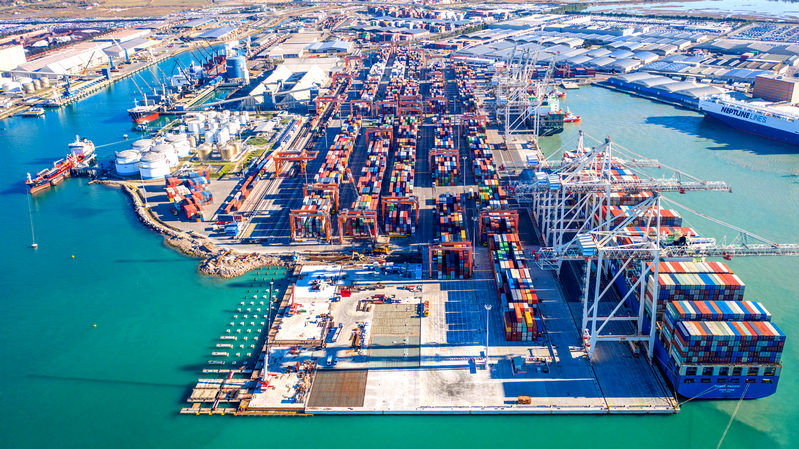
The response to container volume pressures in 2025 is being driven primarily by investment. In July, works began to extend the northern section of Pier I, the main project to increase container terminal capacity. The project includes the installation of 1,750 piles and the construction of 326 metres of new quay with two additional berths, as well as around 7 hectares of new operational areas. The contract is worth €152.9 million and completion is scheduled for the end of 2027. Once fully operational, the container terminal’s annual capacity is expected to rise to 1.8 million TEU.
During the year, the Slovenian port also pushed efficiency and process digitalisation, introducing remote control systems for RMG cranes at the container terminal and advancing digital transformation initiatives. The aim is to increase productivity and safety, while also stabilising performance during peak periods, when the balance between vessel arrivals, yard capacity and availability of rail paths becomes critical.
The external infrastructure framework remains a decisive factor for the continuity of container growth in the medium term. The new Divača–Koper railway line, expected to be completed by the end of March 2026, is the main national project to reduce transit times and increase capacity, with a route length of 27.1 kilometres, more than 20.5 kilometres of which are in tunnels. The intention is that its entry into service, combined with the historic line, will improve the reliability of intermodal flows, precisely along the corridor that in 2025 showed the greatest vulnerability during construction phases.
Total cargo traffic at the port of Koper in 2025 amounted to 23.0 million tonnes, broadly in line with 2024, but the internal dynamics across segments showed a shift towards higher logistical value cargoes. Within this framework, the container terminal handled 11 million tonnes of containerised goods, up 7.3% year on year, confirming growth not only in units but also in tonnage.
M.G.