







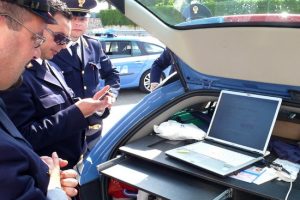
Tampering with DPF and AdBlue systems on both light and heavy diesel vehicles is widespread across Europe and effectively cancels out the benefits of emission-reduction rules. Detecting it is not straightforward, but new tools are now available. In November 2025 the Italian Traffic Police launched an advanced technological inspection campaign to counter this practice, with a particular focus on lorries and commercial vehicles. It marks a significant step forward in the fight against so-called “diesel cheats” who disable or remove anti-pollution systems to avoid maintenance costs.
The first operational phase was launched by the Traffic Police Subsection of Palmanova, in the province of Udine, which at the beginning of November 2025 received five latest-generation diagnostic devices. The initiative stems from cooperation between the Friuli Venezia Giulia Traffic Police and Autostrade Alto Adriatico, the concessionaire that purchased and supplied the tools to counter behaviours that alter vehicle emissions.
Checks are initially focusing on the A4 Venice–Trieste motorway and on the network managed by Autostrade Alto Adriatico, corridors that carry heavy east–west traffic and see a high proportion of foreign industrial vehicles. The choice of this area is no coincidence: the first inspections carried out by the Trieste Traffic Police Department revealed a significant incidence of tampering and alteration of anti-pollution devices.
The tools supplied to the Traffic Police are portable devices that connect directly to the vehicle’s OBD (On-Board Diagnostics) socket, fitted to all recent vehicles and usually located beneath the dashboard. Through this connection, the system reads real-time data from the engine control unit, allowing officers to verify the correct operation of the main components involved in emissions control.
With this system, officers can analyse crucial parameters such as exhaust-gas pressure before and after the DPF, checking whether readings match manufacturer specifications; particulate levels, to assess whether they fall within normal limits; the presence of AdBlue in the tank and the correct functioning of the dosing system; and whether the DPF is performing its normal automatic regeneration cycles.
If the recorded values are inconsistent or abnormal, the software flags a possible mechanical or electronic manipulation. In the case of a deactivated or removed DPF, for example, the control unit shows constant differential-pressure values or the absence of the regeneration cycles typical of functioning filters. The new devices can also detect the presence of emulators or additional control units that simulate proper operation of anti-pollution systems to evade checks.
Tampering has spread among motorists and, above all, haulage companies, often with the complicity of workshops and mechanics. The main reasons are economic. DPF maintenance costs are significant: professional cleaning can cost between 100 and 500 euros, while a full regeneration ranges from 200 to 500 euros. In more serious cases, replacing the particulate filter can cost between 500 and 5,000 euros, depending on the vehicle and the part. AdBlue systems also entail recurring expenses: an Euro VI vehicle typically consumes 250 to 300 euros’ worth of AdBlue, depending on mileage and operating conditions. Furthermore, the system may develop faults in the dosing pump, injectors or sensors, requiring costly repairs.
Faced with these expenses, some owners opt for tampering through various methods, including engine-control-unit software modifications, the physical removal of the DPF and its replacement with a hollow pipe of the same diameter, and the installation of AdBlue emulators, which are electronic devices that intercept sensor signals and replace them with fake values, simulating the presence and correct operation of the system even when the additive is absent.
Penalties for disabling anti-pollution systems are severe. Under Article 78 of the Italian Highway Code, anyone driving a vehicle whose type-approval characteristics have been modified without the required inspection faces a fine ranging from 422 to 1,697 euros for private vehicles and domestic goods vehicles, withdrawal of the registration certificate with an obligation to restore the vehicle to its original condition, and administrative impoundment for up to three months in the most serious cases.
For international transport the rules are even stricter: since Cemt permits are issued only for Euro V or Euro VI vehicles, a lorry fitted with an emulator that effectively reduces its emissions class to Euro 0 or Euro 1 is deemed to be operating illegally, with penalties that can reach 4,130 euros. In some situations, tampering may constitute an environmental crime, with possible criminal charges, prison sentences of up to six years and fines of up to 100,000 euros. It also voids the vehicle warranty.