




- On 13 March 2026, the Rechtbank Overijssel issued a provisional but immediately enforceable ruling in favour of Muhammad, a truck driver from Tajikistan employed by the Lithuanian company Uab Marvel Solar Energy. The judge recognised the legitimacy of the driver’s right of retention over the company vehicle and ordered the payment of €19,519.04 gross in unpaid wages — including a €4 per hour supplement for work carried out outside Lithuania under the EU posting of drivers directive — as well as €13,054 net in daily allowances for 214 days, minus €14,680 already paid by the company.
- The case has drawn attention to the conditions of non-EU drivers employed by eastern European firms to carry out transport operations mainly in western Europe. According to the European Transport Workers’ Federation (ETF), this is a “hidden reality” potentially affecting thousands of workers, forced to live in truck cabins for months without returning home and without receiving agreed pay or the legal minimum in transit and destination countries.
- The case has also sparked debate on the application of EU posting rules in road transport, liability in subcontracting chains and the adequacy of enforcement tools. ETF and the Dutch union FNV have called for stronger inspection capacity, stricter rules against “bogus posting” and tighter regulation of labour intermediaries and subcontracting contracts in the sector.
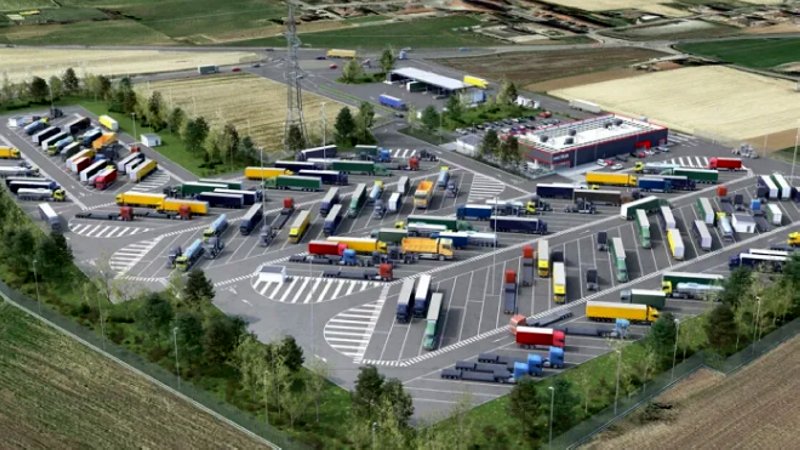
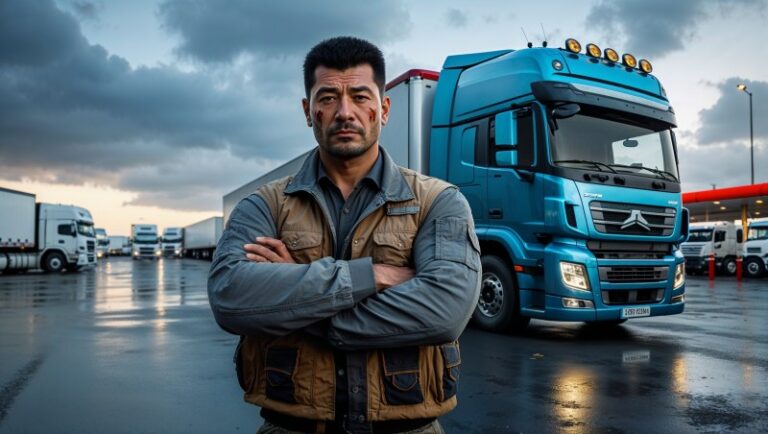
Muhammad, a driver from Tajikistan, was hired on 2 July 2025 by Uab Marvel Solar Energy, based in Klaipėda, under a Lithuanian employment contract. For seven months he drove across western Europe delivering goods for major clients — including, according to unions, large retail chains — sleeping permanently in his truck cab and without receiving his agreed salary. On 5 February 2026 he was instructed to deliver 24 pallets to a company in the Netherlands. The following day, instead of completing the job, he parked the vehicle — owned by Marvel — at the Het Veelsveld service area on the A1 motorway in Deurningen, Overijssel province, and declared he would not resume driving until he was paid what he was owed.
From that point, Muhammad lived in the stationary truck under precarious conditions, supported by the local community, which provided food and drink and launched a fundraiser for him and his family in Tajikistan. His story attracted the attention of the Dutch union FNV, which provided legal assistance. Meanwhile, the Lithuanian company sought intervention from Dutch and Lithuanian police authorities to remove the driver and recover the vehicle. After assessing the situation, Dutch police declined to carry out a forced eviction, classifying the matter as a civil dispute over wages and property.
The company then initiated a “kort geding” — an emergency procedure under Dutch procedural law — before the kantonrechter (Dutch labour court judge) in Enschede, seeking immediate return of the vehicle under penalty of daily fines for the driver. With FNV’s support, Muhammad filed a counterclaim for unpaid wages and daily allowances, also invoking EU rules on the posting of drivers in road transport. The hearing took place on 5 March 2026, attended by observers from ETF and FNV, and the decision was issued on 11 March.
The case involved significant international complexity: the employer is established in Lithuania, the worker resides in Tajikistan, transport operations mainly took place in Germany, Belgium and the Netherlands, and the vehicle was located in the Netherlands at the time of the dispute. The judge determined the applicable law for each claim, referring to the Rome I Regulation for contractual matters and Rome II for tort claims. The parties agreed to apply Dutch law, which the judge accepted based on their express choice during the hearing. The court also noted that, absent such agreement, Lithuanian law would have applied as the law of the employer’s country of establishment, while mandatory provisions of Lithuanian law would in any case remain applicable.
On the central issue — the legality of retaining the truck — the judge applied Article 3:290 of the Burgerlijk Wetboek (Dutch Civil Code), which allows a creditor to suspend the return of an asset until the debtor fulfils their obligation, provided there is a sufficient connection between the obligations. The company disputed both the existence of the wage claim and the proportionality of the measure, arguing that the vehicle’s market value far exceeded the worker’s claim.
The judge rejected both arguments. On wages, the court found that Muhammad had worked 1,348 hours at a gross rate of €10.48 per hour — equal to 1.65 times the Lithuanian minimum wage, as provided by the contract — and added a €4 per hour supplement for work performed outside Lithuania, applying Directive (EU) 2020/1057 on the posting of drivers in international road transport. The judge noted that full tachograph data were exclusively held by the employer, which failed to produce them in court, and therefore considered the hours declared by the worker insufficiently challenged. The unpaid wages were calculated at €19,519.04 gross, based on €14.48 per hour for 1,348 hours worked.
Regarding daily allowances, the company acknowledged Muhammad’s entitlement but argued they were only payable upon his return to Lithuania. The judge rejected this interpretation, noting that the purpose of the allowance is to cover living costs incurred while working abroad in countries with higher costs than Lithuania. The court also took into account Muhammad’s statement — not disputed by the company — that he had repeatedly been kept on western European routes under the pretext of driver shortages, under threat of dismissal or non-payment. The allowance was set at €61 net per day for 214 days, totalling €13,054 net, based on Belgium as the country with the lowest applicable rate among those where he worked.
From the total due, €14,680 net already paid by the company was deducted, as acknowledged by Muhammad. The Rechtbank Overijssel also ordered the company to pay €2,452 in legal costs and declared the ruling immediately enforceable. The court’s official statement referred to “almost €18,000” in total arrears as a simplified estimate, while the detailed amounts are set out in the full judgment. All claims by Marvel were dismissed.
Muhammad’s case is not isolated. In the week before the hearing, ETF reported a similar case in the Netherlands: another Tajik driver, identified as Parviz, had stopped at Maasvlakte Plaza in Rotterdam after seven months without pay and two years without returning home, using the same strategy of retaining the vehicle as leverage and ultimately securing payment. According to unions, such cases are multiplying in parking areas along major western European routes, where non-EU drivers — particularly from Central Asia — spend weeks or months waiting for overdue wages.
According to ETF and FNV, the recurring model involves transport companies registered in eastern European countries — often with only a nominal presence, so-called “letterbox companies” — hiring third-country drivers under contracts governed by the law of the country of registration, with wages aligned to local levels and in breach of posting rules applicable in the countries where the transport actually takes place. In this framework, workers are difficult to protect for the authorities of the member states where operations occur, and equally struggle to enforce their rights without external legal and union support.
Muhammad’s case also highlights the complexity of subcontracting chains. Four separate companies were involved in the disputed transport operation, making it difficult to identify ultimate responsibility. ETF noted that the Austrian client on whose behalf Muhammad carried out some deliveries did not contribute to resolving the situation. This directly touches on the issue of joint liability in subcontracting chains, which remains under debate at European level.
From a European labour law perspective, the ruling by the Rechtbank Overijssel contains elements of broader significance. The recognition of the applicability of Directive (EU) 2020/1057 — part of the Mobility Package — and the resulting €4 per hour wage supplement for work carried out outside Lithuania constitute, according to ETF and FNV, a useful precedent for future cases involving drivers in similar situations.
It should be noted that this is a decision issued a part an emergency procedure, with provisional effect: a full trial could lead to a more in-depth assessment, also considering mandatory provisions of Lithuanian law that the court acknowledged as potentially applicable but could not examine in detail due to a lack of information provided by the parties.
ETF and FNV welcomed the ruling as a significant victory but stressed the need for structural measures. Their demands following the decision include increased resources for inspections, more effective tools to combat bogus posting, regulation of labour intermediaries in international transport and stricter rules on joint liability in subcontracting chains. The unions reiterated that the right of retention and protections under the posting directive are accessible only to those able to secure qualified legal assistance — a condition many drivers in similar circumstances cannot meet — and that the response cannot rely solely on case-by-case support.
M.L.