

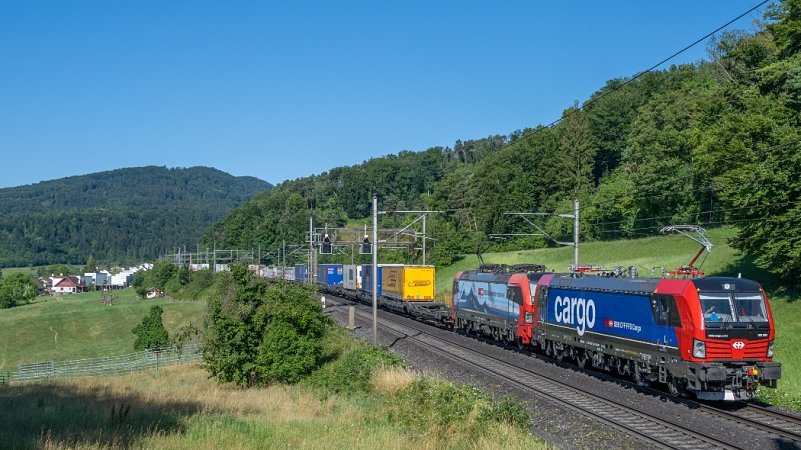




The Swiss Federal Council approved on 19 November 2025 the new report on the transfer of transalpine freight, noting that over the past two years the shift from road to rail has stalled. According to the document, five years after entering service Alptransit has yet to reach its full potential, while the rail share of transalpine freight traffic fell to 70.3 per cent at the end of 2024, down 2.6 points from 2022. In the same year, 960,000 heavy goods vehicle transits were recorded, exceeding the target set by federal transfer policy. Forecasts for 2025 indicate a further decline in rail’s share.
In the report, presented as a tool to ensure the implementation of the objectives laid down in the traffic transfer law, the Federal Council identifies delays on the northern access routes to Alptransit as the main cause of the slowdown. Lines that have not yet been upgraded prevent reliable operations and have a negative impact on rail freight productivity. In addition, in areas affected by construction works, reduced capacity on alternative routes further limits service quality.
The federal authorities therefore intend to support the rapid modernisation of infrastructure in neighbouring countries, focusing on more effective coordination of international works and improved availability of efficient diversion routes. Upgrades to the Stuttgart–Singen line and the Swiss Schaffhausen–Oerlikon–Othmarsingen connection are planned by 2028 to ease pressure on the Rhine valley and offer an alternative corridor. At the same time, following a declaration of intent with France, work has begun on the left bank of the Rhine to develop an Alptransit access suitable for freight. On the Swiss side, the upgrading of two tunnels in the Basel area will start in 2026.
A second subject concerns the end of the rolling motorway, scheduled for mid-December 2025. The Federal Council fears that its closure could increase through road traffic and is planning financial incentives to shift a significant share of volumes to unaccompanied combined transport, which includes semi-trailers, containers and swap bodies. The authorities are also examining the extension beyond 2030 of support measures for transalpine combined transport. On 28 May 2025, the government had already submitted to Parliament a proposal to revise the performance-related heavy vehicle charge, aiming to maintain rail’s competitiveness against road.