





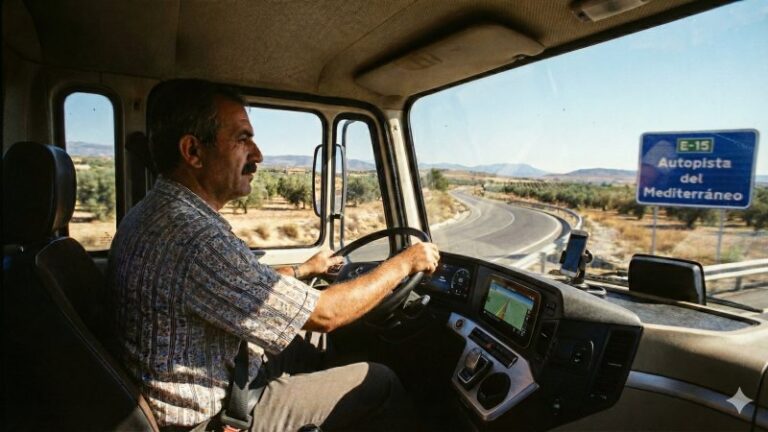
Spanish road haulage companies need at least 30,000 heavy goods vehicle drivers, a demand they have been unable to meet domestically. As a result, they are looking abroad. In this context, the Spanish road haulage association Usintra signed an operational protocol in December 2025 with the Turkish public employment agency Iskur, also involving the Fundación Campus de Córdoba as a training hub. The initiative aims to provide Spanish transport companies with access to a pool of more than 300,000 unemployed or available drivers in Turkey, with an initial organisation of flows estimated at 40 to 80 drivers per week once fully operational.
The protocol also stems from the official visit to Spain by the Turkish minister Vedat Işıkhan on 24–25 September 2024, during which meetings were held with Yolanda Díaz Pérez and Elma Saiz Delgado. Labour cooperation and migration issues were framed as part of a bilateral relationship strengthened by the Turkish–Spanish summit held on 13 June 2024 in Madrid, when thirteen cooperation agreements were signed.
The scope of the initiative is national, although the operation originated in Andalusia. Training and the administrative start-up phase will be concentrated in Córdoba, at the Campus de Formación Profesional y Empleo, while final recruitment may involve companies based in any Spanish region. The protocol sets out a standardised pathway that starts with companies’ demand and ends with recruitment under a regular employment contract in Spain, following a sequence designed to reduce the typical risks of unassisted international recruitment and to make timelines and requirements more predictable.
The first phase is selection. Usintra will forward requests to Iskur specifying numbers and profiles, with priority given to candidates who already have experience driving heavy goods vehicles and also to those who obtained their driving licence before 2009, as they are considered more likely to meet requirements or to have well-established driving habits. At this stage, the aim is to use the Turkish public channel as an administrative and professional filter, avoiding fragmented, company-by-company selection and reducing the risk of unverifiable applications.
The second phase is linguistic. The model includes a one-month online Spanish language course before relocation to Spain, with the aim of providing basic skills for professional communication and road safety. This will be followed by a third phase of professional training in Spain. After the online month, candidates will move to Córdoba for an intensive seven-day module to obtain the required professional certification, known in Spain as the CAP. This training will be delivered with the support of interpreters, a key element in compressing start-up times despite initially limited language skills. Obtaining the Spanish CAP involves 130 hours of classroom-based theoretical training and ten hours of practical driving, with renewal every five years through continuing training.
The fourth phase concerns legalisation. During the training period in Córdoba, procedures for work and residence permits will be launched, while costs associated with the stay during the training phase will be borne by the companies intending to hire the drivers, including accommodation, transport and daily expenses. By shifting part of the initial costs to the employer, the entry barrier for workers is reduced, making participation more likely for candidates who would otherwise need to self-finance.
The fifth phase is recruitment and operational integration. At the end of the training and administrative process, the driver will join the company workforce under a regular contract with a Spanish transport firm. If the plan to introduce 40 to 80 drivers per week is consistently maintained, this could result in several thousand new hires. However, this figure would still not cover the entire driver shortage unless the programme is expanded or supplemented with other channels.
The protocol text also addresses pay and other conditions. Gross annual salaries may reach €35,000, while other provisions include a range of regularisation and social protection measures: residence permits, healthcare and social security coverage under Spanish law, entitlement to a pension after fifteen years of effective work, and the possibility of family reunification once the position is stabilised. In Turkey, pay for heavy goods vehicle drivers ranges between 30,000 and 45,000 Turkish lira per month, equivalent to around €595–893, in a context of high inflation.
The development of the agreement will follow an already defined timetable. The first step after signing the protocol will be its public presentation in Spain, scheduled for 3 February 2026 at the Campus de Formación Profesional y Empleo and open to interested companies. This meeting will clarify participation requirements, financial responsibilities during training and the timing of the first flows, marking the transition from a signed agreement to concrete implementation.
During the initial implementation phase, several key issues will need to be closely monitored. The first concerns oversight of compliance with working conditions and contractual regulations, to prevent social dumping. The second relates to language management and operational safety, given that initial language training is concentrated over a limited period. The third concerns the structural dimension of the problem: figures on workforce ageing and retirements indicate that the Turkish channel, while significant, fits into a broader context that will continue to require domestic training policies and measures to attract new drivers.
P.R.