









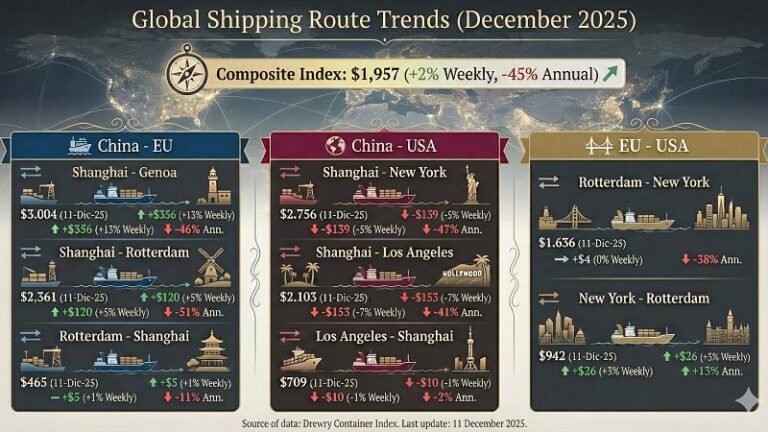
The latest reading of the Drewry World Container Index on 11 December 2025 shows that average spot container freight rates between China and Europe continue to rise, while those between China and the United States have reversed course and are falling. The composite index increased slightly week on week, up by 2% to $1,957 per 40-foot container, although it remains 45% lower year on year.
On the China–Europe trades, spot rates show the most favourable trend for carriers. The Shanghai–Genoa route recorded the sharpest increase across the entire index, with a strong weekly rise of 13% bringing the rate to $3,004 per 40-foot container, up $356 compared with the previous week. Despite the recovery, the year-on-year comparison remains negative, with a decline of 46% versus the same period in 2024. The route to Northern Europe also strengthened, with the Shanghai–Rotterdam rate rising to $2,361, up 5% week on week, equivalent to $120, and down 51% year on year. On the return leg Rotterdam–Shanghai, the situation remained broadly stable, with a marginal 1% increase to $465 and a contained annual decline of 11%.
According to Drewry’s analysis, the resilience of the Asia–Europe routes is not episodic. Spot rates on these trades have been stable or rising for four consecutive weeks, supported by a shift in seasonal patterns. Over the past three years, December has seen double-digit month-on-month demand growth, pointing to structurally higher year-end volumes. This is compounded by the pull-forward of bookings linked to the Lunar New Year, which in 2026 will fall in February. This factor is already generating earlier cargo flows and, according to Drewry, could support further modest rate increases in the coming week.
The picture is the opposite on the China–United States routes, where the recent recovery in outbound rates proved short-lived. After last week’s rebound from lows not seen since January 2025, spot rates have resumed their decline. The Shanghai–Los Angeles route recorded a weekly drop of 7%, with the rate falling to $2,103 per 40-foot container, down $153 and 41% lower year on year. Weakness is even more evident on the East Coast, where the Shanghai–New York rate fell by 5% to $2,756, losing $139 week on week and posting a 47% annual decline. On the return leg Los Angeles–Shanghai, the rate stood at $709, down 1% on the week, but with a limited year-on-year change of 2%, the most stable in the entire index.
The difficulties of the transpacific market are confirmed by capacity data. According to the Drewry Container Capacity Insight report, sailing cancellations on the China–US routes increased in the past week and are set to rise further, with twelve blank sailings already announced for the following week. Carriers are intensifying these cancellations in an effort to support spot rates, but the strategy is facing clear limits due to a lack of volumes. Most goods destined for Christmas sales were shipped in November and, in the current period, available cargo is insufficient to sustain rates. In this context, Drewry expects a further slight weakening of transpacific freight rates in the short term.
On the Europe–United States routes, the market shows signs of greater balance. The Rotterdam–New York route remained broadly unchanged at $1,636 per 40-foot container, with a near-zero weekly variation and a 38% year-on-year decline. The return leg New York–Rotterdam was more dynamic, rising by 3% to $942, an increase of $26 compared with the previous week. This is the only route in the Drewry index to record a year-on-year increase, at 13%.
Overall, last week’s performance highlights a market that remains fragile but uneven. The Drewry composite index is benefiting from the strength of the Asia–Europe routes, while trades to the United States are weighed down by seasonally weak demand and excess capacity that blank sailings are struggling to offset. On an annual basis, all major routes remain significantly below 2024 levels, with the exception of the New York–Rotterdam connection, confirming that the recovery seen in December is still at an early and selective stage.