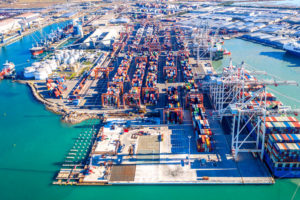







The Autorità di Sistema Portuale del Mare Adriatico Orientale (Eastern Adriatic Sea Port Authority) has submitted the project report for the new multifunctional terminal Molo VIII at the port of Trieste. The document, dated 6 June 2025, marks the next stage of the process, namely the public consultation phase. The facility will be built on the site previously occupied by the Ferriera di Servola steel plant, which has already undergone redevelopment. The project involves the port authority as the granting body, together with the companies Hhla Plt Italy, Logistica Giuliana and Icop.
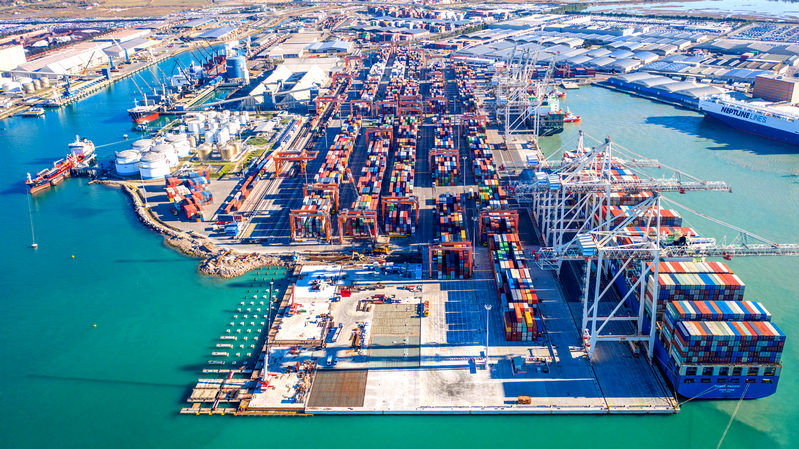
The maritime infrastructure is based on a quay 422 metres long and 53 metres wide, with a seabed that will reach a depth of 17.2 metres after dredging, suitable for accommodating container ships of up to 15,000 teu, with the possibility of later adjustment for vessels of up to 24,000 teu. Container capacity is projected at 200,000 teu in 2030, rising to 450,000 teu by 2040. The terminal will also feature a berth for ro-ro vessels, 232 metres in length. The quay will be equipped with ducting to support a future cold ironing system, allowing ships to connect to shore-side power, thereby reducing emissions and noise in the port area. The dredged material, approximately 120,000 cubic metres, will be reused within the reclamation basin of the adjacent logistics platform.
On the land side, the terminal will be equipped with a rail terminal featuring six tracks, each 300 metres long at the outset, with the possibility of extending them to 750 metres. The facility will have the capacity to handle twelve trains per day. For road transport, it will be directly connected to the Trieste Main Road Network via dedicated ramps, separating heavy traffic flows from urban ones. Access for industrial vehicles will be managed by eight automated gates (four inbound and four outbound) using Optical Character Recognition and RFID technologies to ensure smooth traffic flow.
In terms of equipment, Molo VIII will rely solely on electric cranes, including three remotely controlled ship-to-shore cranes with a 70-metre outreach, three remotely controlled rail-mounted gantry cranes for the rail yard, and four rubber-tyred gantry cranes to move containers within the yard. Operations will be managed through a Terminal Operating System, which will also provide real-time tracking and interoperability with Customs.
According to the 6 June plan, the new terminal will generate approximately 805 jobs during the construction phase and 2,650 permanent jobs once fully operational. When running at full capacity, it is expected to generate over two billion euros in tax revenue over fifteen years, including VAT, customs duties and personal income tax. An additional benefit comes from the regeneration of the former Ferriera di Servola site, a 180-hectare area that for more than a century was a source of pollution. This includes a Permanent Safety Project to contain and isolate contaminated land.
Formally, the environmental impact assessment is expected to be completed between 2025 and 2026. The port authority estimates the overall duration of the project at 58 months, including 16 months for permits and licences, 15 months for final design, 35 months for civil works (with quay construction taking around 28 months), and 41 months for equipment supply and installation.