



On 4 June 2025, the Duferco Group launched activities at its new multipurpose terminal located between Milazzo and Messina, in Sicily, developed through the redevelopment of the former Giammoro steel site. The terminal’s equipment and machinery were inaugurated with the unloading of a 130-tonne transformer from the merchant vessel Deo Volente, arriving from Marghera and destined for the Raffineria Mediterranea di Milazzo. By the end of June, the first container ship is expected to call at the port. A distinctive feature of the Duferco Terminal Mediterraneo, as the facility is named, is that it is the first of its kind developed in Sicily by private enterprise. Once fully operational, it will employ 50 workers, including former employees of the old steelworks.
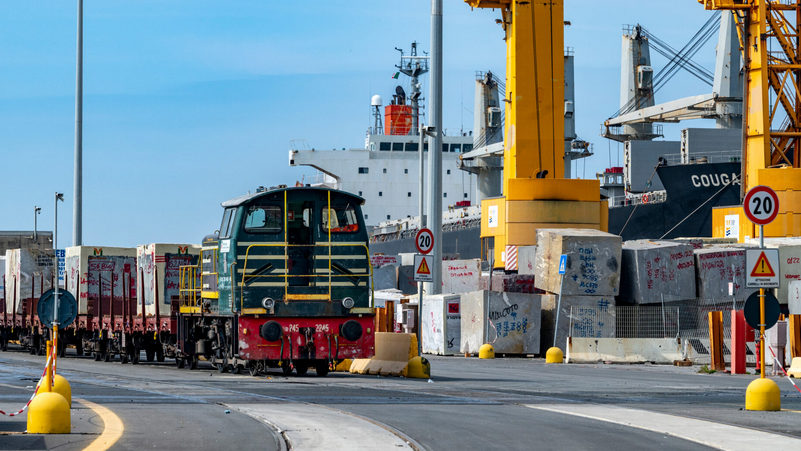
The state maritime concession for managing the Giammoro pier was formalised on 28 March 2024 and will remain valid until 2049. It covers an area of more than 52,000 square metres, including the pier, land connection infrastructure and the adjacent waters used for commercial operations. The terminal aims to serve as a logistics hub for trade flows between Europe, North Africa and the Middle East, integrating sea, road and rail transport. Cargo handling is carried out using a 125-tonne Konecranes Gottwald Esp.6 mobile harbour crane equipped with hybrid technology and ultracapacitors that recover energy during lowering and braking phases. The crane is already configured for external electric power, in anticipation of full electrification of the pier.
The terminal is not a standalone initiative, but part of a broader industrial plan presented in 2024 at the Chamber of Commerce of Messina, which foresees total investments of 95 million euros. Duferco Group’s strategy is built on three pillars: logistics, energy and infrastructure services. In this framework, alongside the logistics facility, Giammoro will also host a low-emission natural gas peaker power plant, already built and made available to Terna to support the stability of Sicily’s electricity grid.
In parallel, a project is underway to develop a Hydrogen Valley in collaboration with Caronte and Nippon Gases Italia. The goal is to produce approximately 100 tonnes of green hydrogen per year, powered by a 4 MW photovoltaic system and a 1 MW electrolyser. To complete the sustainable energy investment portfolio, a battery energy storage system (BESS) will be installed to help balance the power grid, along with upgrades to the existing photovoltaic plants in the area.
Duferco Group was founded in 1979 by Bruno Bolfo, the current chairman, together with a team of steel trade experts, with the aim of leveraging the competitive advantages of emerging markets in steel production. In its early years, the company was based in New York and São Paulo, quickly establishing strong ties with local steel producers and becoming the leading Brazilian exporter of steel products worldwide. Duferco’s growth and profitability relied on longstanding relationships with major Brazilian producers such as Cosipa, CSN, CST, Açominas and Usiminas, along with a commercial network mainly focused on the United States and the Far East.
During the 1980s, the Group pursued geographic expansion, beginning in South America with major success in Argentina, Venezuela and Mexico. In 1981, it opened its first European office in London, following a strategy aimed at penetrating the North American and European markets. That decade also saw the launch of several offices across the Pacific region, including Taiwan, the Philippines, Singapore, Hong Kong, China and South Korea. By the mid-1990s, the company had opened offices in Eastern Europe to build the necessary infrastructure to meet rising demand in these emerging markets.
After 2000, Duferco began diversifying its operations, expanding into energy, shipping and logistics in addition to its core steel business. Over the past fifteen years, the company has phased out much of its steel production in Belgium, the United States and South Africa to focus on steel trading and investments in renewable energy sectors, particularly solar and hydroelectric, alongside shipping. Today, the group’s estimated assets amount to around 2 billion euros and it maintains a global presence through twenty proprietary steel plants that, in 2007, had a combined output of 6.9 million tonnes of steel.