





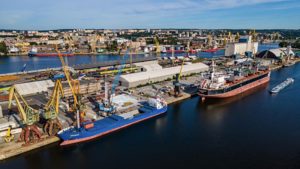
2025 was a record year for Polish ports on the Baltic Sea. The terminals of Gdańsk, Gdynia, Szczecin and Świnoujście handled a total of 141 million tonnes of cargo, five million tonnes more than the previous year. Container traffic rose to 3.9 million TEU, an increase of 18%. Despite recent protests by carriers, the most striking figure came from the Baltic Hub terminal in Gdańsk, which recorded growth of 23% and handled 2.767 million TEU.
Polish ports are now emerging as a genuine alternative to the more congested and costly ports of Belgium, the Netherlands and Germany. They have succeeded in attracting large volumes of liquefied natural gas from the United States and Qatar, up 32% compared with 2024. Traffic from Asia is also significant, mainly consumer goods and electronics, alongside imports of steel and cereals. Net profits at the ports reached 650 million zloty, around €154 million, marking a year-on-year increase of 20%. According to the website of the Polish Ministry of Infrastructure, this represents the best result in the country’s history, underscoring the increasingly important role of Polish ports in global trade. To sustain and consolidate this trend, Poland is continuing to invest heavily in infrastructure.
Under the 2025 budget, the government increased funding for the economy by almost 50%, allocating nearly 3 billion zloty, equivalent to more than €700 million. These resources will be used to develop new deep-water quays, upgrade terminals and storage areas, and modernise and expand road and rail connections. Among the most significant projects is the construction of the Deepwater Container Terminal in Świnoujście, scheduled for completion in 2028, as well as the development of a grain traffic management network in Gdańsk. Work has already begun on building the Vistula and Szczecin quays and nine new warehouses for grain transhipment, increasing current storage capacity fivefold. A new Marine Off-Loading Facility (MOLF) quay will also be built, dedicated to handling materials for the construction of Poland’s first nuclear power plant.
However, the issue of security linked to GNSS signal interference and Russia’s shadow fleet remains unresolved. This fleet comprises around 900 vessels responsible for almost 70% of the country’s maritime exports, the proceeds of which largely help to finance Russia’s war effort in Ukraine. Poland is paying the price of its geographical proximity to the Kaliningrad exclave, which is considered responsible for the increase in GNSS signal interference. This tool is used to enable the transit of shadow tankers and disrupts vessel positioning, increases the risk of accidents and undermines shipowners’ confidence.
On the matter, Deputy Minister of Infrastructure Arkadiusz Marchewka, together with representatives from 13 other European countries, has called for intervention by the International Maritime Community through an open letter signed at the end of last January. The urgency of the appeal reflects a reality that Baltic operators experience daily, due to continuous disturbances to satellite signals that are multiplying in European waters. These recurring incidents compromise positioning quality, make traffic management more complex and significantly increase the likelihood of collisions, environmental accidents and vessel delays, with direct consequences for insurance, risk premiums and service reliability.
In the letter, Poland, Belgium, Denmark, Estonia, Finland, France, the Netherlands, Iceland, Lithuania, Latvia, Germany, Norway, Sweden and the United Kingdom made it clear that satellite systems and technology are not a luxury but an indispensable tool for ensuring safety. “Modern maritime transport relies essentially on the reliability of satellite navigation,” the text states. “For more than three decades, global maritime operations have increasingly relied on positioning, timing and navigation (PTN) data provided by satellite systems. Interference with such signals represents a threat to the safety and reliability of maritime transport. We are currently facing new security risk scenarios arising from the growing disruption of GNSS signals in European waters, particularly in the Baltic Sea region. Such interference, originating from the Russian Federation, undermines the safety of international navigation. All vessels are at risk.”
The Polish and northern European appeal addresses both technical and regulatory aspects, effectively calling for greater international cooperation and full, consistent enforcement of IMO regulations as a prerequisite for protecting crews, the marine environment and the continuity of trade. According to the initiative’s promoters, only through strict controls, rigorous compliance with international conventions and, above all, the blocking of illegal vessels will it be possible to definitively stop the shadow fleet. The future of Polish ports, and more broadly of all European infrastructure facing the Baltic Sea, is therefore closely linked to Russia and increasingly conditioned by the conflict in Ukraine and the hybrid warfare pursued by the Russian Federation.
Marco Martinelli