






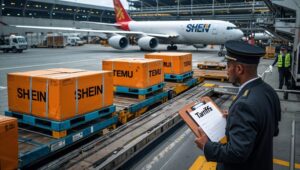
From 29 August 2025, all international shipments bound for the United States with a value of 800 dollars or less will no longer benefit from exemption from customs duties. This shift is enshrined in an executive order signed by the President on 30 July, which brings an end to the so-called de minimis regime for all imported goods, regardless of their origin, declared value, or transport method.
Until now, the de minimis threshold, set by US federal law, allowed American consumers to receive parcels from abroad without paying taxes or duties as long as the goods did not exceed a value of 800 dollars. This mechanism has supported the growth of global e-commerce for years, enabling millions of users to purchase products from international platforms such as Temu, Shein or Alibaba without incurring additional customs charges. However, according to the US administration, this very exemption has become a critical vulnerability for the country's economic and national security.
The White House justifies the decision as a necessary measure to combat tariff evasion practices and illicit trafficking, particularly of synthetic opioids such as fentanyl, which are often brought into the United States through small postal packages. The executive order makes explicit reference to the urgency of addressing an extraordinary and unusual threat to national security and the economy, deeming it necessary to suspend the preferential treatment provided by the de minimis rule.
In the preceding months, the government had already introduced similar measures selectively against specific trade partners, including Canada, Mexico, China and Hong Kong. Those suspensions were justified by the need to enforce tariffs introduced to correct persistent trade imbalances and to stem the flow of suspicious goods. With the 30 July order, however, the suspension is extended to all countries, without exception, and becomes a structural measure.
From an operational standpoint, the new rules will take effect at the end of August and will differentiate shipments based on the transport channel used. Goods that do not pass through the international postal network will be subject to all applicable duties, taxes and excise charges, regardless of their value. For these shipments, a formal customs declaration via the Automated Commercial Environment (ACE) system will also be mandatory. Postal shipments, on the other hand, will remain temporarily exempt from standard duties but will be subject to specific transitional tariffs until new procedures are defined by US customs.
The US President has stated that the measure will remain in place for as long as the economic and security threats that prompted it are considered to persist. The decision was taken following an official communication from the Secretary of Commerce, who confirmed that customs authorities are now capable of efficiently managing the new regime, even on a global scale.