





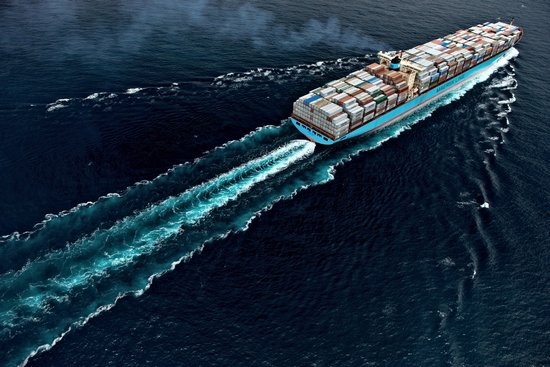
- A.P. Moller-Maersk closed 2025 with results broadly in line with expectations but with a pronounced deterioration in profitability. Revenue stood at USD 54 billion, down 2.7%, while net profit fell to USD 2.7 billion, the lowest level in the past five years, reflecting the return of freight rates to historical levels and continued pressure from operating costs.
- The Ocean segment recorded volume growth but saw Ebit fall sharply, turning negative in the fourth quarter. By contrast, Terminals delivered its best performance ever, with high margins and a return on capital well above targets, confirming its role as the group’s main pillar of stability in a complex market environment.
- For 2026, Maersk expects a further deterioration in the outlook, with Ebitda forecast between USD 4.5 and 7 billion and a risk of operating losses. Within this context comes the announcement of one thousand redundancies in corporate functions, part of a cost-cutting strategy aimed at addressing structural overcapacity and the impact of the reopening of the Suez Canal.
A.P. Moller-Maersk closed 2025 in a market environment profoundly different from previous years. The Danish group, the world’s second-largest container shipping operator, ended the year with revenue of USD 54 billion, slightly down from USD 55.5 billion in 2024, but above all with a sharp contraction in profitability. Ebitda fell to USD 9.5 billion, while net profit came in at USD 2.7 billion, down 55.7% year on year, according to the annual results published in February 2026.
The figures sum up a year in which Maersk achieved the upper end of its own guidance but had to contend with rapid margin erosion, driven by a combination of structural overcapacity in the sector, the normalisation of freight rates and still-elevated operating costs. The fourth quarter made the scale of the shift clear: Ebit in the Ocean segment slipped into negative territory, as average freight rates per loaded container dropped by 23% compared with the same period a year earlier.
Chief executive Vincent Clerc framed the performance as consistent with a transitional phase in global trade, highlighting the group’s ability to maintain high operational standards despite a complex geopolitical and market backdrop. However, the gap compared with 2024 profitability levels underlines how the favourable cycle in container shipping has now come to an end.
In 2025, the Ocean segment continued to grow in volume terms, with a 4.9% year-on-year increase, broadly in line with the global market. This momentum, however, did not translate into proportional financial results. The return of freight rates towards pre-pandemic levels and competition in a market characterised by excess capacity have sharply reduced carriers’ ability to convert operational efficiency into sustainable margins. Route diversions via the Cape of Good Hope, imposed by the Red Sea crisis, also weighed on costs by extending transit times and increasing fuel consumption.
Alongside the difficulties in ocean transport, Maersk displayed a strong polarisation across its activities. The Terminals segment delivered the best performance in its history, with revenue of USD 5.3 billion and an Ebit margin close to 30%, excluding certain impairments. Return on invested capital reached 16.1%, well above the 9% target, confirming the role of port terminals as a more stable revenue source and one less exposed to freight rate volatility. In Europe, volumes rose by 9%, supported by operations at the Vado and Aarhus terminals and by the launch of the Rijeka Gateway in Croatia.
Logistics & Services also continued on a path of gradual improvement. In 2025, logistics and services revenue reached USD 15.1 billion, while the Ebit margin in the fourth quarter rose to 4.9%, marking the seventh consecutive quarter of profitability growth. This represents steady progress, though still some distance from the group’s long-term targets, which position integrated logistics as a key strategic lever in its transformation.
What emerges from 2025 is therefore a group capable of operational excellence, as shown by reliability levels above 90% on the new East-West network and the results of the Gemini Cooperation with Hapag-Lloyd, but operating in a market environment that penalises the profitability of its core maritime transport business. High reliability has become an expected market standard and is no longer sufficient on its own to sustain margins in the presence of excess supply.
These dynamics explain the caution, if not outright pessimism, underpinning the 2026 outlook. Maersk forecasts Ebitda between USD 4.5 and 7 billion, sharply down from USD 9.5 billion in 2025, and Ebit ranging from a loss of USD 1.5 billion to a profit of USD 1 billion. The guidance reflects the expected impact of global overcapacity, fuelled by vessel orders equivalent to around 30% of the existing fleet, and by the gradual reopening of the Suez Canal, which will release capacity currently absorbed by longer routes.
A return to the Suez route, albeit gradual, could bring between 6% and 8% of global capacity back onto the market, exerting downward pressure on freight rates estimated at between 30% and 35%. In such a scenario, even high service quality risks failing to translate into adequate financial results. Unsurprisingly, several analysts have revised their 2026 forecasts downwards, placing them below previous consensus levels.
It is against this backdrop that the announcement, made alongside the publication of the annual results, of the cut of one thousand corporate positions should be seen. The redundancies represent around 15% of administrative and managerial functions. According to the company, the measure is aimed at simplifying the organisation and strengthening cost discipline, with estimated annual savings of around USD 180 million. While the cuts account for less than 1% of the total workforce, they carry significant symbolic weight, confirming the start of a new phase of structural rationalisation.
The 2026 cuts fit into a trajectory that began as early as 2023, when Maersk launched a deep reorganisation to adapt to what management has described as a “new normal”, characterised by more subdued demand, prices in line with historical averages and inflationary pressure on costs. This context also includes tensions that emerged in Italy, particularly at the Genoa office, where in January 2025 the dismissal of four customer service employees triggered trade union protests linked to the introduction of automation and artificial intelligence solutions.
Looking ahead to 2026, Maersk therefore finds itself operating in a delicate balancing phase. On the one hand, the group continues to invest heavily, with a capital expenditure plan of between USD 10 and 11 billion over 2026–2027, earmarked for logistics infrastructure, fleet renewal and decarbonisation. On the other, it must manage a market that risks returning to very low, if not negative, profitability conditions across the container shipping sector.
The ability to navigate this phase will depend on the evolution of the geopolitical environment, capacity management and the resilience of the more stable segments, particularly Terminals. The experience of 2025 has shown clearly that operational excellence remains a defining strength of Maersk, but also that, in a market structurally characterised by excess supply, efficiency alone is no longer enough to guarantee sustainable margins.
A.I.