






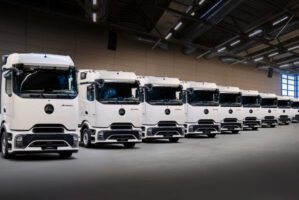

Registrations of towed vehicles in Italy—trailers and semi-trailers with a total mass exceeding 3.5 tonnes—saw a sharp rise of 20.5% in May 2025 compared to the same period in 2024, according to figures from Unrae's Centre for Studies and Statistics, based on registration data provided by the Ministry of Transport. The number of registered units climbed from 1,370 to 1,650 month-on-month, reinforcing a positive growth trend that has characterised the first half of the year. Between January and May, 6,472 towed vehicles were registered, up from 5,784 in the same period of 2024, marking an overall increase of 11.9%.
“The registration figures for towed vehicles have recently been boosted by a significant impulse, largely due to the need to complete investments linked to previous incentive schemes,” explained Michele Mastagni, coordinator of the Trailers, Semi-Trailers and Bodyworks Group at Unrae. However, Mastagni warns against being misled by the numbers, noting that much of the increase is the delayed effect of orders placed some time ago. For at least two months, the sector has been experiencing a gradual decline in demand—a trend which, according to Mastagni, is already emerging in other European countries as well, casting a worrying outlook for the medium term.
Unrae has welcomed the recent, albeit limited, funding measures introduced by the latest Infrastructure Decree, along with the Transport Minister’s announcement of a €600 million fund for the sector. Nevertheless, the association is calling for faster implementation and more targeted planning. “It is especially crucial that a substantial portion of these resources be allocated to modernising towed vehicles, given that the average age of the circulating fleet now exceeds 17 years,” Mastagni emphasised.
Alongside calls for additional funding, Unrae is renewing its proposal to introduce disincentives for older vehicles. These could include revisions to motorway tolls, adjustments to road tax, circulation restrictions and load limits—measures intended to accelerate fleet renewal. The issue of ageing vehicles is critical not only for environmental reasons but also for road safety and the competitiveness of road freight transport. The sector also needs investment stability and continuity, avoiding a cyclical dependence on incentives.
On the regulatory front, the association is once again urging a revision of rules regarding convoy length. “There is still an urgent need for a legal amendment that would allow full circulation of articulated lorries up to 18.75 metres in length, removing constraints that currently hamper the logistical efficiency of freight transport.”