




In a statement issued on 13 April 2026, Italian association Unatras announced that meetings held nationwide over the weekend of 11 and 12 April revealed a unified stance in favour of a national haulage strike. According to the coordination of associations, this “unanimous” position brings together small and medium-sized companies. The statement explains that “among the factors described as ‘disruptive’ by companies in the sector is the behaviour, deemed ‘irresponsible’, of clients, which leads to a reduction of up to 40 cents per litre, and the lack of attention from the Government which, according to statements by Minister Urso, had already taken decisions in favour of the sector. However, the category notes that it is not aware of any concrete measures.”
Unatras also highlights other critical issues identified by the consumer association Codacons: “while companies are heavily penalised on the one hand, on the other there is a continued presence of speculative practices and higher revenues for certain operators as well as for the state.” The next step towards a possible strike will be a meeting of the executive committee, which will decide on Friday 17 April and, if the outcome is positive, will initiate the procedures required to call and announce the suspension of road haulage services.
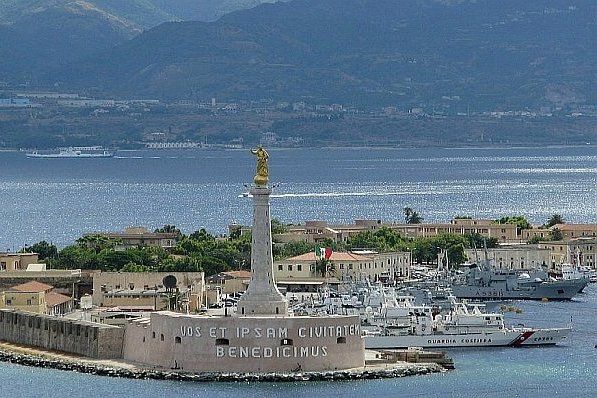
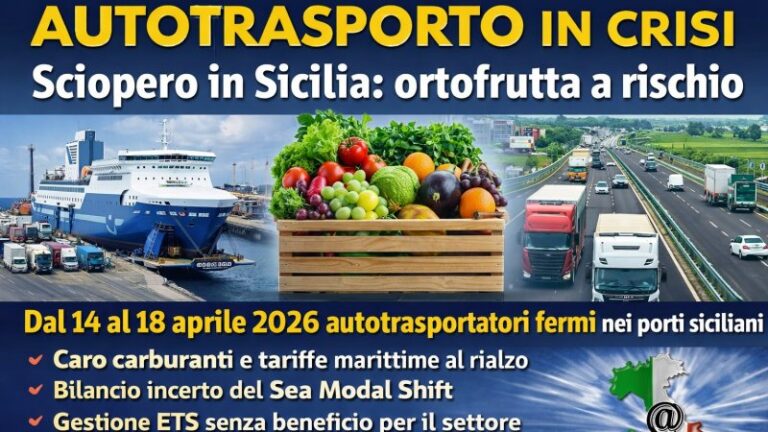
Meanwhile, protests are continuing at local level. Also on 13 April, the Sicilian association Aitras announced that the stoppage called by the Comitato Trasportatori Siciliani (Sicilian Hauliers Committee) would begin at midnight the same day. The protest “will last five days and will affect activities at all Sicilian commercial ports, where all loading and unloading operations of semi-trailers from ships will be frozen. Ninety per cent of companies involved in intermodal transport have joined the stoppage; there will be no roadblocks or picketing. Our objective is not to supply large-scale retail distribution at least until we receive written commitments from the national government following a meeting.”
The demands of Sicilian hauliers are wide-ranging: clarity on the calculation methods and payment criteria for Sea Modal Shift, the incentive scheme for combined road-sea transport; the use of ETS funds paid by shipping companies to the Ministry of Transport to finance Sea Modal Shift; a request to Brussels for an extension of the scheme, which is due to expire in 2027; clarification on the introduction of ETS2 in 2028; and measures to address rising ferry costs.
Aitras also complains about institutional indifference to the sector’s demands: “To date, only the prefect of Catania has taken concrete steps to secure a meeting with the Ministry of Transport after summoning us last Friday to understand the reasons for the stoppage. Neither the president of the Sicilian Region, Schifani, nor the regional transport councillor, Aricó, have taken steps even to meet us and understand the reasons for the protest.”