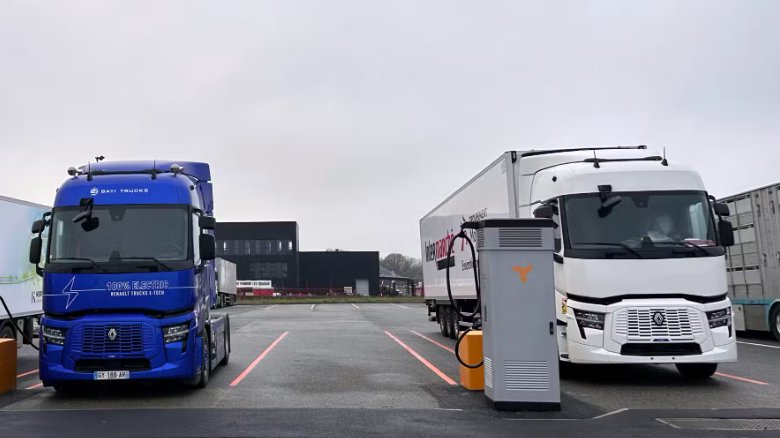






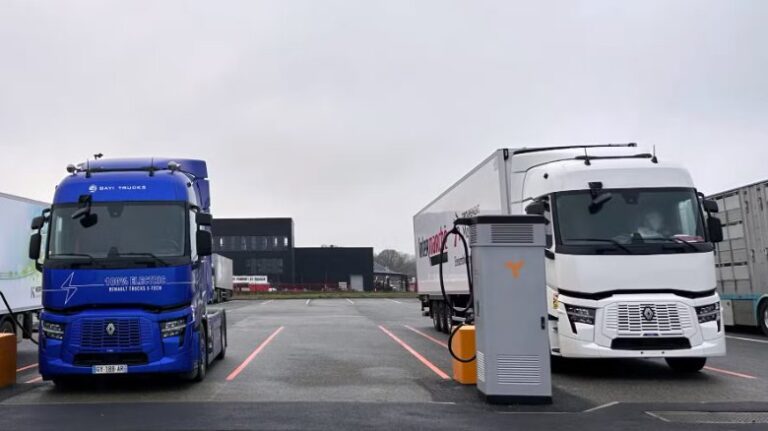
In the car park of the truck drivers’ restaurant La P’tite Fringale, in Étrelles, Brittany, the first charging station of the Yaway network specifically designed for electric trucks was inaugurated on 29 January 2026. Located along the logistics corridor between Rennes and Laval, the site represents an operational milestone in Kallista Energy’s plan to extend ultra-high-power charging to heavy-duty transport, integrating it into rest areas already used by drivers for their mandatory breaks.
The station is equipped with four direct current charging points delivering up to 400 kW each, installed on two Siemens Sicharge D400 units and configured for electric trucks and buses. The system has been designed to allow charging to take place within the mandatory 45-minute rest period. During the inauguration, under demonstration conditions, an electric tractor unit recovered an estimated range of around 300 kilometres. The infrastructure is already prepared for future evolution towards the MCS standard, expected in the coming years, which will allow further increases in available power and delivered energy volumes.
The project stems from a partnership between Kallista Energy, an independent renewable energy producer active since 2005, and Bertrand Vivier, operator of the La P’tite Fringale relais routier. The restaurateur has made the land and car park available while continuing to manage his core business, whereas Kallista is responsible for the installation, operation and maintenance of the charging equipment. This model enables the relais to enhance its attractiveness for drivers and electric fleets without taking on technical burdens, benefiting instead from increased customer flows during stopovers.
The Étrelles site did not start from scratch. As early as January 2025, a Yaway station for light vehicles had opened there, with three chargers and six charging points delivering up to 300 kW. Throughout 2025 it recorded rising utilisation rates, with full occupancy during certain time slots. In this context, opportunistic use by long-distance electric buses was also observed, signalling an unmet potential demand for heavy-duty vehicles along this corridor.
From a pricing perspective, the station applies a base rate of around €0.435 per kWh excluding VAT, equivalent to €0.522 per kWh including VAT, applicable to both light vehicles and trucks. Dedicated contractual offers are already available for transport fleets, with a tariff of €0.40 per kWh excluding VAT and the possibility of further reductions for high consumption volumes. According to assessments by operators across the value chain, the economic break-even range for electric trucks lies between €0.25 and €0.35 per kWh excluding VAT, depending on daily mileage and mission profiles.
The inauguration was also attended by players from the electric transport industrial ecosystem, including Kertrucks, Renault Trucks dealer for Brittany and the Pays de la Loire, which took part with E-Tech T and D electric trucks. Since 2022, around 100 electric trucks and 100 electric light commercial vehicles have been sold in the region, while by the end of 2025 electric vehicles accounted for 1.1% of new registrations of trucks over 6 tonnes in the dealer’s portfolio. Manufacturers’ forecasts point to a potential 30% share by 2030, provided that high-power charging infrastructure becomes widespread along major logistics corridors.
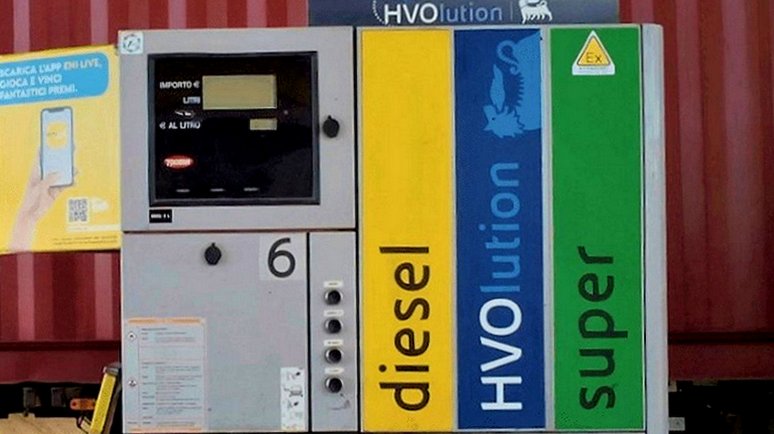
The location of the station highlights a phase of coexistence between traditional infrastructure and new electric solutions. The Étrelles car park is situated in a business area that also hosts an AS24 diesel fuel station for heavy-duty vehicles. This configuration reflects a gradual transition, in which fleets can begin integrating electric vehicles without immediately abandoning conventional solutions.
From a strategic standpoint, the Étrelles station forms part of Kallista Energy’s plan to develop around 90 Yaway stations across different regions of France, with configurations dedicated to light vehicles, heavy-duty vehicles or hybrid use. Existing installations offer power levels between 300 and 400 kW and are supplied entirely by renewable energy, often directly connected to wind or solar parks, following a short-loop production and consumption logic. The aim is to combine emissions reduction, price competitiveness and long-term economic stability.