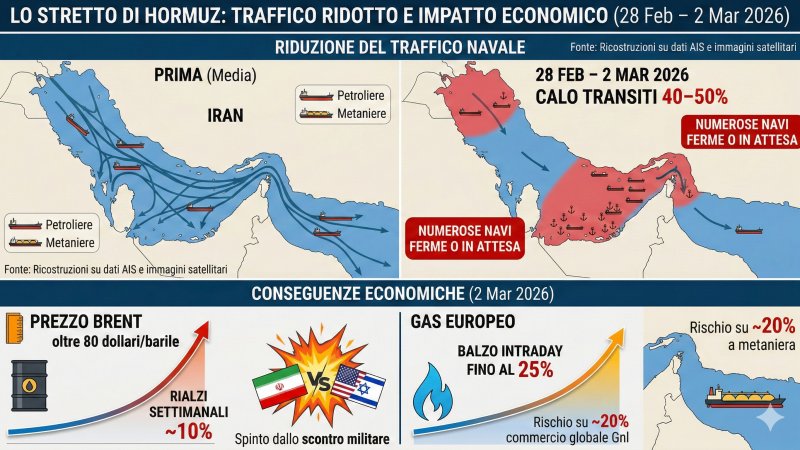









The conflict in the Middle East has already produced its first direct effects on global container shipping supply chains, and Xeneta presented an initial assessment on 5 March 2026. According to its analysis, 147 container ships are currently idle in the Persian Gulf as shipping lines avoid transiting through an area considered high risk. Peter Sand, chief analyst at Xeneta, notes that supply chains do not stop even during the most serious crises, which means new vessels continue heading towards the region while operators search for alternative solutions to unload containers destined for Gulf markets.
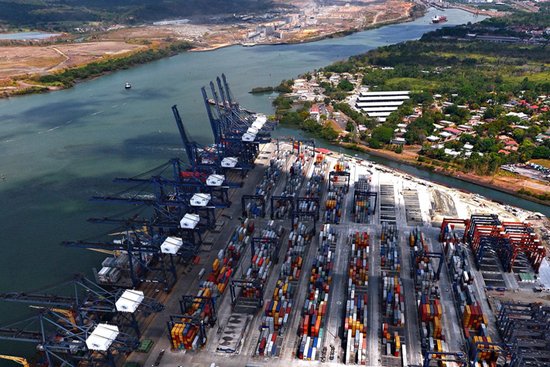
According to Sand, the main issue concerns the capacity of alternative ports to absorb sudden increases in traffic. Ports not designed to handle large additional volumes risk becoming rapidly congested, particularly when vessels arrive with irregular berthing schedules that have been changed at the last minute. In such conditions, port delays tend to propagate along the entire logistics chain, affecting other transhipment hubs as well.
Among the ports that could experience indirect effects are major Asian hubs such as Tanjung Pelepas in Malaysia and Singapore, which play a central role in connections between Asia, the Middle East and Europe. Congestion at alternative ports and transhipment nodes tends to generate knock-on delays across maritime services. Salalah is one of the main alternatives for cargo bound for the Gulf thanks to its geographical proximity and the possibility of continuing transport overland to markets in the region. However, this port has also been hit by drone attacks, a factor that could push shipping lines to choose ports even further away from the crisis area.
The first effects are already being reflected in freight rates. According to Xeneta data, the most significant increases concern routes closest to the conflict zone. Average spot rates between China and Salalah, in Oman, have risen by 28% compared with levels on 26 February, before the escalation of the conflict. One of the alternatives being considered is Colombo, in Sri Lanka. Preliminary Xeneta data show that average spot rates from China to this port have increased by 17% compared with pre-conflict levels. The increase is lower than on the route to Salalah, but still confirms the impact of route reorganisation.
The effects are also beginning to spread beyond the region directly involved. Xeneta reports a 9% increase in average spot rates between China and the United Kingdom compared with levels prior to 26 February, a sign that logistical disruptions are already influencing broader intercontinental trades.
Meanwhile, the freight market on the main long-haul routes still shows average levels that remain relatively contained compared with the peaks of previous years. As of 5 March 2026, average spot rates stand at 2,123 dollars per forty-foot container on the Far East–US West Coast route and 2,870 dollars to the US East Coast. On the Far East–North Europe route, the average rate is 2,338 dollars, while shipments to the Mediterranean reach 3,570 dollars per forty-foot container.
In addition to freight rates, Xeneta data also show changes in capacity supply on major trade routes. In the week beginning 2 March, capacity on the Far East–North Europe route is down by 12.7% compared with the previous week. Reductions are also recorded to the US East Coast (-7.1%) and West Coast (-5.6%), while capacity to the Mediterranean has declined by 3.3%. Moving in the opposite direction is the North Europe–US East Coast route, where capacity supply has increased by 16%. According to Xeneta’s analysis, these variations reflect the first operational adjustments by shipping lines in response to geopolitical tensions and the need to revise itineraries and port calls.
Peter Sand emphasises that the dynamics of freight rates and logistics flows will depend above all on the duration of the crisis and the number of ports involved in route diversions. In the presence of widespread congestion, the effects could spread rapidly along the main global maritime corridors, with repercussions for delivery times and transport costs.