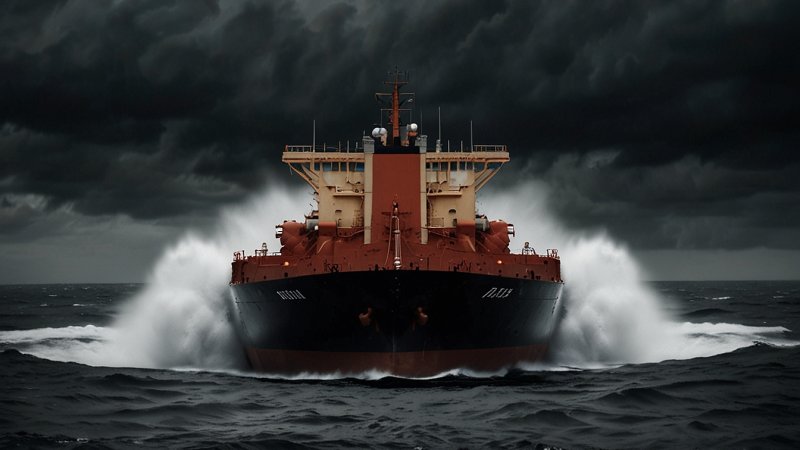







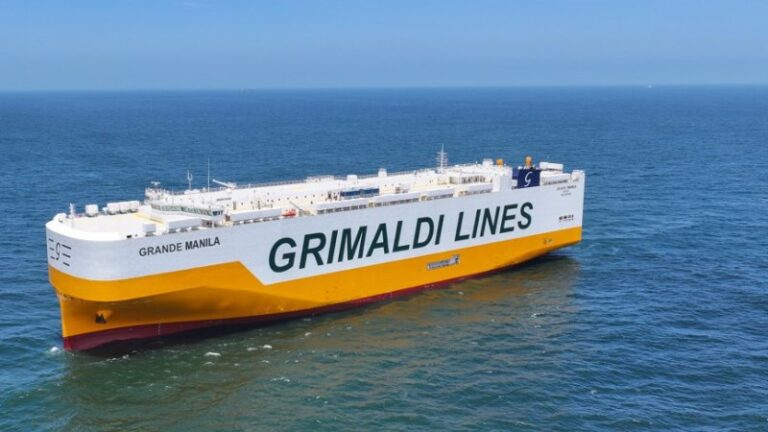
The new Grande Manila represents the latest milestone in the Grimaldi Group’s delivery programme for next-generation vehicle carriers. The vessel, the seventh ammonia-ready PCTC built by the Chinese yards Shanghai Waigaoqiao Shipbuilding and China Shipbuilding Trading, was delivered and christened in Shanghai on 12 January 2026, following its launch in November. Designed for deployment on Asia–Europe routes, the ship is already earmarked for services departing from China to the United Kingdom, Spain and Belgium, with further distribution via the Antwerp hub.
Grande Manila is 200 metres long, 38 metres wide and has a gross tonnage of around 77,500 tonnes. It offers a cargo capacity of 9,241 CEU, with decks suitable for heavy rolling cargo of up to 250 tonnes and clear heights of 6.5 metres. The vessel is equipped with a latest-generation electronic engine, advanced emission-reduction systems and shore power capability while in port. The Ammonia ready class notation issued by Rina (Italian Shipping Register) certifies the possibility of a future conversion to ammonia as a zero-carbon fuel. According to data released by the group, CO2 emissions per unit of cargo carried are reduced by up to 50% compared with previous generations of PCTC vessels.
The arrival of Grande Manila comes in a year marked by particularly intense fleet renewal activity for the Grimaldi Group. Over the course of 2025, the company introduced a total of eight new vessels, including Eco Napoli, the final unit of the hybrid ro-ro Grimaldi Green 5th Generation class, and seven ammonia-ready PCTCs. This delivery programme reflects a substantial investment and an industrial strategy focused both on environmental sustainability and on increasing operational capacity along key intercontinental corridors.
Eco Napoli, delivered in March 2025 by the Jinling shipyard in Nanjing, completed the GG5G series. With a length of 238 metres and a capacity of 7,800 linear metres of cargo, the vessel is equipped with 5 MWh lithium batteries and solar panels, enabling zero emissions during port stays. The ship has been deployed in the eastern Mediterranean, strengthening ro-ro connections between Turkey, Greece and Italy.
At the same time, 2025 saw a sharp acceleration in the PCTC segment. In August, Grande Tianjin was delivered as the first of seven units ordered from the Sws and Cstc shipyards, followed by Grande Shanghai, the first in a series built by China Merchants Heavy Industries Jiangsu. In the following months, Grande Auckland, Grande Svezia, Grande Melbourne and Grande Istanbul entered the fleet, all featuring capacities between 9,000 and 9,800 CEU and technical solutions aimed at reducing fuel consumption and emissions. These new vessels have been deployed on Asia–Europe, Asia–East Africa and Asia–Persian Gulf routes, supporting automotive industry flows and industrial rolling cargo.
Between 2018 and 2025, the Grimaldi Group ordered 48 new vessels with a total value of around five billion dollars, with the aim of accelerating the maritime transport sector’s ecological transition and strengthening its presence in Asian markets. Ammonia-ready PCTCs are a central element of this strategy, alongside hybrid ro-ro vessels and investments in port infrastructure and shore power supply.