




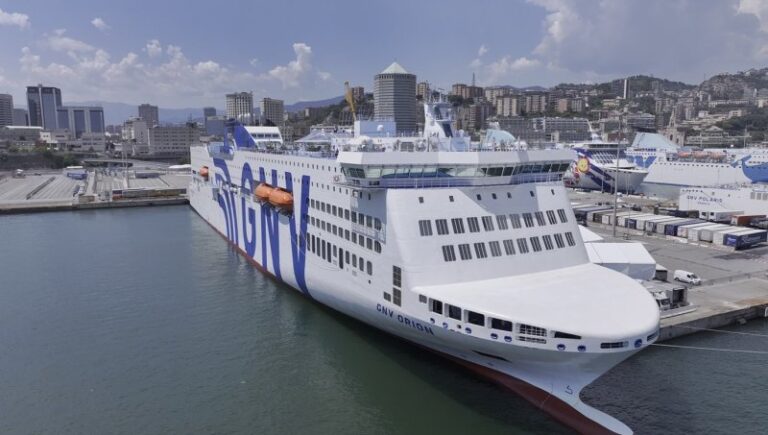
Gnv marked the official christening of the ro-pax Gnv Orion on 3 July 2025 at the port of Genoa. Orion is the company’s 26th ferry and the second unit delivered as part of a renewal plan that foresees the arrival of eight new state-of-the-art ships powered by liquefied natural gas by 2030. The programme, worth over one billion euros, aims to radically modernise the fleet, increasing its tonnage by 60 percent within the next five years.
The ceremony took place at the company’s historic headquarters, just beneath the Lanterna lighthouse, where Gnv was founded in 1992 and from which it has built a solid and expanding network. In recent years, the number of vessels operated by Gnv has grown by more than 50 percent, and today the company runs 33 routes across eight countries bordering the Mediterranean, establishing itself as a key operator for services connecting Italy, Spain and North Africa. During the ceremony, Gnv’s executive chairman Pierfrancesco Vago highlighted how this investment is a tangible sign of the Msc Group’s commitment—not only to the growth of its own enterprise but also to the strengthening of the country’s logistics and infrastructure system.
Gnv Orion was built at the Guangzhou Shipyard International in Canton, China. The vessel has a gross tonnage of approximately 52,000 tonnes, is 218 metres long and nearly 30 metres wide. It can carry up to 1,700 passengers and 3,080 linear metres of cargo, with a top speed of 25 knots. With its 433 cabins and spacious onboard facilities, it ranks among the largest and most advanced ro-pax vessels currently operating in the Mediterranean. The ship is commanded by Captain Salvatore Provenzano and crewed by 109 members.
The vessel features a range of technical solutions designed for energy efficiency and reduced environmental impact. Compared to previous-generation vessels, it can cut CO2 emissions by more than 30 percent per tonne transported. It is equipped for cold ironing—drawing electricity from shore power while docked—and features efficient onboard systems, including heat recovery units, electric optimisation inverters, LED lighting, optimised hull and appendages, and silicone-based hull coatings that reduce hydrodynamic resistance.
Following Polaris and Orion, Gnv’s fleet expansion plan foresees the addition of two further LNG-powered vessels, Gnv Virgo and Gnv Aurora, by early 2026. These ships will also be capable of cutting CO2 emissions by 50 percent compared to conventional vessels. The second phase of the programme will begin in 2028, with the construction of four more ferries, also powered by liquefied natural gas. These ships will have a gross tonnage of around 71,300 tonnes, a length of 237 metres and a beam of 33 metres. They will be able to accommodate up to 2,500 people, including passengers and crew, and will offer over 500 cabins and 3,500 linear metres of garage space, making them the largest and most capacious vessels in the fleet.