



Summer 2026 marks a new phase in the strengthening of roadside checks on industrial vehicles. The first measure concerns an equipped, unmarked vehicle handed over on 22 July by the Innenministerium Rheinland-Pfalz (Rhineland-Palatinate Ministry of the Interior) minister Achim Schwickert to the Polizeipräsidium Mainz (Mainz Police Headquarters). It is the Verkehrsüberwachungskraftwagen Gewerblicher Güter- und Personenverkehr, a van based on a MAN TGE with no “Polizei” markings or flashing lights, built specifically to avoid being recognised by drivers before an inspection. The German police union GdP has described it as unique in Germany for this technical configuration.
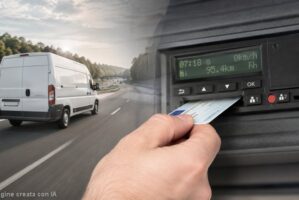
The van is fitted with a thermal camera that detects the temperature of brakes and tyres as vehicles pass, a system for measuring the dimensions of industrial vehicles and a digital tachograph reader using DSRC (Dedicated Short Range Communication), the technology that allows remote acquisition of driver card data and any infringements of driving and rest time rules. The Innenministerium Rheinland-Pfalz (Rhineland-Palatinate Ministry of the Interior) says the inspection also covers cargo, including the transport of dangerous goods subject to ADR regulations. Up to three officers can operate on board, monitoring anomaly alerts in real time on tablets. The vehicle is being piloted for one year by the Polizeipräsidium Mainz (Mainz Police Headquarters), with its operating base in Wörrstadt. Only once the trial has been completed will a decision be made on whether to extend it to the other four regional police headquarters in Rhineland-Palatinate.
Since 2023, BALM (Bundesamt für Logistik und Mobilität, Federal Office for Logistics and Mobility) has been applying a mobile inspection system at federal level based on similar sensors. In its first year, the system carried out 750,000 additional sensor-based checks, rising to more than one million by October 2024. The Mainz van is the latest regional version of this trend: vehicles with similar functions have been operating, for example, in Hof, Bavaria, since 2022, where officers have nicknamed them “Sentinel”. It should be remembered that remote tachograph reading does not allow fines to be issued directly at a distance. Regulation (EU) 165/2014, Article 9(4), limits data transmission to elements that indicate suspected tampering or misuse of the tachograph, without allowing full access to driving and rest time data, for which the vehicle must still be physically stopped. The system is therefore used to select suspicious vehicles, not to issue automatic fines.
At the same time, fixed control systems for vehicles’ total weight are being activated: on 30 July 2026, the first dynamic weighing station in the network planned by Autobahn and BALM entered service. The facility is located at the Rur-Scholle-Süd service area on the A4 towards Cologne, around 30 kilometres from the Belgian border, and was built in just over a year, with work starting in the early months of 2025. Piezoelectric sensors and inductive loops embedded in the asphalt measure axle load and the overall weight of industrial vehicles while they are in motion, while an ANPR camera reads the number plate. Vehicles suspected of being overloaded are directed by LED panels towards a dedicated lane for static and dynamic weighing, where the check has legal validity and can be used in court.
State Secretary Stefan Schnorr confirmed an investment of just under €7 million for the pilot facility, higher than the roughly €2.5 million indicated in 2025 as the expected average cost of future stations in the network, a difference attributable to initial development costs. The A4 between Aachen and Cologne is an important corridor for freight arriving from the ports of Antwerp and Rotterdam. It is used by more than 10,000 industrial vehicles a day, and Köln-Eifeltor, Germany’s largest rail container terminal, is also located nearby.
The cooperation agreement between Autobahn and BALM, signed in May 2023, provides for 16 stations by 2028: Düren is the first to enter operation, with another 15 to follow across the country. Anyone exceeding the 5% overload threshold faces a fine of €80 for the driver and €140 for the vehicle owner, as well as one point in the Flensburg register and a ban on continuing the journey until the excess load has been unloaded or redistributed. The ministry is also working on tougher penalties targeting freight forwarders.
Pietro Rossoni